


How accurate is the FIT stool test for bowel cancer?
At the commonly used 10 µg haemoglobin per gram of stool (µg Hb/g) threshold, modern faecal immunochemical tests (FIT) detect roughly 88–92% of colorectal cancers in symptomatic UK populations, with specificity typically between 75% and 89%. In plain terms: FIT catches the large majority of bowel cancers, but not every single one.
High negative predictive value: In symptomatic populations where colorectal cancer prevalence is relatively low, a negative FIT result carries a very high negative predictive value (NPV), meaning the overwhelming majority of people who test negative genuinely do not have cancer at that moment.
What those numbers mean in practice:
- Positive FIT result (≥10 µg Hb/g): In the UK, this typically triggers an urgent referral for colonoscopy or further investigation. It is a triage signal, not a cancer diagnosis.
- Negative FIT result: Offers strong reassurance in most cases, but does not completely rule out cancer, particularly if symptoms persist. Clinical review and repeat testing may still be appropriate.
Key takeaways
FIT detects roughly 88–92% of colorectal cancers at the standard 10 µg Hb/g threshold used in UK NHS pathways, with a very high negative predictive value in symptomatic populations.
| Point | Details |
|---|---|
| Sensitivity at 10 µg Hb/g | FIT detects approximately 88–92% of colorectal cancers at this standard NHS threshold. |
| High NPV in symptomatic patients | A negative FIT is highly reliable as a rule-out, but persistent symptoms still warrant GP review. |
| Positive FIT triggers investigation | A positive result prompts urgent colonoscopy referral; it is not a cancer diagnosis. |
| Threshold affects performance | Lower thresholds increase sensitivity but raise colonoscopy demand; the right cut-off depends on clinical context. |
| Rapidtest at-home FOB kit | Provides a private 15-minute result; positive or symptomatic results should always be followed up with NHS care. |
Table of Contents
- What does FIT actually measure, and how is it different from older stool tests?
- FIT stool test accuracy: what the pooled evidence actually shows
- Why the µg Hb/g threshold matters more than you might think
- What a positive or negative FIT result means for you in the UK
- When FIT can miss a cancer: causes of false negatives
- How FIT compares with colonoscopy and other stool tests
- How to collect your FIT sample correctly
- The key studies and guidelines behind FIT accuracy figures
- A word from us on FIT and early detection
- Thinking about an at-home FOB test? Here is what Rapidtest offers
- Sources
- FAQ
What does FIT actually measure, and how is it different from older stool tests?
FIT stands for faecal immunochemical test. It works by detecting human haemoglobin protein in a stool sample, using antibodies that react specifically to human blood from the lower gastrointestinal tract. The result is expressed as micrograms of haemoglobin per gram of faeces (µg Hb/g), giving laboratories a measurable concentration rather than a simple positive/negative signal.
That specificity for human lower-gut blood is what makes FIT genuinely useful. Older guaiac-based faecal occult blood tests (gFOBT) react to any haem-containing compound, including red meat and certain vegetables, which meant patients had to follow dietary restrictions before testing. FIT requires no such restrictions, making it more convenient and reducing the risk of false positives from food.
Key differences worth knowing:
- FIT: Detects human haemoglobin specifically; quantitative result; no dietary prep needed; used in NHS symptomatic triage and the NHS Bowel Cancer Screening Programme.
- gFOBT: Detects any haem; qualitative (positive/negative only); dietary restrictions required; largely replaced by FIT in UK practice.
- FIT-DNA: Combines FIT with stool DNA markers; higher sensitivity for some advanced polyps but more false positives and higher cost.
Pro Tip: Not all FIT kits and analysers are interchangeable. Different brands and laboratory analysers can produce measurably different results for the same sample, so the threshold your lab uses is specific to their validated system. If you are comparing results across different settings or time points, check whether the same assay was used.
FIT stool test accuracy: what the pooled evidence actually shows
The numbers below come from systematic reviews, meta-analyses, and large UK diagnostic studies. They are not marketing claims; they are the figures clinicians and guideline bodies use when deciding how to deploy FIT in practice.
Sensitivity and specificity at different thresholds
At the standard 10 µg Hb/g threshold used in many NHS pathways, pooled sensitivity sits at roughly 88–92% and specificity at 75–89%. Push the threshold down to the assay limit of detection (LoD), and sensitivity climbs towards the mid-90s in pooled estimates, though specificity falls. One pilot cohort showed that at a detectable threshold of >2 µg Hb/g, FIT identified all colorectal cancers in that cohort, but the trade-off is a significant increase in colonoscopy referrals.
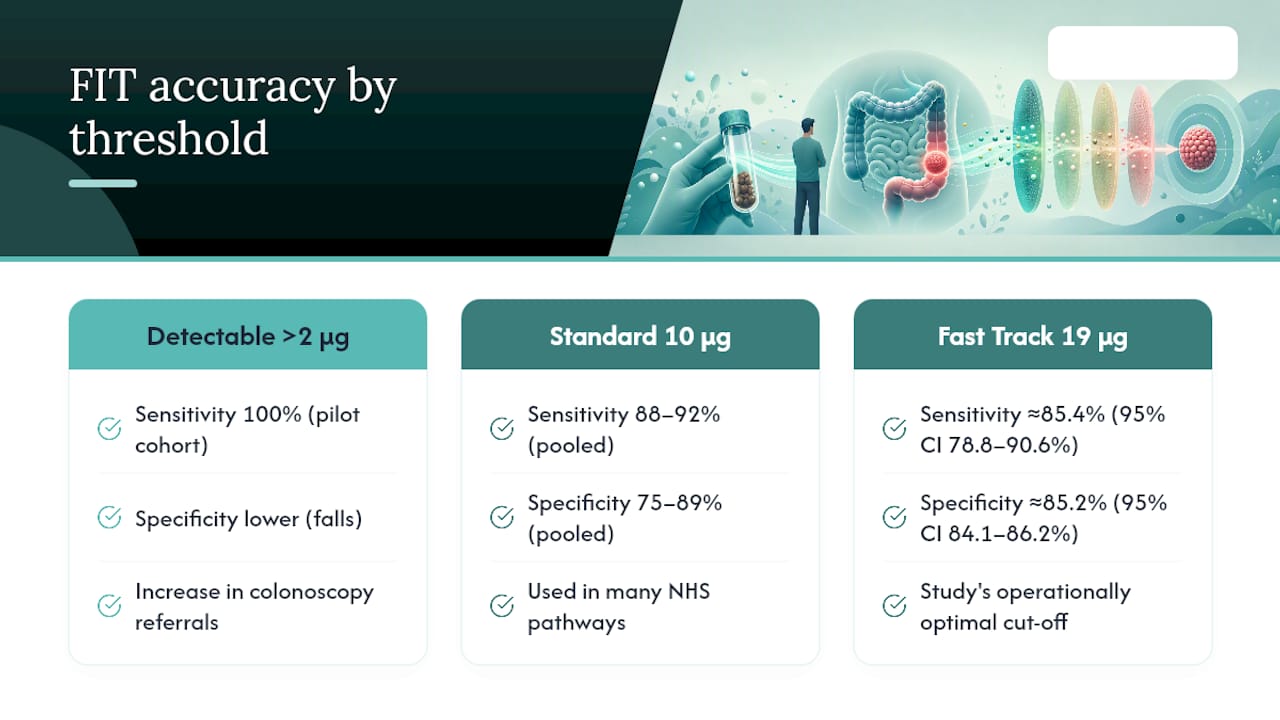
The Fast Track FIT study, a large UK diagnostic accuracy study in symptomatic referral patients, found an operationally optimal cut-off of 19 µg Hb/g, at which sensitivity was approximately 85.4% (95% CI 78.8–90.6%) and specificity approximately 85.2% (95% CI 84.1–86.2%). That study illustrates something important: the “best” threshold is not universal; it depends on the clinical population and the system’s capacity for follow-up investigation.
How PPV and NPV shift with age and prevalence
Positive predictive value (PPV) and negative predictive value (NPV) are not fixed properties of the test. They depend heavily on how common colorectal cancer is in the group being tested.
- Older adults (60+): Higher cancer prevalence means a positive FIT carries a meaningfully higher PPV. A positive result in this group is more likely to reflect genuine disease.
- Younger adults (under 40): An age-stratified UK analysis found sensitivity of approximately 92.4% and specificity of approximately 88.5% at 10 µg Hb/g in symptomatic patients under 50, but PPV was substantially lower in the youngest age groups because colorectal cancer is far less prevalent there.
Statistic to hold onto: In symptomatic cohorts with low cancer prevalence, NPV consistently exceeds 99% at the 10 µg Hb/g threshold, meaning a negative result is highly reliable as a rule-out in most primary care settings.
Why the µg Hb/g threshold matters more than you might think
Think of the threshold as a dial. Turn it down (lower µg Hb/g) and the test becomes more sensitive: it catches more cancers, but it also flags more people who do not have cancer, sending them for colonoscopies they may not need. Turn it up and you reduce unnecessary procedures, but some cancers slip through.
The NHS uses a threshold of 10 µg Hb/g for symptomatic triage in primary care because it balances sensitivity with the practical capacity of endoscopy services. Bowel cancer screening programmes historically used higher thresholds for similar reasons: a national screening programme testing millions of people cannot afford to send everyone with a faintly positive result for colonoscopy.
Practical consequences of threshold choice:
- Lower threshold (e.g. LoD or 2 µg/g): Maximises cancer detection; increases colonoscopy demand; appropriate where missing a cancer is the primary concern.
- Standard threshold (10 µg/g): Balances sensitivity and specificity; the current NHS primary care standard.
- Higher threshold (e.g. 19 µg/g or above): Reduces referral burden; may miss a small proportion of cancers; may suit resource-constrained settings.
Pro Tip: If your FIT result comes back close to the threshold (for example, 8–12 µg Hb/g), your GP may use clinical context, such as your symptoms, age, and family history, alongside the number rather than treating the threshold as a hard line. A borderline result is a conversation starter, not a verdict.
What a positive or negative FIT result means for you in the UK
After a positive result
A FIT result at or above 10 µg Hb/g in a symptomatic patient typically prompts an urgent referral for colonoscopy under NHS pathways. That referral is not a cancer diagnosis. Positive FIT results can arise from non-malignant sources, including haemorrhoids, gastric ulcers, or other benign causes of lower-gut bleeding. Colonoscopy identifies the source.
PPV varies considerably by age. In older adults, a meaningful proportion of positive FITs will reflect genuine colorectal cancer or significant polyps. In adults under 40, the PPV is much lower, though the test still has clinical value as a triage tool. A positive result in any age group warrants investigation, not panic.
After a negative result
A negative FIT is genuinely reassuring in most cases. The high NPV in symptomatic populations means the probability of missing a cancer is low. That said, a single negative result is not a permanent all-clear. If your symptoms continue or worsen, go back to your GP. Clinical judgement, repeat testing, or alternative investigations may still be appropriate.
Key actions to remember:
- Positive FIT: Accept the urgent referral; attend colonoscopy promptly.
- Negative FIT with ongoing symptoms: Return to your GP; do not assume the result rules out all pathology indefinitely.
- Negative FIT, no symptoms: Follow NHS screening programme guidance on when to repeat.
Worth knowing: PPV for colorectal cancer after a positive FIT in symptomatic UK adults is generally in the range of a few percent to around 10% depending on age and setting. That means most people with a positive FIT do not have cancer, but all of them need investigation to find out why they are bleeding.
When FIT can miss a cancer: causes of false negatives
FIT is not infallible, and understanding why it sometimes misses cancers helps you use the result sensibly.
Intermittent bleeding. Colorectal tumours do not bleed continuously. If a cancer happens not to bleed into the stool at the moment of sample collection, haemoglobin concentration in that sample may be below the detection threshold. This is the most common reason for a false negative.
Right-sided lesions. Cancers in the right side of the colon (ascending colon, caecum) tend to produce lower stool haemoglobin concentrations by the time the stool reaches the rectum, because haemoglobin degrades during transit. Assay variation and sampling issues are documented causes of missed cancers, and right-sided lesions are disproportionately represented among false negatives.
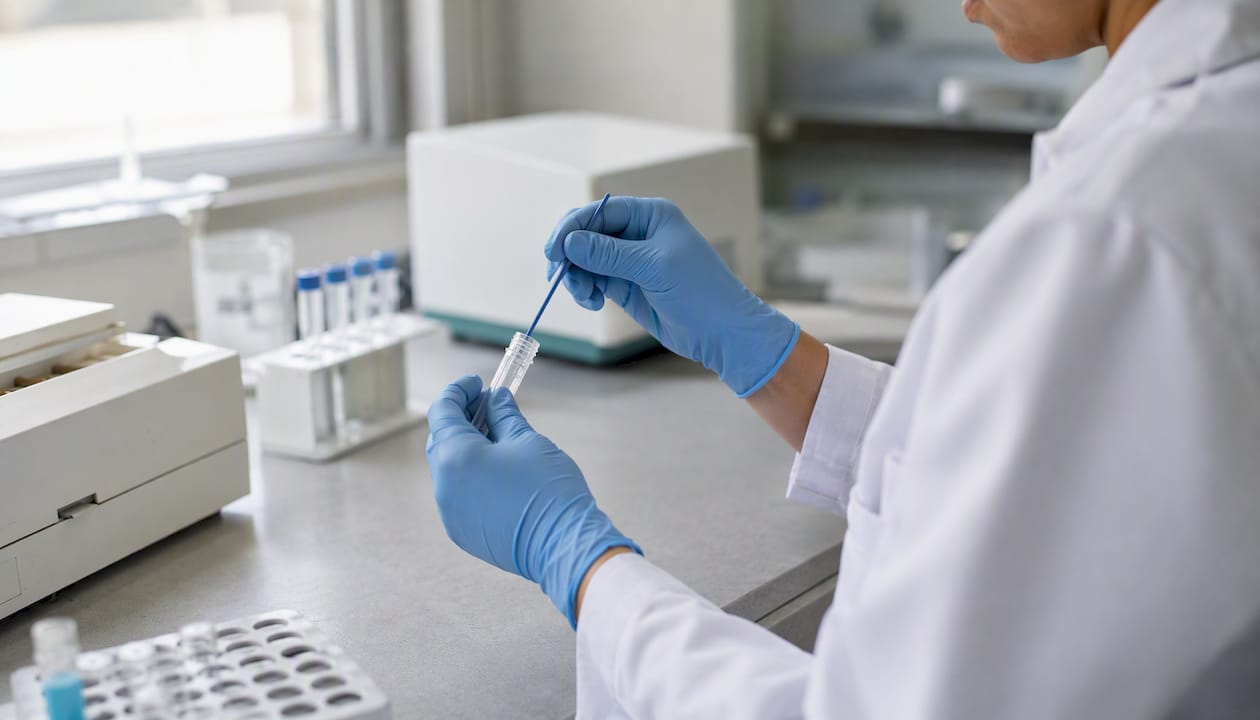
Pre-analytical errors. Haemoglobin in a collected sample degrades over time, particularly in warm conditions. A sample that sits at room temperature for too long before reaching the laboratory may show falsely low haemoglobin levels.
Patient and tumour factors:
- Early-stage or small tumours that bleed very little
- Certain medications (anticoagulants may increase bleeding; NSAIDs may cause non-tumour bleeding that confounds results)
- Assay brand variation between laboratories
Pro Tip: If your FIT comes back negative but you have symptoms such as rectal bleeding, unexplained weight loss, or a persistent change in bowel habit, do not stop there. Tell your GP the symptoms are still present. A single negative FIT does not override a clinical picture that warrants further investigation.
How FIT compares with colonoscopy and other stool tests
FIT occupies a specific role in the diagnostic pathway. Understanding where it sits relative to other tests helps set realistic expectations.
Colonoscopy remains the diagnostic gold standard. It can visualise the entire colon, detect and remove polyps in the same procedure, and take biopsies. The trade-off is that it is invasive, requires bowel preparation, carries a small risk of complications, and places significant demand on NHS endoscopy capacity. FIT exists partly to triage who needs colonoscopy most urgently.
FIT-DNA tests combine the standard immunochemical haemoglobin detection with analysis of DNA markers shed by abnormal cells. They show higher sensitivity for some advanced adenomas compared with FIT alone, but they also generate more false positives, cost more, and are not currently part of routine NHS pathways in the UK.
Guaiac FOBT (gFOBT) is the older stool test that FIT has largely replaced in UK practice. It is less specific (reacts to non-human haem sources), requires dietary restrictions, and offers only a qualitative result. FIT outperforms it on convenience and specificity.
A brief comparison:
- FIT: Non-invasive; 88–92% sensitivity at 10 µg/g; requires correct sample collection; no dietary prep; quantitative.
- Colonoscopy: Invasive; near-complete sensitivity; diagnostic and therapeutic; resource-intensive.
- FIT-DNA: Higher sensitivity for polyps; more false positives; higher cost; not routine in UK NHS.
- gFOBT: Less specific; dietary restrictions needed; largely superseded by FIT.
FIT’s role is triage, not diagnosis. It tells clinicians who needs colonoscopy most urgently, and it does that job well.
How to collect your FIT sample correctly
Getting the collection right matters. Pre-analytical errors are one of the avoidable causes of inaccurate results, and the steps are straightforward once you know them. A detailed walkthrough is available in Rapidtest’s FIT test sample collection guide.
- Read the instructions first. Whether you are using an NHS-issued kit or an at-home option, the manufacturer’s instructions specify the collection device and buffer solution for that particular assay. Do not mix components from different kits.
- Collect from a formed stool. Diarrhoeal samples are harder to analyse accurately. If your stool is loose on the day, wait for a more formed sample if clinically appropriate.
- Avoid contamination. Keep urine and toilet water out of the sample. Use the collection paper or device provided to catch the stool before it contacts the toilet bowl water.
- Use the supplied sampling device. Insert it to the marked depth, cap it securely, and label the tube with your details.
- Return the sample promptly. Haemoglobin degrades at room temperature. Post or deliver the sample on the same day or the next day at the latest, following the storage guidance on the kit.
- Single vs. repeat sampling. Some NHS programmes and clinical protocols request two or three samples on separate days to account for intermittent bleeding. Follow the specific instructions you have been given.
Pro Tip: Store the capped sample tube in the fridge (not the freezer) if you cannot post it immediately. Cold temperatures slow haemoglobin degradation and help preserve the accuracy of the result.
The key studies and guidelines behind FIT accuracy figures
The 88–92% sensitivity range at 10 µg Hb/g is not a single study’s finding. It comes from a body of evidence built over more than a decade.
- Systematic reviews and meta-analyses: Multiple pooled analyses of FIT performance in symptomatic populations consistently report sensitivity in the 88–92% range at 10 µg Hb/g, with specificity between 75% and 89%. At the assay limit of detection, pooled sensitivity estimates reach into the mid-90s, though with lower specificity.
- The Fast Track FIT study (UK): This large UK primary care study in symptomatic patients found an operationally optimal cut-off of 19 µg Hb/g, with sensitivity ~85.4% and specificity ~85.2%, demonstrating that optimal thresholds vary by clinical population and setting.
- Age-stratified UK analysis (South West England): Published in the British Journal of Cancer, this study reported sensitivity of ~92.4% and specificity of ~88.5% in symptomatic patients under 50 at 10 µg Hb/g, but highlighted that PPV is substantially lower in younger adults due to lower disease prevalence.
- ACPGBI/BSG and NICE guidance: National guideline updates from 2022 to 2024 broadened FIT use in primary care triage and modified referral thresholds, embedding FIT as the standard first-line triage tool for symptomatic adults in UK primary care.
Evidence gaps to be aware of: The evidence base is thinner for adults under 40, where colorectal cancer is rarer and study populations are smaller. Optimal thresholds by age group and by specific cancer location (right-sided vs left-sided) remain active areas of research. Recommendations may evolve as more age-stratified and location-stratified data accumulate.
A word from us on FIT and early detection
FIT is one of the most useful non-invasive tools available for bowel cancer triage. Used within NHS pathways, it catches the large majority of colorectal cancers at a stage where treatment is more likely to be effective. That is genuinely significant.
But it is worth being clear: FIT is a triage tool, not a diagnostic test. A positive result means you need investigation, not that you have cancer. A negative result is reassuring, not a guarantee. Persistent symptoms always deserve clinical attention, regardless of what a FIT result says.
The evidence underpinning FIT comes from rigorous sources: NHS guidance, Cancer Research UK, and peer-reviewed systematic reviews. If you want to read further, those are the places to start.
Thinking about an at-home FOB test? Here is what Rapidtest offers
Waiting for an NHS appointment is not always practical, and some people simply prefer to screen privately before deciding whether to seek further care.
Rapidtest’s at-home FOB testing kit gives you a result in 15 minutes, with no queue, no GP appointment, and no lab return. It is designed for adults who want a fast, private first look at whether blood is present in their stool.
A clear result in 15 minutes is a starting point, not a finish line. If your at-home result is positive, contact your GP or NHS 111 promptly and request a formal clinical assessment. If you have symptoms that concern you regardless of the result, do the same. At-home testing is a convenient screening option; it does not replace the NHS diagnostic pathway. For broader bowel health information, Rapidtest’s complete guide to bowel screening is a good next read.
This article is for general information only and is not a substitute for professional medical advice. If you have symptoms or a positive result, please contact your GP or NHS 111.
Sources
- The diagnostic accuracy of the faecal immunochemical test for colorectal cancer in risk‑stratified symptomatic patients
- Role of the faecal immunochemical test in patients with risk‑stratified suspected colorectal cancer symptoms: A systematic review and meta‑analysis to inform the ACPGBI/BSG guidelines
FAQ
How likely is bowel cancer if my FIT test is positive?
Most people with a positive FIT do not have bowel cancer. PPV varies by age and setting, generally ranging from a few percent in younger adults to around 10–15% in older symptomatic patients. All positive results require colonoscopy to identify the cause of bleeding.
Is a FIT test as good as a colonoscopy?
No. Colonoscopy remains the diagnostic gold standard, with near-complete sensitivity for colorectal cancer and the ability to remove polyps in the same procedure. FIT is a non-invasive triage tool that identifies who most needs colonoscopy; it does not replace it.
What counts as a passing score on a FIT test?
There is no universal “pass.” In UK NHS primary care, a result below 10 µg Hb/g is generally considered negative and reassuring. Results at or above that threshold typically prompt urgent referral. Borderline results near the threshold are interpreted alongside clinical symptoms and history.
Can FIT miss a bowel cancer?
Yes. FIT misses roughly 8–12% of colorectal cancers at the standard 10 µg Hb/g threshold, most commonly because tumours bleed intermittently or because right-sided lesions produce lower haemoglobin concentrations in the stool. If symptoms persist after a negative result, return to your GP.