


FOB test at home: your complete guide to bowel screening
A faecal occult blood test, commonly called an FOB test, detects invisible traces of blood in your stool before you would ever notice any symptoms yourself. Performing an FOB test at home is now straightforward, private, and genuinely accurate. Modern kits reach sensitivities up to 99% and specificities around 94%, which puts them well within the range of clinical screening tools. The test does not diagnose bowel cancer or any other condition. What it does is flag hidden blood early, giving you the chance to act before a problem grows.
What do you need to do an FOB test at home?
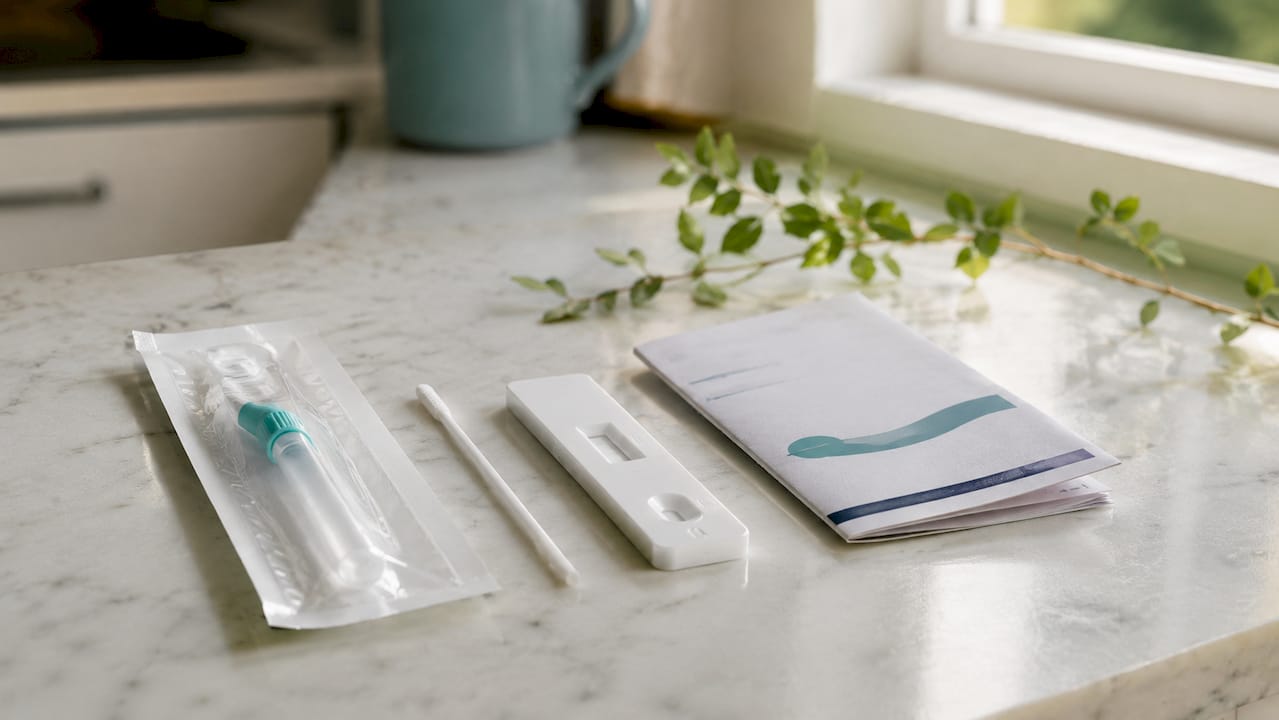
A good at-home FOB test kit contains everything you need in one box. Nothing extra is required from a pharmacy or a clinic.
What comes in the kit
Most kits include the following:
- A sample collection stick or swab
- A small collection tube filled with extraction buffer solution
- A test cassette (the strip that reads your result)
- A result window with clear positive and negative indicators
- A step-by-step instruction leaflet
The instruction leaflet is not optional reading. Following the exact instructions is the single biggest factor in getting a reliable result. Skipping a step or rushing the timing is where most errors happen.
Do you need to change your diet first?
No. This is one of the most common misconceptions about home bowel testing. Immunological FOB tests do not require dietary restrictions, unlike older guaiac-based tests that flagged red meat and vitamin C as potential false positives. Modern kits use immunoassay technology, which reacts only to human haemoglobin. You can eat normally before testing.
| Preparation step | Required? |
|---|---|
| Avoid red meat | No (immunological kits only) |
| Avoid vitamin C supplements | No (immunological kits only) |
| Wash hands before collecting | Yes |
| Avoid contaminating sample with urine | Yes |
| Test within the kit’s stated time window | Yes |
Pro Tip: Collect your sample first thing in the morning before using the toilet for anything else. Fresh samples give the most reliable readings.
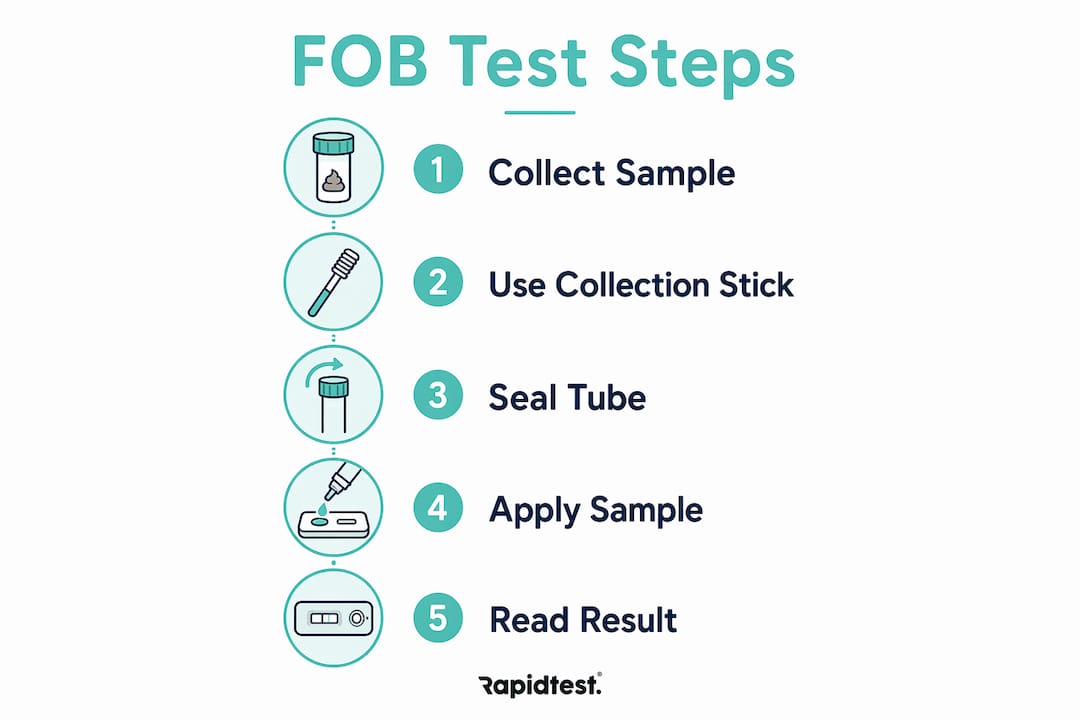
How to perform an FOB test at home: step by step
The process takes around five minutes to complete. Reading the result takes a further 2–10 minutes depending on your kit.
- Wash your hands thoroughly with soap and water before you begin.
- Prepare your collection surface. Place some toilet paper or a disposable liner in the toilet bowl to catch the stool sample without it touching the water.
- Collect the sample. Use the collection stick to take a small sample from two or three different areas of the stool. This improves the chance of detecting blood that may not be evenly distributed.
- Transfer the sample. Place the stick into the extraction buffer tube and mix it according to the instructions. Do not overfill the tube.
- Apply the solution to the cassette. Use the dropper or pipette provided to place the correct number of drops into the sample well on the test cassette.
- Wait for the result. Results appear within 2–10 minutes. Do not read the result after the maximum stated time window, as the cassette can develop misleading lines if left too long.
- Dispose of materials safely. Seal everything in the bag provided or wrap in tissue and place in your household bin. Do not flush the cassette.
Common mistakes to avoid
Rushing step three is the most frequent error. Taking a sample from only one spot on the stool reduces accuracy. Contamination with urine is another common issue. Urine can dilute the sample and affect the result. If you are unsure whether contamination occurred, discard the sample and start again with a fresh kit.
If you cannot test the sample immediately, most kits allow short-term storage in the sealed tube at room temperature. Check your specific kit’s instructions for the maximum storage window, as this varies.
Pro Tip: Read the result in good natural light. Faint lines still count as lines. If you are squinting at the cassette, photograph it and zoom in on your phone.
How do you read FOB test results?
The result window on the cassette shows one or two lines. The interpretation is consistent across most immunological kits.
- One line (control line only): Negative. No detectable blood was found in the sample. This is a reassuring result, but it does not rule out all bowel conditions. Some issues bleed intermittently.
- Two lines (control line and test line): Positive. Hidden blood has been detected in the sample. The strength of the test line does not indicate severity. Any visible test line counts as a positive.
- No lines at all: Invalid. The test did not work correctly. This is usually caused by insufficient sample volume or a faulty cassette. Repeat the test with a new kit.
What does a positive result actually mean?
A positive result means the test detected occult (hidden) blood. A positive test indicates blood presence, not a definitive diagnosis. Blood in the stool can come from several sources, including haemorrhoids, a small polyp, an anal fissure, or, in some cases, more serious bowel conditions. You cannot tell from the test alone which of these is the cause.
A positive FOB result is a signal to seek further investigation, not a reason to panic. Your GP will arrange the appropriate next steps, which may include a colonoscopy to examine the bowel directly.
Early detection of occult blood significantly improves the chances of successful treatment if a serious condition is present. Acting on a positive result promptly is the most important thing you can do.
Can you get a false result?
Yes, though it is uncommon with modern immunological kits. Modern immunoassay tests are generally unaffected by foods like red meat or vitamin C, which were the main culprits behind false positives in older guaiac tests. A false negative is more likely if the sample was collected poorly, stored incorrectly, or if the bleeding is intermittent and happened to be absent at the time of testing.
Troubleshooting your home FOB test
Even when you follow the instructions carefully, questions can come up. Here are the most common ones.
The result line is very faint. Does it count? Yes. Any visible line in the test window counts as a positive result, regardless of how faint it appears. Faint lines are not weak positives. They are positives.
The test showed invalid. What now? Repeat the test or consult a health professional if you get an invalid result. An invalid result gives you no information at all. Do not try to interpret it. Use a fresh kit and follow the instructions again from the start.
Can I test during my period? No. Menstrual blood can contaminate the stool sample and produce a false positive. Wait until your period has finished before collecting a sample.
How do I dispose of the kit discreetly? Wrap the used cassette, collection stick, and tube in tissue or place them in the sealed bag included in the kit. Put everything in your household bin. At-home testing removes the logistical and privacy barriers of clinic visits, and discreet disposal is part of that.
When should I repeat the test? If your result was negative but you have ongoing symptoms such as changes in bowel habits, unexplained weight loss, or persistent abdominal discomfort, speak to your GP rather than simply repeating the test at home. The FOB test is a screening tool, not a substitute for clinical assessment.
Pro Tip: Keep a spare kit at home if you are in a higher-risk group, such as those aged 50 and over or with a family history of bowel cancer. Regular screening is far more useful than a single one-off test.
Key takeaways
An at-home FOB test is a reliable, private screening tool that detects hidden blood in stool, and a positive result always requires follow-up with a healthcare professional.
| Point | Details |
|---|---|
| High accuracy at home | Modern immunological kits reach up to 99% sensitivity and 94% specificity. |
| No dietary prep needed | Immunoassay kits are unaffected by red meat or vitamin C, unlike older guaiac tests. |
| Positive means investigate | Any positive result requires GP follow-up; it is not a diagnosis on its own. |
| Invalid results need repeating | An invalid cassette gives no information; always retest with a fresh kit. |
| Regular testing matters | One-off testing is less useful than routine screening, especially for those aged 50 and over. |
Let’s be real about bowel health screening
I have spoken to a lot of people who put off bowel health checks for years. Not because they do not care, but because the idea of booking an appointment, explaining symptoms to a stranger, and waiting weeks for a result feels like more effort than the worry is worth. That is how things fall through the cracks.
What I find genuinely useful about home FOB testing is that it removes the friction entirely. You do not need a referral. You do not need to take time off work. You get a result in under 15 minutes, in your own bathroom, with no one else involved. For people who are private about their health, that matters enormously.
The thing I always remind people is this: the FOB test is a starting point, not an endpoint. A negative result is reassuring, but it does not mean you can ignore symptoms. A positive result is not a catastrophe. It is information. And information is what lets you and your doctor make good decisions early, when treatment options are widest.
If you are over 50, have a family history of bowel cancer, or have noticed any changes in your digestion, I would not wait for your NHS screening invitation to arrive. Testing at home between scheduled screenings gives you a much clearer picture of what is going on. Routine monitoring is not anxiety. It is just good sense.
— Jack
Rapidtest’s at-home FOB kit: results in 15 minutes
Rapidtest offers a CE-certified at-home FOB testing kit that delivers results in 15 minutes with no lab visit, no appointment, and no dietary restrictions required. The kit reaches up to 99% sensitivity and 94% specificity, putting it on a par with clinical screening tools.
Everything you need arrives in one discreet package, with clear step-by-step instructions included. If you want to go further with your health monitoring, Rapidtest also offers a combined PSA and FOB screening bundle covering both bowel and prostate health in one order. Fast, private, and genuinely worth doing.
FAQ
What does FOB stand for in a bowel test?
FOB stands for faecal occult blood. The test detects hidden (occult) blood in a stool sample that is invisible to the naked eye.
How accurate is an FOB test done at home?
Modern immunological home kits reach up to 99% sensitivity and around 94% specificity, making them comparable to tests used in clinical settings.
What should I do after a positive FOB test result?
Contact your GP as soon as possible. A positive result means hidden blood was detected, and your doctor will arrange further investigation, typically a colonoscopy, to find the cause.
Can I eat normally before doing an at-home FOB test?
Yes. Immunological FOB kits do not require dietary restrictions. Unlike older guaiac-based tests, modern kits are not affected by red meat or vitamin C.
How often should I do a home FOB test?
Annual screening is commonly recommended for people aged 50 and over, or more frequently if you have a family history of bowel cancer or ongoing digestive symptoms. Always follow your GP’s guidance on frequency.