


What is a blood marker test? Your plain-English guide
A blood marker test measures specific biological substances in your blood, including proteins, hormones, enzymes, and lipids, to give clinicians an objective picture of what is happening inside your body. These substances, formally known as biomarkers, act as biological signals: they can indicate normal body functions, flag disease states, or show how well a treatment is working. The field spans four broad categories:
- Biochemistry — enzymes, electrolytes, and metabolic waste products
- Haematology — the cells that make up your blood
- Proteomics — proteins linked to inflammation, organ function, or cancer
- Metabolomics — small molecules reflecting your body’s metabolic activity
Results are always interpreted by a clinician alongside your symptoms, medical history, and physical examination. A blood test alone does not confirm a diagnosis. Think of the numbers as clues, not verdicts.
Table of Contents
- What are the most common types of blood marker tests?
- When should you have a blood marker test, and why?
- What to expect when you have a blood test
- How to make sense of your blood marker test results
- What are the risks and limitations of blood marker testing?
- How private at-home testing is changing the picture in the UK
- What happens after you get your results?
- Rapidtest makes proactive health screening genuinely easy
- Key takeaways
- FAQ
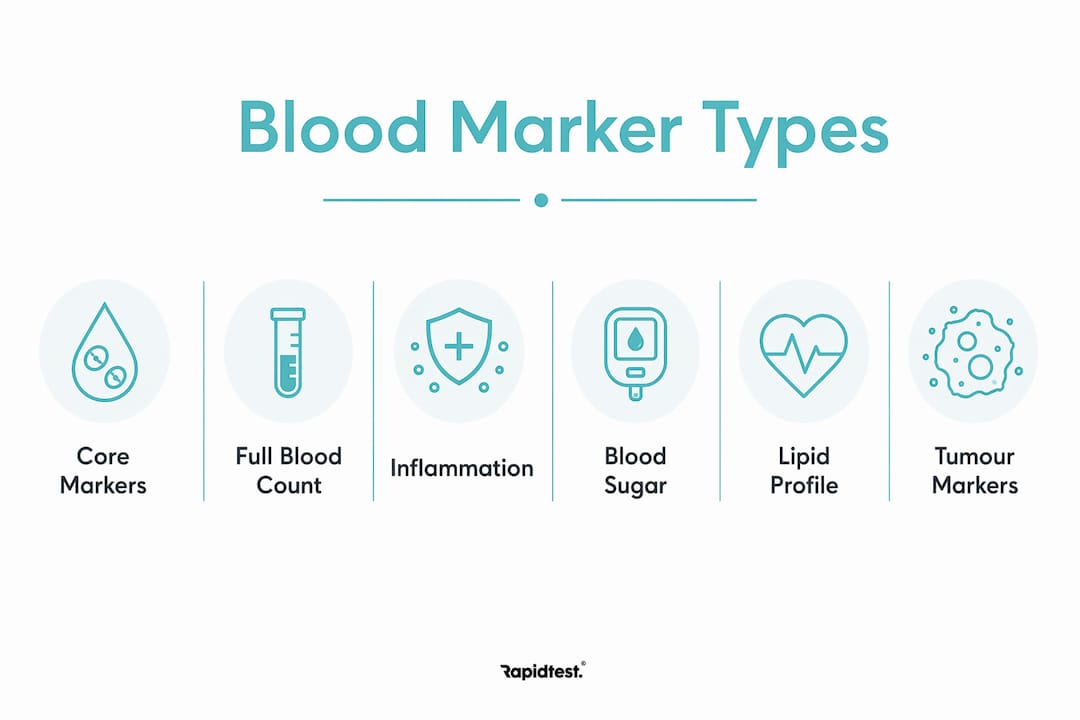
What are the most common types of blood marker tests?
Blood tests cover a wide range of health concerns, and knowing what each one looks at helps you understand why your GP or specialist might request it.
- Full blood count (FBC): The most commonly requested blood test in the UK, the FBC measures your red blood cells, white blood cells, and platelets. It can detect anaemia, infection, clotting disorders, and blood cancers.
- Liver function tests (LFTs): These measure enzymes and proteins such as ALT, AST, ALP, GGT, and albumin. Raised levels can point to alcohol-related damage, fatty liver disease, or the effects of medication.
- Lipid panel: Measures total cholesterol, LDL, HDL, and triglycerides. Advanced markers like ApoB and Lp(a) give a sharper picture of cardiovascular risk; the European Society of Cardiology recommends ApoB as a primary treatment target.
- Inflammatory markers: C-reactive protein (CRP) and fibrinogen rise when the body is fighting infection or inflammation, making them useful in diagnosing conditions like rheumatoid arthritis or monitoring flare-ups.
- Thyroid function tests: TSH, free T3, and free T4 reveal whether your thyroid is overactive or underactive, both of which affect energy, weight, and mood.
- Tumour markers: Substances such as PSA (prostate-specific antigen), CA-125, and CEA are primarily used to monitor known cancers and treatment responses rather than to screen healthy individuals.
- Blood glucose and HbA1c: HbA1c reflects average blood sugar over roughly three months and is the standard test for diagnosing and managing diabetes.
- Kidney function (renal profile): Creatinine and urea levels show how well your kidneys are filtering waste, with rising values often indicating chronic kidney disease.
No single marker tells the whole story. Clinicians typically look at panels or profiles together, because many markers lack sufficient specificity when read in isolation.

When should you have a blood marker test, and why?
Blood tests are not something to request on a whim. NHS guidance is clear: tests should only be ordered when there is a genuine clinical reason, not simply “just to check.” Over-testing without indication creates noise, not clarity.
That said, there are plenty of legitimate reasons a clinician might request one:
- Diagnosis: Suspected infection, anaemia, thyroid disorder, or diabetes all warrant targeted testing.
- Monitoring disease progression: Conditions like chronic kidney disease or inflammatory bowel disease require regular tracking of specific markers.
- Treatment response: Checking whether a medication is working, or whether it is causing side effects on the liver or kidneys.
- Cardiovascular risk assessment: Lipid panels and inflammatory markers help stratify risk before symptoms appear.
- Cancer monitoring: Tumour markers are used to track known cancers, not to screen the general population.
- Preventive health: Some people choose private testing to get a baseline picture of their health before problems arise.
Tests also have defined minimum retesting intervals, set by national guidance, based on the properties of each test and the clinical situation. Repeating a test too soon can produce misleading results and unnecessary worry. Your GP, a hospital specialist, or a practice nurse can all request blood tests within the NHS; private providers offer additional access outside that pathway.
What to expect when you have a blood test
The process is straightforward, and for most people, it takes less than ten minutes from start to finish.
- Sample collection: Blood is usually drawn from a vein in the crook of your arm using a small needle. Some tests, including certain rapid home kits, use a finger-prick sample instead.
- Fasting requirements: Many blood tests do not require fasting, but when they do (lipid panels and fasting glucose, for example), you will typically be asked to avoid food and drink for 10–12 hours beforehand. Always follow your clinician’s specific instructions.
- Medication adjustments: Some drugs affect test results. Tell your clinician or the testing service about any medication you are taking before the sample is collected.
- Laboratory analysis: Samples are processed in UKAS-accredited laboratories operating under ISO 15189 standards, which apply to both NHS and private providers and guarantee analytical accuracy.
- Turnaround time: NHS results typically come back within a few days, depending on the test. Private at-home rapid tests can return results in as little as 15 minutes.
- Informed consent: You have the right to ask what is being tested and why. Engaging with your healthcare provider before and after the test is part of getting the most from it.
The needle prick is brief. The information it provides can be genuinely useful, so it is worth doing properly.

How to make sense of your blood marker test results
Getting your results back can feel a bit daunting, especially if a number sits outside the reference range. Here is what actually matters.
- Reference ranges are population averages: A result flagged as “high” or “low” means it falls outside the range seen in most healthy adults. It does not automatically mean something is wrong.
- Normal does not always mean fine: A normal result does not rule out every condition. Some diseases produce no detectable marker change in early stages.
- Abnormal does not always mean serious: Slightly elevated CRP, for instance, can reflect a minor cold as easily as a chronic condition. Context is everything.
- Panels beat single markers: Because many markers lack specificity alone, clinicians look at results together. An isolated elevated ALT means far less than elevated ALT alongside raised bilirubin and low albumin.
- Common markers and what they suggest: Raised CRP points to inflammation; low haemoglobin suggests anaemia; elevated TSH usually indicates an underactive thyroid; high LDL is a cardiovascular risk factor.
Results must always be analysed alongside your symptoms, history, and any physical examination findings by a qualified clinician.
Pro Tip: Never self-diagnose from a blood test result. Screenshot the numbers, write down any questions, and bring them to your next appointment. A five-minute conversation with your GP can save hours of anxious searching online.
What are the risks and limitations of blood marker testing?
Blood tests are safe and widely used, but they are not infallible. Understanding their limits helps you use them wisely.
- False positives: A result outside the normal range does not confirm disease. Testing without a clear clinical reason increases the chance of a false positive, which can trigger unnecessary anxiety and follow-up procedures.
- False negatives: Some conditions produce no detectable marker change, particularly in early stages, so a normal result is not a clean bill of health.
- Marker specificity: Many biomarkers are not disease-specific. Elevated CRP, for example, rises with infection, autoimmune conditions, and even intense exercise. Interpreting it in isolation is rarely useful.
- Sample stability: Certain tests have strict requirements around how quickly a sample must be processed. Delays or improper storage can affect accuracy.
- Over-testing risks: Unnecessary testing creates patient anxiety, burdens the NHS, and can lead to a cascade of redundant follow-up procedures. Tests should be requested with a clear purpose.
- Minimum retesting intervals: Repeating tests before the recommended interval can produce misleading trends. National guidance sets these intervals based on each test’s clinical properties.
The goal is not to test everything; it is to test the right things at the right time.
How private at-home testing is changing the picture in the UK
For years, getting a blood marker test meant booking a GP appointment, waiting for a referral, and then waiting again for results. That is changing.
Rapidtest offers private, at-home health screening kits that return results in approximately 15 minutes, with no lab visit, no queue, and no appointment needed. The range covers STI screening, fertility markers (including LH, HCG, and sperm health), PSA for prostate health, and FOB for bowel cancer screening, alongside clotting factors and other key biomarkers.
These kits use validated methods designed to meet the same analytical standards as accredited laboratory testing. Private at-home tests are most trustworthy when they are linked to recognised diagnostic standards and supported by clear guidance on what to do with the result, which is exactly the model Rapidtest follows.
The bigger shift is patient empowerment. More people are choosing to take a proactive role in their health, checking markers before symptoms appear rather than waiting for something to go wrong. Private testing complements NHS care rather than replacing it: if a home test flags something unexpected, the next step is always a conversation with a clinician.
The NHS remains the backbone of diagnostic medicine in the UK. Private testing, done responsibly, fills the gaps: faster access, greater discretion, and the ability to check in on your health on your own terms.
What happens after you get your results?
A blood test result is a starting point, not an endpoint. What happens next depends entirely on what the results show.
If results are within normal ranges and your symptoms have resolved, no further action may be needed. Your clinician will confirm this.
When a result is abnormal, the follow-up typically falls into one of three categories. First, a repeat test: some markers fluctuate naturally, so a single out-of-range result is often confirmed with a second sample before any action is taken. Second, further investigation: an elevated PSA, for example, does not diagnose prostate cancer, but it does warrant an urgent referral for further assessment, which may include imaging or a biopsy. Third, treatment or lifestyle changes: a high LDL result might prompt a conversation about statins, dietary changes, or both, depending on your overall cardiovascular risk profile.
Tumour markers are a good example of how nuanced follow-up can be. Because they are primarily used to monitor known cancers rather than screen healthy people, a rising marker in someone already diagnosed signals a need to review their treatment plan. In someone with no known cancer, the same result requires careful clinical judgement before any conclusions are drawn.
The key principle is this: results inform decisions, but clinicians make them. Your role is to attend follow-up appointments, ask questions, and be honest about your symptoms and lifestyle. The more context you give, the more useful the result becomes.
Rapidtest makes proactive health screening genuinely easy
Knowing what a blood marker test can reveal is one thing. Actually getting tested is another, and that is where many people stall. Booking a GP appointment, waiting weeks, and then waiting again for results is a real barrier for busy people who want to stay on top of their health without it becoming a part-time job.
Rapidtest cuts through that. Private, at-home test kits covering STI screening, fertility testing, PSA prostate health, and bowel cancer markers deliver results in 15 minutes, at home, with no appointment and no awkward conversations. The kits use validated methods that meet accredited laboratory standards, so the accuracy is there without the waiting room.
If you have been putting off checking your PSA levels, fertility markers, or STI status because the NHS pathway feels slow or the whole thing feels a bit uncomfortable, Rapidtest is built for exactly that situation. Browse the full range of at-home health screening kits and find the test that fits your situation.
Key takeaways
Blood marker tests are objective biological indicators that must always be interpreted by a clinician in the context of your symptoms, history, and examination findings.
| Point | Details |
|---|---|
| What they measure | Proteins, hormones, enzymes, and lipids that signal normal function or disease states. |
| Results need context | Abnormal results do not confirm disease; normal results do not always rule it out. |
| Test with a reason | NHS guidance recommends testing only with a clear clinical indication to avoid false positives and unnecessary anxiety. |
| Fasting varies by test | Fasting (typically 10–12 hours) is only required for certain tests; always follow your clinician’s instructions. |
| Rapidtest at-home option | Rapidtest offers validated rapid kits for STI, fertility, PSA, and bowel cancer markers with results in 15 minutes. |
FAQ
What do blood markers indicate?
Blood markers indicate the levels of specific biological substances, such as proteins, enzymes, hormones, or lipids, that reflect normal body functions, disease activity, or how well a treatment is working. They are objective signals, not standalone diagnoses.
Which blood test is used as a marker for cancer?
Tumour markers such as PSA (prostate cancer), CA-125 (ovarian cancer), and CEA (bowel cancer) are used primarily to monitor known cancers and treatment responses rather than to screen healthy individuals, as they lack the specificity needed for reliable population screening.
What are the five most important blood markers?
Definitions vary, but clinicians most commonly prioritise the full blood count (FBC), CRP (inflammation), HbA1c (blood sugar), lipid panel (cardiovascular risk), and liver function tests (LFTs) as a core set covering the broadest range of common conditions.
What does it mean if your blood markers are high?
A high result means a marker sits above the reference range for the general population, but it does not automatically indicate serious illness. Slightly elevated CRP can reflect a minor infection; raised PSA can have several causes beyond cancer. A clinician will interpret the result alongside your symptoms and history before drawing any conclusions.
Can I test my blood markers at home in the UK?
Yes. Rapidtest offers validated at-home kits covering markers including PSA, fertility hormones, and STI screening, with results in around 15 minutes. Any unexpected result should be followed up with a GP or specialist for full clinical interpretation.