


Urine HPV test: what you need to know in 2026
A urine HPV test is a non-invasive diagnostic tool designed to detect high-risk human papillomavirus types from a simple urine sample, without the need for a clinical examination. If you have ever put off a cervical screening appointment because the idea of it made you uncomfortable, you are far from alone. The good news is that HPV urine screening is changing what sexual health testing looks like. This guide covers how the test works, how accurate it is, how to collect your sample correctly, and where it fits into your overall health picture.
How accurate is the urine HPV test compared to cervical screening?
Accuracy is the first question most people ask, and it deserves a straight answer. A urine test for HPV shows 82.3% initial agreement with the standard cobas 4800 cervical test. After next-generation sequencing adjudication, that agreement rises to 93%. That jump tells you that some initial discrepancies are down to sample handling rather than the test itself failing.
Sensitivity and specificity tell the fuller story. Studies report moderate sensitivity of around 55.2% but high specificity of around 89.8% compared with cervical swab PCR. High specificity means a positive result is reliable. Moderate sensitivity means the test can occasionally miss an infection that is present. That is why urine HPV testing is best understood as a complementary or entry-point screening tool, not a standalone replacement for clinician-collected cervical samples.
| Metric | Urine HPV test | Cervical swab (PCR) |
|---|---|---|
| Sensitivity | ~55.2% | Higher (reference standard) |
| Specificity | ~89.8% | Higher (reference standard) |
| Initial agreement with cobas 4800 | 82.3% | N/A (reference) |
| Adjudicated agreement | 93% | N/A (reference) |
| Invasiveness | None | Requires clinical collection |
Pro Tip: If your urine HPV result comes back positive, treat it as a prompt to book a follow-up cervical screen rather than a definitive diagnosis. A positive result is meaningful, but the next step is always confirmation.
How to collect a urine sample for HPV testing
Getting the collection right makes a real difference to your result. The process is straightforward, but a few details matter.
Why first-void urine matters
First-void urine is the very first stream of urine you pass after waking or after a period of not urinating. It contains the highest concentration of viral DNA shed from the urogenital tract. First-void collection protocols require that you have not urinated for at least two hours before collecting your sample. Skipping this step is the single most common reason for a weaker result.
Step-by-step collection guide
- Wait at least two hours since your last visit to the toilet before collecting.
- Collect first-void urine only. Catch the very first stream of urine, not a midstream sample.
- Use a standardised collection device. Devices like Colli-Pee® are designed specifically for first-void collection and improve viral DNA yield compared to a standard cup.
- Seal the sample immediately after collection to avoid contamination.
- Store at room temperature if you are posting it. Research confirms that urine samples remain stable at room temperature for up to 10 days, with 95% concordance with original results. That makes mail-in testing genuinely practical.
- Post or process promptly. The sooner the sample reaches the lab, the better, even though the 10-day window gives you flexibility.
Pro Tip: Do not drink large amounts of water before collecting. Diluted urine reduces viral DNA concentration and can affect your result.
Things to avoid before collection:
- Urinating within two hours of the test
- Using a midstream or late-stream sample
- Collecting into a standard cup if a Colli-Pee® or equivalent device is provided
- Leaving the sample unsealed or in direct sunlight
Where does urine HPV testing fit in your screening pathway?
A urine HPV test does not exist in isolation. It sits within a broader picture of cervical cancer prevention and sexual health monitoring. Understanding where it fits helps you use it well.
Urine testing works best as an initial or complementary screening step. If your result is negative, that is reassuring information. If it is positive, the pathway continues.
“A positive urine HPV result may be triaged using urine DNA methylation testing, which helps clinicians decide whether a colposcopy referral is genuinely needed, reducing unnecessary procedures.” — Clinical trial evidence, 2026
This triage approach matters because not every HPV infection leads to cervical changes. DNA methylation testing on the same urine sample can identify which positive results carry a higher risk of progressing to cervical disease. That means fewer people going through colposcopy when it is not needed.
The benefits for people who avoid traditional screening are significant:
- People who find speculum examinations painful or distressing can access screening without that barrier.
- Those with physical disabilities or health conditions that make clinical examinations difficult have a realistic alternative.
- Individuals in areas with limited access to GP or sexual health clinic appointments can screen from home.
- Older women, who often disengage from screening programmes, are more likely to participate. A UK study found a 59% sample return rate among women aged 60–79 using at-home urine HPV kits. That is a meaningful number for a group that frequently falls through the cracks of routine screening.
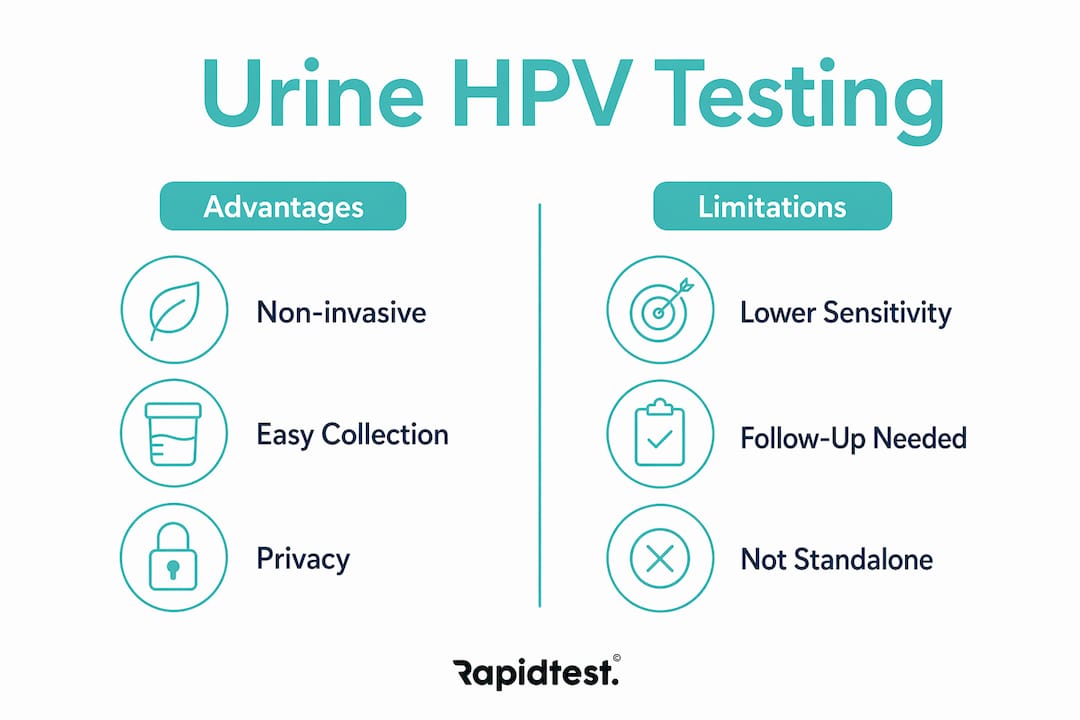
What are the advantages and limitations of urine HPV testing?
Let’s be real about what this test can and cannot do.
Advantages
- No clinical appointment needed. You collect the sample yourself, at home, at a time that suits you.
- Non-invasive. There is no speculum, no examination, and no discomfort.
- Increases screening uptake. Non-invasive urine testing directly addresses barriers like physical discomfort and embarrassment, bringing more people into screening who would otherwise opt out.
- Stable samples. The 10-day room temperature stability window makes postal testing practical and reliable.
- Detects high-risk HPV types. The test identifies the strains most associated with cervical cancer risk.
Limitations
- Moderate sensitivity. At around 55.2%, the test can miss some infections. A negative result does not guarantee HPV is absent.
- Not a standalone diagnostic tool. A positive result requires follow-up. It does not replace a cervical smear or colposcopy.
- Lower viral DNA yield than cervical samples. Urine naturally contains less HPV DNA than a directly collected cervical sample, which is why collection technique matters so much.
- Pending further validation. Urine HPV testing complements but does not replace routine cervical screening while further large-scale validation studies continue.
| Factor | Urine HPV test | Clinician-collected cervical sample |
|---|---|---|
| Invasiveness | None | Moderate |
| Sensitivity | ~55.2% | Higher |
| Specificity | ~89.8% | Higher |
| Self-collection | Yes | No |
| Sample stability | 10 days at room temperature | Requires prompt processing |
| Suitable as standalone test | No | Yes |
Where to get a reliable urine HPV test kit
Knowing where to source your kit is as important as knowing how to use it. Not all HPV testing options are equal.
When choosing a kit, look for:
- CE marking or registered IVD status. This confirms the kit meets European in-vitro diagnostic standards.
- Clear collection instructions. A good kit includes a standardised collection device and unambiguous guidance.
- Lab processing with result turnaround. Understand whether results come from a certified laboratory and how long you will wait.
- Discreet packaging and delivery. Privacy matters, and reputable providers deliver without any identifying branding on the outside.
- Customer support. If your result raises questions, you want to be able to speak to someone.
At-home HPV testing has improved considerably. You can now find kits that guide you through at-home HPV testing with clear instructions and fast turnaround, removing the need to visit a clinic entirely. For people who want to take a proactive approach to their sexual health without the hassle of appointments, this is a practical and accessible route.
Key takeaways
Urine HPV testing is a clinically supported, non-invasive screening option that works best as an entry point into cervical cancer prevention pathways, not as a replacement for traditional cervical screening.
| Point | Details |
|---|---|
| Accuracy is promising but not perfect | Urine HPV tests show 93% adjudicated agreement with standard cervical tests after sequencing correction. |
| Collection technique is critical | First-void urine collected after two hours without urinating gives the most reliable viral DNA yield. |
| Positive results need follow-up | A positive urine result should trigger further testing such as DNA methylation triage or cervical screening. |
| It increases screening participation | A 59% return rate among women aged 60–79 shows urine testing reaches people who avoid clinic-based screening. |
| Sample stability enables postal testing | Urine samples remain stable for up to 10 days at room temperature, making mail-in kits genuinely viable. |
My honest view on where urine HPV testing is heading
I have followed the development of non-invasive HPV screening for a while now, and the trajectory is genuinely encouraging. What strikes me most is not the technology itself but the people it reaches. The 59% return rate among older women in the UK study is the kind of number that should make clinicians sit up. These are people who have quietly dropped out of screening, not because they do not care about their health, but because the existing system did not work for them.
The sensitivity gap is real and worth taking seriously. A test that misses roughly four in ten infections is not something to rely on exclusively. But framing that as a failure misses the point. A person who would never attend a cervical screening appointment but who will post a urine sample is infinitely better served by a moderately sensitive test than by no test at all. The goal of screening is participation, and urine testing moves the needle on that.
What I would like to see next is larger validation studies that look specifically at self-collected urine versus clinician-collected samples across diverse populations. The current evidence is strong enough to act on, but the field needs that broader confirmation to shift urine testing from “promising alternative” to “standard option.” Until then, use it as the entry point it is designed to be, and follow up on any positive result without delay. Your health is worth that next step.
— Jack
Test from home with Rapidtest
Rapidtest makes private sexual health screening genuinely simple. No queues, no appointments, and no awkward conversations. If you want to take control of your sexual health from the comfort of your own home, Rapidtest’s at-home STI testing kits cover a full range of conditions, with results in as little as 15 minutes. Whether you are screening for HPV or checking for other STIs, the kits are discreet, certified, and straightforward to use. You can also explore the HPV rapid test kit for a fast, private result at home. Take the first step today.
FAQ
What is a urine HPV test?
A urine HPV test detects high-risk human papillomavirus DNA from a urine sample, without requiring a clinical examination or cervical swab. It is a non-invasive screening option designed to complement, not replace, traditional cervical screening.
Is the urine HPV test accurate enough to rely on?
The test shows high specificity of around 89.8%, meaning positive results are reliable, but sensitivity is around 55.2%, so it can occasionally miss an active infection. It is best used as an entry-point screen rather than a definitive diagnostic tool.
How do I collect the sample correctly?
Collect first-void urine, the very first stream after at least two hours without urinating, using a standardised device such as Colli-Pee® if provided. Correct collection is the single biggest factor in getting an accurate result.
What happens if my urine HPV test is positive?
A positive result means you should arrange follow-up testing, which may include a cervical smear, DNA methylation triage, or colposcopy referral depending on clinical guidance. A positive urine result is not a diagnosis on its own.
Can I post my urine sample to a lab?
Yes. Urine samples remain stable at room temperature for up to 10 days with 95% result concordance, making postal testing a practical and reliable option for at-home HPV urine screening.