


Why Cycle Day Doesn't Matter: STI Testing in the UK (2–6 Weeks)
Yes, you can usually have an STI test while you’re on your period. The one thing that actually matters is timing since exposure, not where you are in your cycle. Most swabs, blood tests and urine samples stay reliable during menstruation, though your clinic or kit might occasionally ask for a repeat swab for quality reasons. That’s a routine check, not a red flag.
TL;DR:
- STI tests using NAATs for chlamydia and gonorrhea are reliable during menstruation, with sensitivity above 80% for vaginal, cervical, or urine samples.
- Blood tests for HIV and syphilis are unaffected by menstrual blood, making their accuracy consistent regardless of period timing.
- The optimal testing window is about 2 weeks after exposure for chlamydia and gonorrhea, and 4 to 6 weeks for HIV and syphilis, to minimize false negatives.
- A repeat sample may be requested if blood or swab samples are contaminated with menstrual blood, but this is a routine quality control step.
- Using at-home rapid STI kits requires following precise timing and removal of tampons or cups, and results are valid during menstruation.
Table of Contents
- Which tests and specimen types are unaffected by menstrual bleeding
- Window periods and when to wait after exposure, regardless of your period
- How menstruation can affect sample quality and practical steps for a valid swab
- If a sample must be repeated, here’s what happens next
- At-home rapid testing during your period: what you need to know
- Practical reassurance and how to think about timing
- Rapidtest at-home STI kits: a private option worth knowing about
- Sources
- FAQ
Which tests and specimen types are unaffected by menstrual bleeding
Let’s be real: period blood causes more worry than it needs to. The tests used to screen for chlamydia and gonorrhoea are called NAATs, short for nucleic acid amplification tests. They work by detecting the genetic material of bacteria, and they’re the routine tests used across sexual health services, including by Devon Sexual Health.
A systematic review on PubMed looked at how vaginal swabs compare to cervical and urine samples for these infections. Vaginal specimens performed similarly to the other sample types, with sensitivity above 80% in most of the studies reviewed. That means a self-taken vaginal swab, the kind used in most at-home kits, holds up well even when you’re bleeding.
Blood and urine tests follow a different logic entirely. HIV and syphilis are checked through blood serology, which measures your immune response rather than sampling cervical or vaginal cells, so menstrual blood has no bearing on the result. Urine-based chlamydia and gonorrhoea tests work the same way: they’re testing for bacterial DNA in your urine, not examining tissue.
Here’s a quick breakdown of what’s typically unaffected during your period:
- NAAT swabs for chlamydia and gonorrhoea: reliable on vaginal, cervical or urine samples.
- Blood serology for HIV and syphilis: unaffected by menstrual bleeding.
- Urine testing for chlamydia and gonorrhoea: unaffected, since it doesn’t involve direct tissue sampling.
Where it gets more specific is site coverage. A vaginal or cervical swab only tells you about that site. If you’ve had oral or anal sex, NHS guidance on chlamydia is clear that a negative result only covers the sites and infections actually tested, so mention any other exposure when you book a test or choose a kit.
Window periods and when to wait after exposure, regardless of your period
Your cycle and your exposure timeline are two completely separate clocks. A window period is the stretch of time between catching an infection and when a test can reliably pick it up. Test too early and you can get a false negative, whatever day of your cycle it happens to be.
Devon Sexual Health’s guidance sets out the typical windows clinicians work to:
- Chlamydia and gonorrhoea: around 2 weeks after exposure for a reliable NAAT result.
- HIV and syphilis: 4 to 6 weeks for blood serology to detect infection accurately.
- Repeat testing: recommended if you tested early, or if exposure was ongoing.
Serology sensitivity for HIV and syphilis increases substantially by 6 weeks and approaches near complete sensitivity by 3 months, according to Devon Sexual Health. That gradual climb is exactly why a single early test, even a perfectly performed one, shouldn’t be treated as the final word if you tested close to a potential exposure.
If you’re unsure where you sit on the timeline, our guide on when to test after unprotected sex walks through it step by step, and there’s a deeper look at chlamydia’s testing window if that’s your main concern. The short version: test too soon and you risk a false reassurance. If in doubt, retest at the appropriate window or speak to a clinic, especially if you have symptoms.

How menstruation can affect sample quality and practical steps for a valid swab
Visible blood on a swab doesn’t usually change the result, but it can occasionally dilute or contaminate the sample enough that a lab asks for a repeat. This is a quality control issue, not a sign something’s wrong with you. SHL’s clinic guidance confirms repeat sampling happens sometimes, for reasons entirely separate from your results.
A few small steps make a repeat far less likely:
- Remove your tampon or menstrual cup before taking the swab; a few minutes is plenty.
- Wash your hands thoroughly before opening the kit.
- Follow the swabbing instructions exactly, including how many times to rotate the swab and for how long.
- Avoid sex or douching for the period your kit instructions specify beforehand, since this can also affect sample quality.
Clinic-taken swabs and self-taken at-home health tests follow broadly the same principle, just with different hands doing the sampling. In a clinic, a nurse inserts the swab for you. At home, you’re doing exactly what they’d do, following the same rotation and timing instructions printed in the kit.
Pro Tip: If your flow is heavy, try swabbing shortly after you’ve changed your tampon or pad, when flow tends to be lighter and handling is easier. A panty liner afterwards helps with comfort.
If a sample must be repeated, here’s what happens next
A repeat request usually comes down to one of three things: not enough sample material was collected, the swab got contaminated somehow, or there was an issue processing the kit itself. None of these relate to whether you have an infection.
- Insufficient sample: not enough cells or fluid picked up by the swab.
- Contamination: blood, lubricant or other substances interfering with the lab’s ability to read the result.
- Kit or processing error: occasionally the issue sits with the test itself rather than your sample.
Services handle this differently depending on how you tested. A clinic will usually invite you back for another swab. An at-home kit provider typically sends a replacement free of charge. Either way, it’s worth treating the request calmly: it means the lab wants a cleaner read, not that they’ve spotted something concerning.
If you have symptoms, or you know your exposure involved a risk of gonorrhoea requiring resistance testing, a clinic visit is the better route from the start. UKHSA research notes that culture, which only a clinic can run, remains necessary for checking antibiotic sensitivity, something a NAAT alone can’t do.
At-home rapid testing during your period: what you need to know
Rapid point-of-care tests and lab-based NAATs aren’t quite the same tool. A lateral-flow rapid test gives you a result at home within minutes by detecting antibodies or antigens directly, while a NAAT sent to a lab detects genetic material and tends to be used for chlamydia and gonorrhoea specifically.
If you’re using an at-home kit during your period, the checklist is much the same as any swab:
- Remove your tampon or cup before sampling.
- Stick to the exact timing given in your kit’s instructions, both for the swab and for reading the result window.
- Read the result within the stated time frame, since leaving it too long or checking too early can distort what you see.
Pro Tip: Keep the instruction leaflet open in front of you while you test rather than relying on memory. Small timing slips are the most common reason results look unclear.
Rapid kits are built for convenient screening, with discreet delivery and results in around 15 minutes. If you have symptoms, a known high-risk exposure, or need resistance testing for gonorrhoea, follow up with a clinic lab NAAT rather than relying on the rapid result alone, as NHS guidance advises for cases needing closer clinical assessment.
Practical reassurance and how to think about timing
Menstruation on its own is rarely a reason to put off testing. The thing that actually decides whether your result means anything is how much time has passed since the exposure you’re worried about, not which day of your cycle you happen to be on.
If you’re close to an exposure, follow the window period guidance rather than testing the moment anxiety strikes. And if you’ve got symptoms, bleeding that feels unusual for you, or pain, don’t wait out the window: get seen. Our guide to testing timing is a good next stop if you want the fuller picture.
— Jack
Rapidtest at-home STI kits: a private option worth knowing about
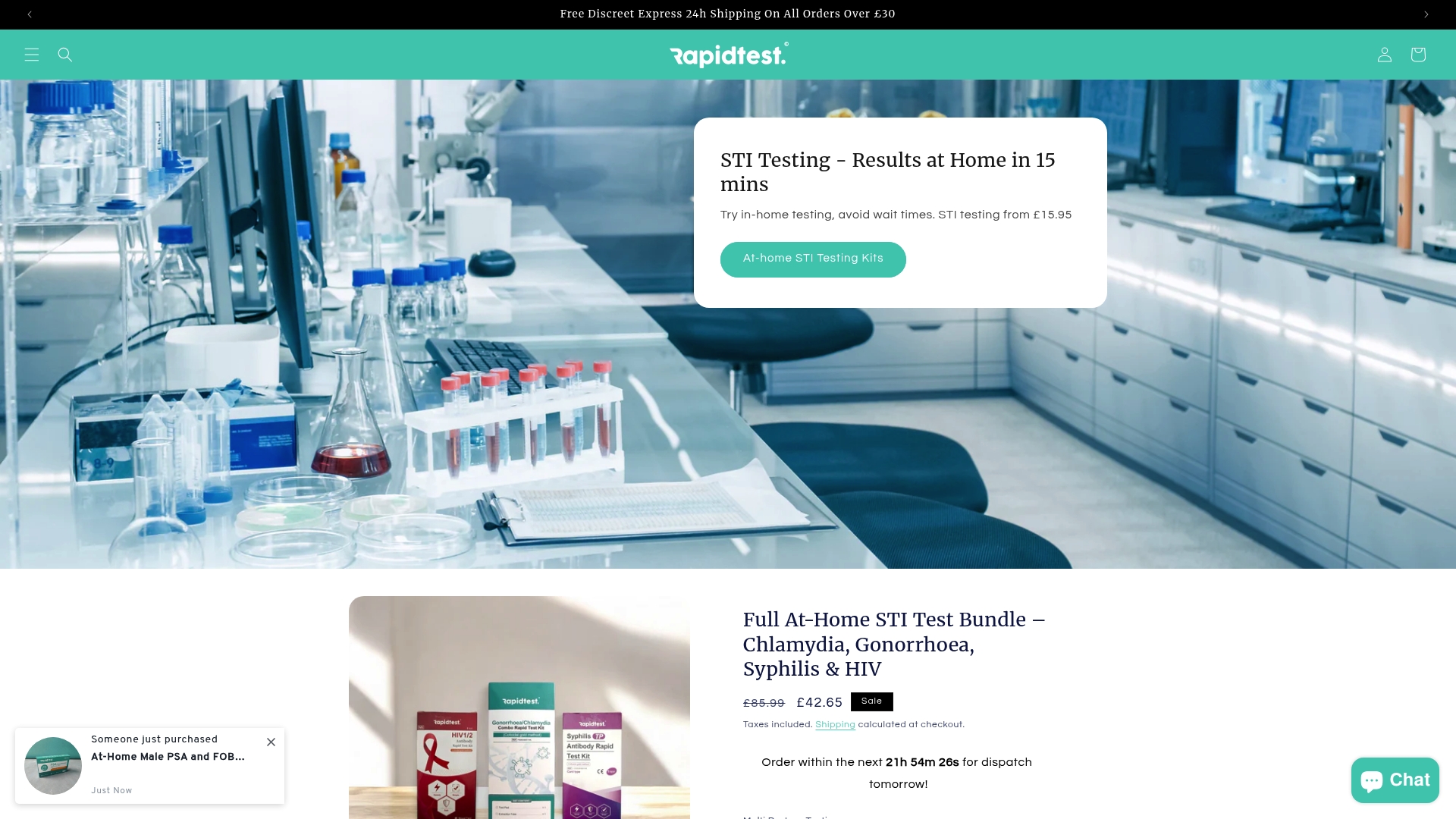
If appointments and waiting rooms aren’t your thing, at-home kits cover chlamydia, gonorrhoea, syphilis, HIV, Hepatitis B, Hepatitis C, HSV-2 and HPV, with results in 15 minutes and no lab returns needed.
- CE-certified kits with clear instructions you can follow during your period.
- Discreet packaging and shipping.
- A refund guarantee in case a kit doesn’t work as expected.
If you’ve got symptoms, a known high-risk exposure or need resistance testing for gonorrhoea, a clinic lab test is still the better call, as covered earlier. For straightforward screening, though, browse the full range of STI test kits or take a look at the complete at-home testing bundle covering chlamydia, gonorrhoea, syphilis and HIV in one go.
This article is general information, not a substitute for advice from a qualified doctor. Consult a qualified healthcare professional about your own circumstances before acting on anything here.
Sources
- STI screening in primary care | Devon Sexual Health
- Evaluation of the performance of NAATs in detection of chlamydia and gonorrhoea in vaginal specimens (systematic review) | PubMed
- Chlamydia - NHS
FAQ
Can being on your period affect an STI test?
Menstrual blood doesn’t typically affect the accuracy of NAAT swabs, blood tests or urine tests, though a swab may occasionally need repeating for sample quality reasons according to Devon Sexual Health. A repeat request is a quality step, not a sign of a problem.
Can I get an STI test done while on my period?
Yes, you can have an STI test while menstruating, whether that’s a clinic swab, a blood test or an at-home kit. Just remove any tampon or cup first and follow your kit or clinic’s instructions closely.
Is 2 weeks too early for an STI test?
Two weeks is the typical window for a reliable chlamydia or gonorrhoea NAAT result, but it’s too early for HIV and syphilis, which need 4 to 6 weeks for blood serology to detect infection accurately, per Devon Sexual Health. If you tested early for those, plan to retest once you reach the fuller window.
Can you test positive while on your period?
Yes, a positive result during your period is just as valid as one taken at any other point in your cycle, since menstrual blood doesn’t change how NAATs, blood tests or urine tests detect infection. If you get a positive result, it’s worth following up with a clinic for treatment and advice on next steps.