


48 Hours That Matter for Men Before a PSA Test and At Home Testing
The short version: you don’t need to fast or change your diet. What you do need to do is avoid ejaculation, anal sex and vigorous exercise (cycling included) for two days beforehand, steer clear of testing for 4 to 6 weeks after a urinary tract infection or prostate procedure, and tell your clinician about any medicine you’re on, especially finasteride or dutasteride. Get those four things right and your result will actually mean something.
Finasteride is FDA-indicated for men only. Women who are or may become pregnant must not handle crushed or broken finasteride tablets, due to the risk of harm to a male fetus. It can also cause sexual side effects (reduced libido, erectile dysfunction) in a minority of men, which usually resolve after stopping treatment. Discuss these risks with a physician before starting.
TL;DR:
- Avoid ejaculation, vigorous exercise, cycling, and anal sex for 48 hours before testing to prevent temporary PSA spikes.
- Do not test within four to six weeks after a urinary tract infection or prostate procedure, as inflammation can skew results.
- Disclose all medications, especially finasteride or dutasteride, since they can significantly lower PSA levels and affect interpretation.
- Use timing and activity adjustments to ensure an accurate reading, such as scheduling tests after rest days or lighter activity days.
- An at-home PSA test is useful for quick screening and privacy but should be followed by a clinical test if results are raised or abnormal.
Table of Contents
- The 48-hour checklist: what to do and avoid before your PSA test
- Why sex, cycling and exercise can push PSA up temporarily
- Medications and procedures that skew PSA readings
- When you should postpone your PSA test
- What actually happens during the blood test and after
- What a raised or normal PSA result actually tells you
- How at-home PSA testing fits alongside your GP
- The preparation rules that actually matter, and the ones that don’t
- Get a faster read on your prostate health with Rapidtest
- Sources
- FAQ
The 48-hour checklist: what to do and avoid before your PSA test
Prostate-specific antigen doesn’t sit still. It rises and falls with things you’d never think to mention to a phlebotomist, which is exactly why the run-up matters more than the appointment itself.
Do this:
- Eat and drink normally. There’s no fasting requirement for a PSA test, unlike cholesterol or glucose checks.
- Book your appointment for a normal weekday if you can, so you’re not rushing from the gym or a long cycle.
- Write down any medicines you’re taking, particularly anything for hair loss or an enlarged prostate.
Avoid for 48 hours beforehand:
- Ejaculation or anal sex.
- Cycling, spinning classes, or any exercise that leaves you out of breath.
- Heavy lifting or anything that puts sustained pressure on the pelvic area.
The NHS is explicit about this window: sexual activity and vigorous exercise both disturb the prostate gland mechanically, and that disturbance leaks PSA into the bloodstream. It’s not permanent, but it’s enough to skew a reading taken too soon.
On the day itself, wear something with a sleeve you can roll up easily, bring your medicines list, and arrive without having just walked in from a brisk cycle commute.
Pro Tip: If your usual appointment slot falls the morning after a long ride or a heavy gym session, ask to move it. A one-day shift costs you nothing and protects the accuracy of the result.
Why sex, cycling and exercise can push PSA up temporarily
Vigorous physical activity and ejaculation both put mechanical pressure on the prostate gland, and that pressure is enough to release small amounts of PSA into the blood for a short period. The effect isn’t dramatic in every man, but it’s consistent enough that the NHS builds a full 48-hour buffer into its guidance rather than a vaguer “avoid recently”.
Cycling deserves a special mention here because it’s the one that catches people out. A gentle walk or a swim won’t cause problems, but anything that involves sustained pressure on the perineum—think cycling, spin classes, or a long horse ride—belongs in the same category as ejaculation for PSA purposes. If you cycle to work, that’s a genuine scheduling headache.
Practical fixes for regular cyclists:
- Book blood tests for a morning after a rest day, not after your usual commute.
- If you can’t avoid cycling entirely, use public transport or drive on test day and the day before.
- Treat “vigorous exercise” as anything that gets your heart rate up and leaves you breathless, not just structured workouts.
Light activity, walking the dog, gentle stretching, everyday chores, doesn’t carry the same risk. The distinction that matters is intensity and pressure, not activity in general. If you’re unsure whether a specific sport counts, ask yourself whether it involves sitting pressure on the perineal area or heavy exertion. If either applies, give it 48 hours’ clearance.
Medications and procedures that skew PSA readings
Two categories of medicine and procedure can throw your PSA reading off in opposite directions, and both are worth flagging before you book.
Medicines that can lower PSA:
- Finasteride and dutasteride, commonly prescribed for hair loss or an enlarged prostate, can reduce PSA levels substantially, in some cases by roughly half. That’s a big enough shift that a clinician needs to know you’re taking either drug before interpreting your result.
- Some other hormone-affecting medications can have smaller effects, so it’s worth mentioning anything prescribed for prostate symptoms specifically.
Procedures that can raise PSA:
- Prostate biopsy.
- Cystoscopy.
- Recent catheterisation.
Elevation can persist for weeks or longer. Research summarising PSA test effects shows these procedures can raise PSA for weeks to months, not days, so a test booked too soon after any of them risks a false alarm.
Chronic prostatitis is the third category worth knowing about. Ongoing inflammation keeps PSA elevated for as long as the inflammation persists, which is why clinicians generally recommend waiting until symptoms have settled before testing, rather than repeating a raised result while the underlying irritation is still active. Our guide on prostatitis and PSA covers what typically happens next if that’s your situation.
Disclosure is the theme running through all of this. None of these factors are things a phlebotomist can spot by looking at you, so the responsibility sits with you to mention them before the needle goes in.
When you should postpone your PSA test
Some situations are a genuine reason to delay, not just a minor inconvenience to push through.
- Recent urinary tract infection. Wait 4 to 6 weeks after the infection has cleared before testing. A UTI inflames the urinary tract, and that inflammation alone can push PSA into a range that looks worrying but isn’t.
- Recent prostate biopsy or cystoscopy. These procedures can elevate PSA for a prolonged stretch, so ask your urology team when a meaningful reading can actually be taken, rather than assuming a standard 48-hour rule applies.
- Ongoing or recent catheterisation. The same logic applies. Ask before booking rather than after getting a confusing result.
- Active or recently treated prostatitis. If you’ve had symptoms, flare-ups, or a course of antibiotics for prostate inflammation, check with your GP about timing before you go for a routine test.
If any of these apply, phone the surgery or phlebotomy team and explain the situation rather than just cancelling silently. Rescheduling by a few weeks is a small ask compared with the anxiety, and unnecessary repeat testing, that a false positive can trigger.
What actually happens during the blood test and after
The test itself is mercifully undramatic. A nurse or phlebotomist takes a small blood sample from a vein in your arm, usually the crook of the elbow, and the whole process takes a few minutes.
On the day:
- Wear a top with sleeves that roll up easily.
- Bring your list of current medicines, particularly anything affecting the prostate.
- Mention any recent procedures or infections before the needle goes in, not after.
- If you feel light-headed, say so. It’s common and the staff deal with it constantly.
- Avoid heavy exercise for the rest of that day, both for comfort at the puncture site and to keep the reading uncontaminated if a repeat is needed soon after.
Results typically come back within about a week through NHS pathways, though private testing routes can differ. Your GP will usually go through the number with you rather than leaving you to interpret a lab printout alone, which is worth knowing if you’re the type who Googles a result the second it lands in an app.
What a raised or normal PSA result actually tells you
A raised PSA is not a cancer diagnosis. It’s a signal that something in the prostate is producing more of the protein than usual, and that something could be an enlarged prostate, inflammation, a recent infection, or, less commonly, cancer.
Prostate Cancer UK is direct about this: clinicians look at trends over time rather than reacting to a single number in isolation. There isn’t one universal cut-off either. Some clinicians use age-adjusted thresholds, recognising that PSA naturally creeps up as men get older, and factors like family history or ethnicity can shift how a given number gets interpreted. Two men with the same reading might get different advice depending on their age and risk profile.
A single raised reading rarely leads straight to invasive tests. Clinical guidance points to repeating a raised PSA after 6 to 8 weeks before considering further investigation, since a repeat test filters out temporary spikes caused by exactly the factors covered above.
If your result comes back borderline or raised, expect:
- A conversation about your risk factors, age, and family history.
- A repeat test scheduled for 6 to 8 weeks later rather than immediate referral.
- Possible further tests, such as an MRI scan or specialist urology referral, if the repeat confirms the rise.
The concept clinicians use here is sometimes called PSA velocity, how fast the number is climbing over successive tests, alongside PSA density, which weighs the PSA level against the size of the prostate itself. Neither is something you need to calculate yourself, but knowing they exist explains why your GP might ask for a repeat rather than reacting to one figure. Our guide to PSA levels by age breaks down how those thresholds typically shift as you get older.
How at-home PSA testing fits alongside your GP
An at-home rapid PSA test gives you a screening result in minutes rather than waiting for a lab appointment and a follow-up call. Rapidtest’s PSA rapid test kit works on the same preparation principles covered above, and comes with step-by-step instructions so you’re not guessing at technique.
Worth understanding before you use one:
- Lateral-flow rapid tests give a quick indicative reading; laboratory assays run on venous blood give a more precise numerical value.
- At-home tests are a screening tool, not a replacement for clinical diagnosis, and an abnormal result should always prompt a GP conversation.
- The same 48-hour and UTI-related preparation rules apply whether you’re testing at a clinic or at your kitchen table.
Pro Tip: Use an at-home test as a way to check in between GP appointments or if you’re anxious and want a quicker read on where you stand, not as a substitute for a clinician reviewing a raised result.
Where an at-home kit genuinely helps is privacy and speed, particularly for men who put off booking a GP appointment out of embarrassment. Where it doesn’t help is replacing the follow-up conversation a raised number deserves.
The preparation rules that actually matter, and the ones that don’t
Most PSA advice online buries the two or three rules that genuinely change your result under a pile of general health tips that don’t. Fasting doesn’t matter. Cutting out coffee for a week doesn’t matter. What matters is timing around ejaculation, cycling, infection, and disclosure of medication, and those four get far less attention than they deserve given how directly they affect the number on your report.
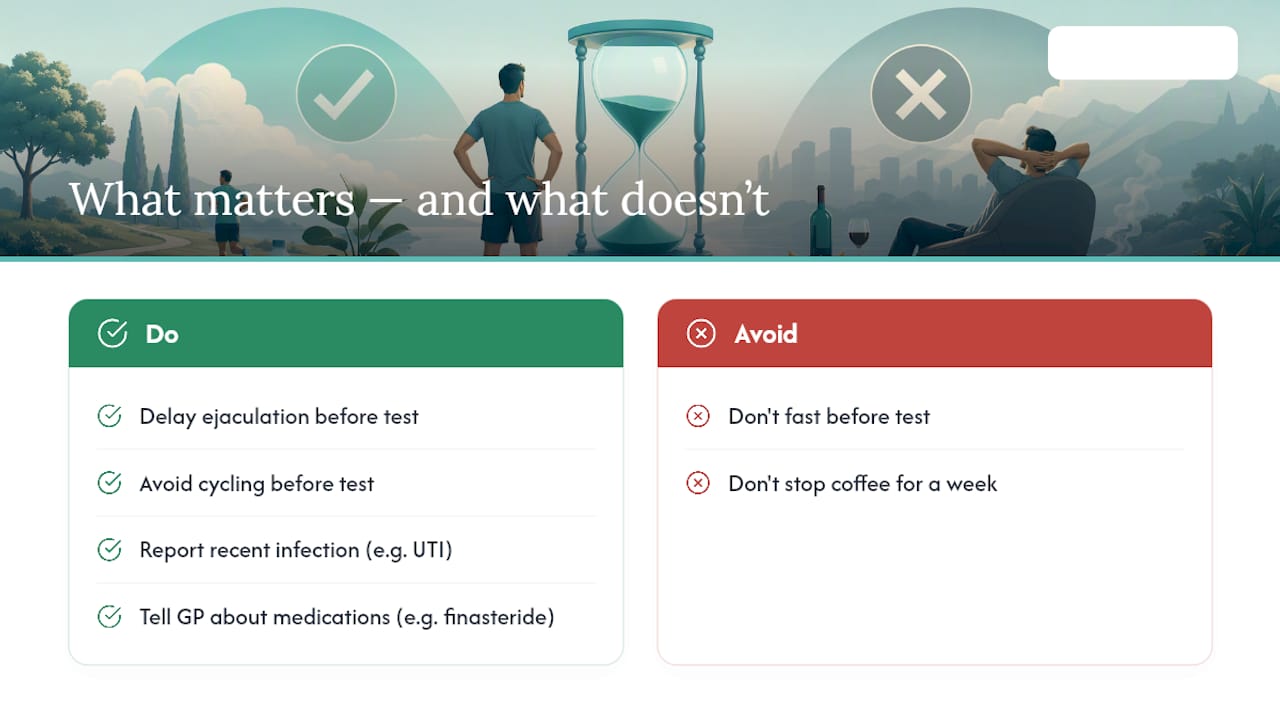
The gap I’d flag is around cycling specifically. Men are told about sexual activity fairly consistently, but the cycling rule gets treated as a footnote when it’s just as significant, especially for commuters who ride daily and have no reason to think a Tuesday morning test needs a Monday without the bike.
If you take one thing from this, prioritise the disclosure conversation. A result interpreted without knowing you’re on finasteride, or that you had a UTI three weeks ago, isn’t a wasted test exactly, but it’s a result your GP is reading with one hand tied behind their back.
— Jack
Get a faster read on your prostate health with Rapidtest
You can check your PSA level at home, in minutes, without booking time off work for a GP appointment you might keep putting off. The kit follows the same preparation rules covered in this article, and comes with clear step-by-step instructions.
It’s the right choice when you want a private, quick indicative reading, particularly if anxiety or awkwardness has been the reason you’ve delayed getting checked. It’s not the right choice if you’ve already had a raised result and need the trend-tracking and clinical judgement only a GP or urologist can provide. For a broader check, the Men’s 35+ Full Health MOT bundle covers PSA alongside other key markers in one order. Order the PSA RapidTest kit today and get a result at home in around 10 minutes, then take it straight to your GP if the reading gives you cause for concern.
Sources
For the official preparation rules, the NHS PSA test page is the primary reference and the source for the 48-hour and UTI guidance throughout this article. Prostate Cancer UK’s patient information on the PSA blood test explains what a raised result can mean and how clinicians approach interpretation. For a more clinical summary of how procedures and other factors affect PSA readings, the open-access review on PMC is worth reading in full.
This article is general information, not a substitute for advice from a qualified doctor. Consult a qualified healthcare professional about your own circumstances before acting on anything here.
FAQ
What should you not do before a PSA test?
Avoid ejaculation, anal sex, cycling and vigorous exercise for 48 hours beforehand, and don’t test within 4 to 6 weeks of a urinary tract infection or a recent prostate procedure.
Is it better to have a PSA test in the morning or afternoon?
There’s no strict rule requiring a morning appointment, but booking earlier in the day makes it easier to avoid vigorous activity, like a cycle commute, beforehand.
Can you drink water before a PSA test?
Yes. There’s no fasting requirement for a PSA test, so normal eating and drinking, including water, is fine right up to your appointment.
How can you lower your PSA before a test?
You can’t meaningfully lower PSA on demand, but you can avoid the things that artificially raise it, ejaculation, cycling, vigorous exercise and recent infection, so your result reflects your genuine baseline rather than a temporary spike.
Can an at-home PSA test replace a GP blood test?
No. An at-home rapid test like Rapidtest’s PSA kit is useful for quick screening, but any abnormal or borderline result should be followed up with your GP for a laboratory test and proper interpretation.