


10 minute PSA kits in the UK: why home results miss 3–4 ng/mL
Rapid at-home PSA kits fall well short of the reliability you get from a lab venous blood test, and both false positives and false negatives are genuinely possible. If your result comes back raised, or you’re worried about symptoms regardless of what the kit says, the safe next step is a lab-confirmed PSA test or a chat with your GP. The MHRA and Prostate Cancer UK both flag rapid kits as unreliable stand-alone indicators, not diagnostic tools.
TL;DR:
- Rapid lateral-flow PSA kits provide only a yes-or-no result and are prone to false positives and negatives, especially in borderline PSA ranges.
- Home collection kits offer quantitative results with lab analysis, which is more reliable for tracking PSA levels over time and informing medical decisions.
- A lab venous PSA test delivers a specific number that distinguishes between mild elevations and urgent concerns, unlike rapid tests that only indicate a raised or normal level.
- Proper test preparation, like avoiding ejaculation and strenuous activity for 24 to 48 hours beforehand, can improve the accuracy of at-home PSA readings.
- Any raised or unclear home result should be confirmed with a laboratory test and discussed with a healthcare professional for appropriate follow-up.
Table of Contents
- What is a home PSA test, and which type did you buy?
- How reliable are the numbers behind PSA home test accuracy claims?
- Why does a lab venous PSA test tell your doctor more?
- What usually goes wrong with an at-home PSA reading?
- What should you actually do with your result?
- How can you get a more reliable PSA result at home?
- How Rapidtest approaches PSA testing responsibly
- Why the accuracy debate misses the real point
- Take the more reliable route to checking your prostate health
- Sources
- FAQ
What is a home PSA test, and which type did you buy?
There are two very different products hiding under the same “home PSA test” label, and knowing which one you’ve got changes how much you should trust the result.
Rapid lateral-flow kits work a bit like a pregnancy test. You prick your finger, drop blood onto a strip, and wait for a line to appear. These are one-step immunoassays with a binary cut-off, usually set around 4.0 ng/mL. You either get “raised” or “not raised,” full stop. No number, no nuance. Results land in 10 to 15 minutes.
Home collection kits are the other route. You still prick your finger at home, but instead of reading a strip yourself, you post the capillary blood sample to an accredited laboratory. A lab technician then runs it through proper analysis and gives you an actual number in ng/mL, the same measurement your GP would see from a venous blood draw.
That distinction matters more than most people realise when they’re comparing options online, because the two formats aren’t interchangeable in terms of trustworthiness.
- Rapid lateral-flow kits: instant, binary result, typically £20 to £40, sold in pharmacies and online
- Home collection kits: sample posted to a lab, quantitative ng/mL result within a few days, generally £30 to £60
- Both are widely available through pharmacies, supermarkets, and online retailers without a prescription
If you’re weighing up your options, PSA levels by age in the UK gives useful context on what a numeric result should look like for your age bracket.
How reliable are the numbers behind PSA home test accuracy claims?
Sensitivity tells you how good a test is at correctly flagging a genuine problem. Specificity tells you how good it is at correctly clearing someone who doesn’t have one. A false positive is a raised reading in a man with a healthy prostate. A false negative is a normal reading that misses an actual problem. Predictive value then asks: given this particular result, how likely is it to be right for you? All four numbers move depending on where the cut-off is set and how carefully the test was read, which is exactly where rapid home kits run into trouble.
Statistic Callout: A validation study of a one-step PSA test published in BMC Urology recorded sensitivity of around 79.9% and specificity near 93% at the optimal reading time of 30 minutes. Read the same strip at 15 minutes and sensitivity drops sharply. Accuracy also weakened in the 3 to 4 ng/mL range, the exact zone where many borderline decisions get made.
That single detail explains a lot. A test that performs well at one reading time and poorly at another isn’t a stable diagnostic tool. It’s a tool that depends heavily on the person using it doing everything exactly right.
Real-world testing backs this up. A BBC investigation ran five rapid at-home PSA kits against the same blood sample. One kit failed outright. Three came back negative. One produced a false positive when the private lab result for that same sample was 0.27 µg/L, comfortably normal. Five kits, five different stories, one blood sample. The BBC’s report also cited the MHRA’s position directly: over-the-counter PSA kits “are not a reliable indicator of prostate cancer,” and manufacturers aren’t permitted to claim otherwise.
Prostate Cancer UK’s concern runs alongside this. Their commentary points out that a binary raised/not-raised result strips away everything a clinician would normally add: context, counselling, and a plan for what happens next. That absence is where both false reassurance and needless panic creep in.
- Sensitivity and specificity for rapid kits vary meaningfully with reading time and cut-off point
- Real-world testing found inconsistent results from identical blood samples across different kits
- Borderline PSA ranges (3 to 4 ng/mL) are where rapid kits are least trustworthy
Why does a lab venous PSA test tell your doctor more?
A lab result gives your GP an actual figure, not a yes or no. That number is what makes clinical decisions possible, because prostate-specific antigen behaves very differently depending on how high it climbs and how quickly.
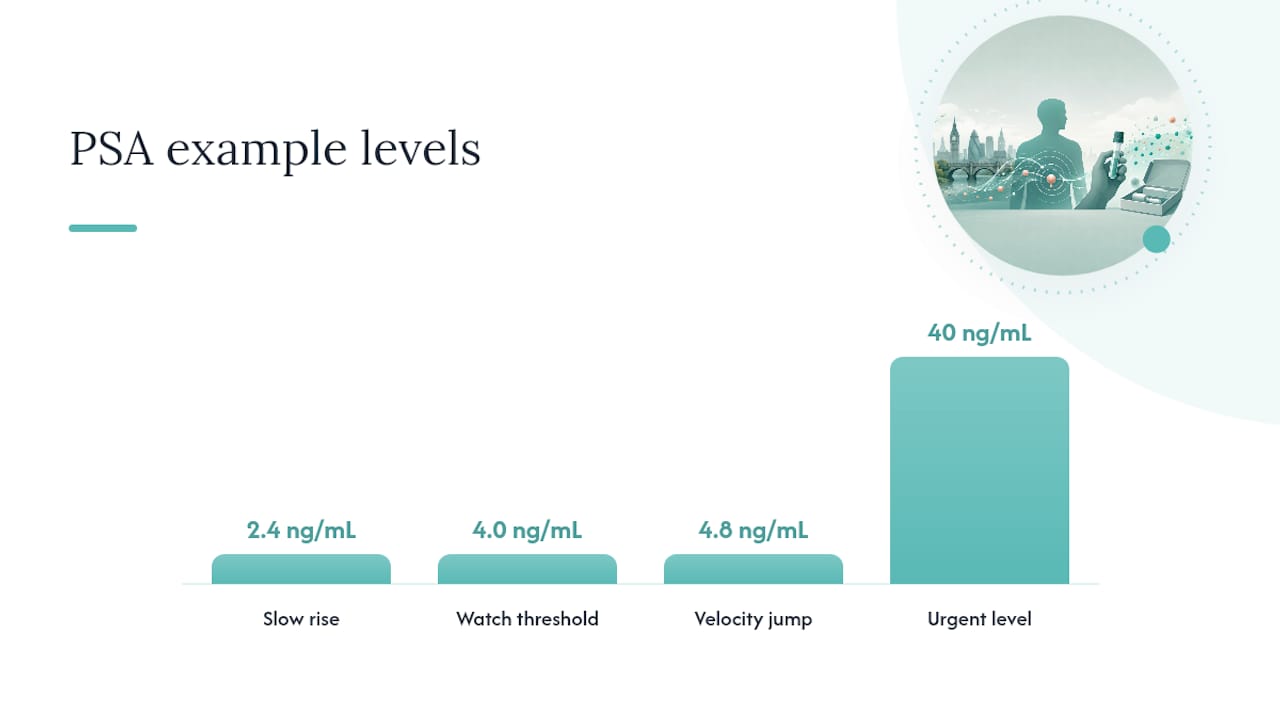
Consider the gap between two hypothetical results. A PSA of 4.0 ng/mL sits right at the conventional watch-and-wait threshold. It might prompt a repeat test in a few weeks, or a referral for further assessment. A PSA of 40 ng/mL, by contrast, points towards urgent investigation and a very different conversation with your GP. Rapid lateral-flow kits can’t distinguish between these two scenarios. Both would simply read as “raised.”
Clinicians also look at PSA velocity, meaning how much your level has changed over the past year rather than a single snapshot in time. A slow, steady climb from 2.1 to 2.4 ng/mL over twelve months tells a different story than a jump from 2.1 to 4.8 ng/mL in the same window, even though the starting point was identical.
- Absolute value: distinguishes mild elevation from a level demanding urgent referral
- PSA velocity: tracks change over time, catching trends a one-off reading misses
- Free-to-total PSA ratio: helps separate benign prostate enlargement from more concerning causes
- Repeat testing: confirms whether a raised result is a pattern or a one-off blip
None of this is available from a strip that only tells you “high” or “normal.” A checklist for PSA testing in men over 40 walks through how clinicians weigh these numbers alongside your age and family history, which is worth reading before you interpret any result on your own.
What usually goes wrong with an at-home PSA reading?
Most inaccurate home PSA results trace back to one of three causes, and only one of them is really the manufacturer’s fault.
- Collection errors. Lateral-flow kits need a precise blood volume. Too little on the strip, or reading the result outside the recommended window, skews the outcome in either direction. Reviews of home testing procedures point specifically to the multi-step process, lancet, pipette, reagent drop, as a weak link that professional phlebotomy simply doesn’t have.
- Biological interference. PSA rises temporarily after ejaculation, vigorous cycling, a recent prostate exam, catheterisation, or a urinary tract infection. Test within 48 hours of any of these and you risk a false positive that has nothing to do with prostate health.
- Fixed cut-offs. A rapid kit set at a single threshold can’t account for the fact that PSA rises naturally with age. What counts as raised for a 45 year old may be perfectly normal for a 70 year old, but the strip doesn’t know your birthday.
Pro Tip: Wait at least 48 hours after ejaculation, strenuous exercise, or any prostate examination before testing, and set a timer rather than trusting your memory for the reading window. Both cost nothing and remove two of the most common causes of a misleading result.
What should you actually do with your result?
A negative or “not raised” result feels reassuring, but the NHS is clear that PSA testing isn’t a definitive screen for prostate cancer. A normal reading lowers probability; it doesn’t eliminate it. If you have urinary symptoms, blood in urine or semen, or a family history of prostate cancer, see your GP regardless of what the strip showed.
A raised result needs a specific sequence, not panic:
- Book a lab venous PSA test to confirm the reading with an actual number
- Speak to your GP, who will usually want to repeat the test after a few weeks to rule out a temporary spike
- If the raised level persists, expect a conversation about further investigation, which may include an MRI scan and, in some cases, a biopsy
- Ask your GP to explain your specific number in context of your age, rather than treating “raised” as a single verdict
An unreadable or failed test (weak or missing line, error message) is not a result at all. Treat it as no test performed, and either repeat it correctly or move straight to a lab-based option.
The timeline from a raised home result to a firm answer typically spans several weeks, covering the repeat test, the GP appointment, and any imaging that follows. That waiting period is uncomfortable, but rushing to conclusions from a single strip is worse than a short delay for proper confirmation.
How can you get a more reliable PSA result at home?
A few habits close much of the gap between a home test and a lab result, whichever format you choose.
- Avoid ejaculation for 24 to 48 hours beforehand, along with vigorous exercise or cycling on the same day
- Test in the morning where possible, and avoid testing soon after a UTI, catheterisation, or prostate examination
- Where you have the choice, pick a home collection kit analysed by an accredited lab over an instant lateral-flow strip. You lose the 10 minute wait but gain an actual ng/mL figure your GP can act on
- Treat any rapid lateral-flow result as a starting point for a conversation, never as a final answer
Full preparation guidance, including exactly why the 24 to 48 hour window matters, is covered in avoiding ejaculation before a PSA test. A rapid kit still has a role as a first check for a man who’s been putting off any prostate screening at all. It’s simply not the tool for confirming a diagnosis.
How Rapidtest approaches PSA testing responsibly
Rapidtest’s PSA home test gives results in around 10 minutes from a simple finger-prick sample, designed as a first-line check rather than a replacement for clinical diagnosis. We publish the same preparation guidance referenced throughout this piece, avoiding ejaculation for 24 to 48 hours beforehand, checking for recent UTIs or procedures, because those details genuinely change outcomes.
We’re equally clear about limits. No rapid test, ours included, replaces a lab-confirmed venous PSA or a GP’s clinical judgement. Independent validation and proper follow-up matter more than any single reading. If your result comes back raised, our guidance is the same as the NHS’s: repeat it, and talk to your GP.
Why the accuracy debate misses the real point
The conventional advice on home PSA testing tends to split into two camps: enthusiasts who treat any test as better than no test, and sceptics who dismiss home kits entirely because a BBC crew got inconsistent readings from five strips. Both miss what the evidence actually supports.
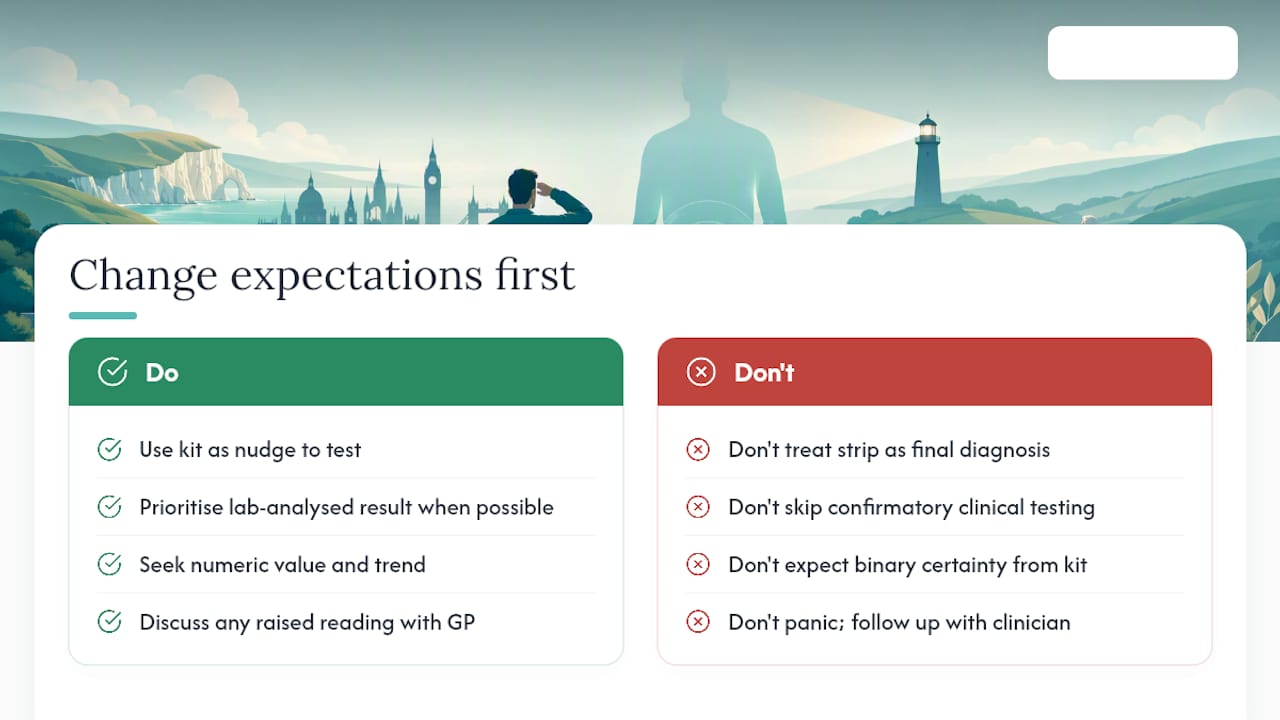
The real issue isn’t whether home testing has a place. It’s that rapid lateral-flow kits are being sold and used as if they answer a question they were never built to answer. A binary “raised or not” result invites a binary emotional reaction, relief or dread, when what a man actually needs is a number, a trend, and a clinician who can put both in context. That’s not a flaw you fix by reading the strip more carefully. It’s a structural limit of the format itself.
What should change first is expectation, not access. Use a rapid kit as a nudge to get properly tested, never as the final word. Prioritise a lab-analysed result whenever cost and access allow it, and treat any raised reading, however it was generated, as the start of a conversation with your GP rather than a diagnosis you carry around unconfirmed.
— Jack
Take the more reliable route to checking your prostate health
Rapidtest gives you a way to start that conversation without booking a GP appointment just to ask a question you might already suspect the answer to. Our PSA home test delivers results in around 10 minutes from a simple finger-prick sample, with clear instructions and no awkward waiting room chat required.
It suits men who want a private first check, particularly if prostate cancer runs in the family or you’re simply past the age where checking makes sense and haven’t got round to it. If you’re looking after your health more broadly, the Men’s 35+ Full Health MOT Bundle covers PSA alongside other key markers in one order. Whichever you choose, treat a raised result the way this article recommends: confirm it, then get it in front of your GP.
This article is general information, not a substitute for advice from a qualified doctor. Consult a qualified healthcare professional about your own circumstances before acting on anything here.
Sources
- Prostate cancer: Rapid at-home PSA tests spark concerns - BBC News
- The pros and cons of PSA self-test kits for prostate cancer | Prostate Cancer UK
- PSA test - NHS
FAQ
Why is the PSA test not routinely recommended for men over 70?
PSA levels rise naturally with age, and older men are more likely to have a raised reading caused by benign prostate enlargement rather than cancer, which increases the risk of unnecessary investigation for a slow-growing condition unlikely to affect life expectancy. Decisions at this age are usually made case by case with a GP, factoring in overall health and life expectancy rather than the PSA number alone.
Can you have a high PSA level without having prostate cancer?
Yes. A raised PSA is often caused by an enlarged prostate, prostatitis, a urinary infection, or even recent ejaculation or cycling, and the NHS confirms PSA is not a specific test for prostate cancer. That’s exactly why any raised home result needs a repeat lab test rather than immediate alarm.
What counts as an average PSA level for a 70 year old?
PSA reference ranges rise with age, and a level considered normal in your 70s would be flagged as raised in a much younger man. Our PSA levels by age guide sets out typical ranges by decade, though your GP will interpret your specific number alongside your health history.
Is there a better prostate cancer test than PSA?
No single test replaces PSA outright, but it’s rarely used alone in clinical practice. GPs combine it with a physical examination, and a raised result typically leads to an MRI scan and sometimes a biopsy for a fuller picture, rather than relying on the PSA figure in isolation.
Are rapid at-home PSA tests accurate enough to trust on their own?
No. Both the MHRA and BBC testing found rapid lateral-flow kits produce inconsistent results, including false positives and false negatives, so any raised or unclear reading should be confirmed with a lab venous PSA test rather than acted on alone.