


Under 2% Gap: When Blood or Oral HIV Tests Make a Difference
Blood-based HIV tests detect infection slightly earlier and edge out oral swabs on raw sensitivity, but the gap is small enough that both are considered highly reliable screening tools. Oral swabs win hands down on comfort and privacy, though they carry a slightly longer window period before results can be trusted. The practical rule: if you’re testing soon after a possible exposure, blood gives you a marginally earlier answer; if you’re testing routinely and want zero fuss, oral works well too.
TL;DR:
- Blood-based tests have slightly higher sensitivity, detecting about 99.7%, compared to 98% for oral swabs, which can lead to more false negatives especially early after exposure.
- Oral tests are more comfortable and private, increasing the likelihood that users will complete testing routine and at-home screening, despite a marginal sensitivity gap.
- The window period before reliable detection is longer for oral tests, often requiring 6 to 12 weeks, while blood tests can be dependable around 4 to 6 weeks post-exposure.
- Both test types primarily detect HIV antibodies; blood tests can also identify antigens and other infections, offering broader diagnostic information.
- Confirmatory laboratory testing remains essential after any reactive screening result, regardless of which specimen type was used.
Table of Contents
- Hiv oral vs blood: how the accuracy actually compares
- Window period and timing: when each test becomes reliable
- What each test actually measures
- Comfort, privacy and where people go wrong
- What to do if your result is reactive or inconclusive
- How Rapidtest approaches at-home HIV screening
- Why accuracy and access have to be weighed together
- Discreet, at-home HIV screening when you need answers now
- Sources
- FAQ
Hiv oral vs blood: how the accuracy actually compares
The numbers are closer than most people expect, but they still matter. A widely cited meta-analysis published in The Lancet pooled data across dozens of studies and found rapid oral antibody tests achieve a sensitivity of about 98%, compared with about 99.7% for blood-based rapid tests. Specificity for both methods sits at a similarly high level, meaning false positives are rare with either.
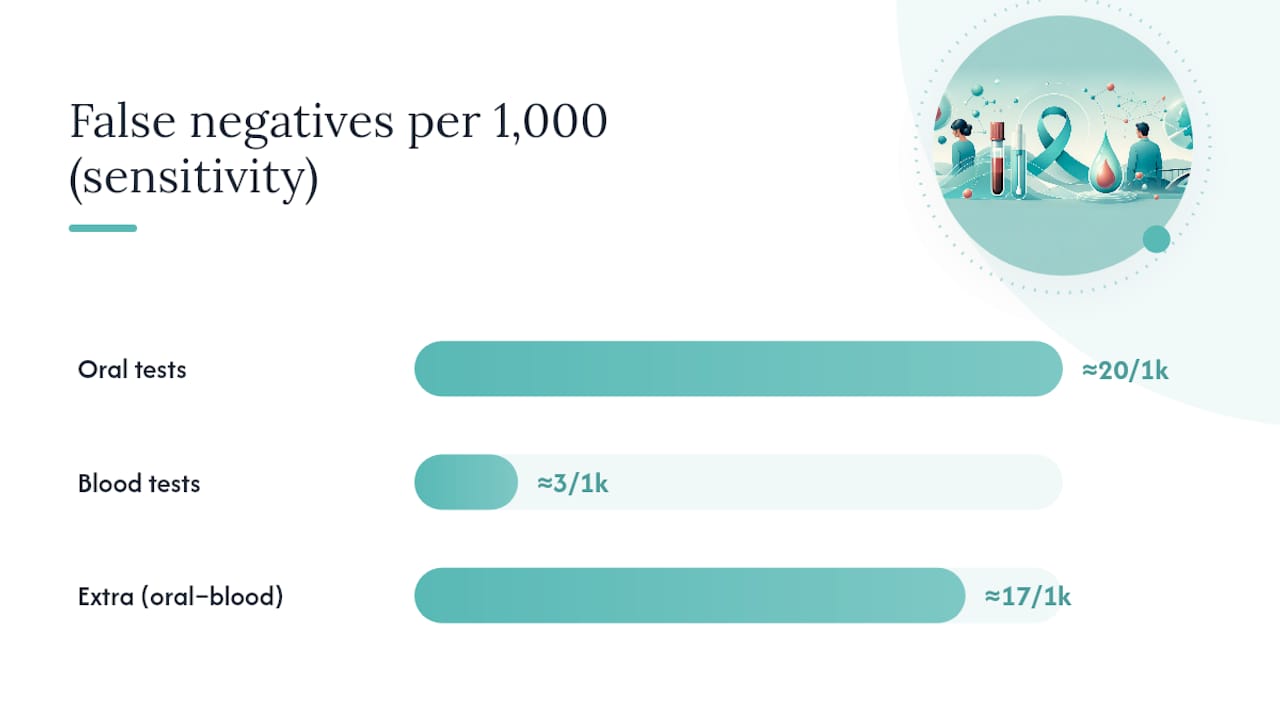
What does a 1 to 2 percentage point sensitivity gap mean in practice? It means that, out of every 1,000 people with HIV tested using an oral swab, roughly 10 to 20 more false negatives could occur than with a blood test under the same conditions. That sounds alarming until you factor in prevalence. In low-prevalence populations, most reactive results (from either test) still need confirmation, and most negative results (from either test) are genuinely negative. The gap becomes more meaningful in high-risk groups or shortly after a suspected exposure, where every extra day of sensitivity counts.
A newer cross-sectional study on blood-based versus oral-fluid self-testing reinforces this pattern: blood-based self-tests continue to edge out oral-fluid tests on both sensitivity and specificity, though the study’s authors stress that both are accurate enough for screening when used correctly and followed by proper confirmatory testing.
Here’s the trade-off in plain terms:
- Blood-based rapid tests: marginally higher sensitivity (99.68%), better at catching very early infections, requires a fingerprick or venous draw.
- Oral swab rapid tests: slightly lower sensitivity (98.03%), no needles, samples oral mucosal transudate rather than blood.
- Both methods: high specificity, both are screening tools, both need confirmatory testing after a reactive result.
Statistic to remember: the sensitivity difference between the two methods is under 2 percentage points, but it can shift meaningfully depending on how early after exposure you test and how the sample was collected.
For most people testing outside the immediate aftermath of a specific exposure, this accuracy gap is not the deciding factor. Convenience, privacy, and whether you’ll actually go through with the test tend to matter more for overall public health outcomes than a fraction of a percentage point in a lab study.
Window period and timing: when each test becomes reliable
The “window period” is the stretch of time between exposure and the point where a test can reliably detect infection. It exists because your body needs time to build up enough antibodies (or, for some lab assays, detectable antigen) for a test to pick them up. Test too early, and a negative result doesn’t mean much.
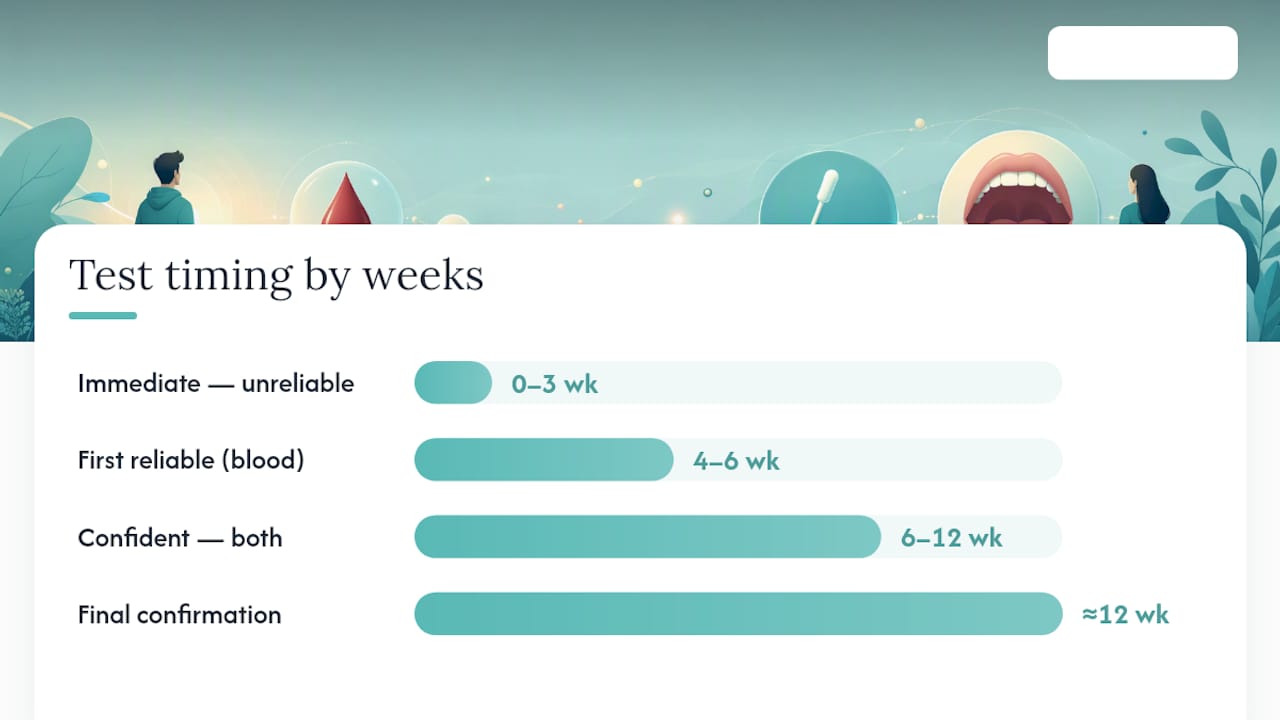
Antibody-based tests, whether oral or blood, generally become reliable somewhere between 23 and 90 days after exposure, though the exact figure depends on the individual and the specific test. Oral tests often need longer than blood tests to give a trustworthy negative result, because oral mucosal transudate carries far lower antibody concentrations than blood, sometimes hundreds of times lower according to the NCBI Bookshelf on HIV testing.
Here’s a practical timing sequence worth following:
- Immediate screening (0 to 3 weeks post-exposure): Testing now is possible but unreliable with antibody-only tests, whether oral or blood. If you’ve had a recent high-risk exposure, ask about PEP (post-exposure prophylaxis) rather than relying on a same-week test result.
- First reliable checkpoint (around 4 to 6 weeks): A blood-based rapid test can start giving meaningful results here, though it may still miss very recent infections.
- Confident window (6 to 12 weeks): Both oral and blood antibody tests are considerably more trustworthy by this point.
- Final confirmation (90 days): Public-health guidance generally treats a negative result at this stage as conclusive for most people, barring further exposure.
If you’re testing after a specific incident rather than for routine screening, our guide on when to test after unprotected sex walks through the timing in more detail.
What each test actually measures
Oral and blood tests aren’t just different in how they feel to take. They measure different biological signals, and that’s the real reason accuracy varies between them.
Oral tests sample oral mucosal transudate, a fluid drawn from the gum line rather than saliva itself, which contains HIV antibodies at concentrations roughly 800 to 1,000 times lower than in blood serum. That’s the entire explanation for the sensitivity gap: there’s simply less antibody material to detect.
Common specimen types you’ll encounter include:
- Fingerprick whole blood: used in most at-home rapid antibody tests; quick, minimally invasive, and widely available.
- Venous blood draw: used for lab-based confirmatory testing and fourth-generation antigen/antibody assays, which can detect infection earlier than antibody-only tests.
- Oral swab: samples oral mucosal transudate; completely non-invasive but limited to antibody detection.
Blood also opens the door to more than a single yes/no answer. A venous sample can be run through additional confirmatory assays, screened for coinfections such as Hepatitis B or C, or processed with a combined antigen/antibody test that catches infection before antibodies have fully developed. Oral swabs are antibody-only by design, which keeps them simple but limits what a single sample can tell you.
Comfort, privacy and where people go wrong
Accuracy is only half the story. A test that’s marginally more sensitive but that someone avoids because it involves a needle isn’t actually helping anyone. Acceptability research backs this up: participants consistently prefer oral swabs over blood-based testing because they’re non-invasive and private, even in scenarios where a blood test might be marginally quicker.
That preference matters for real-world outcomes. A test that people are willing to take, and take correctly, beats a marginally more accurate test that gets skipped or botched.
Common user errors differ by test type. Fingerprick blood kits often fail because of an insufficient sample, either too little blood collected or blood applied incorrectly to the test strip. Oral swabs tend to go wrong through poor technique: swabbing too quickly, not covering the full gum line, or eating, drinking, or brushing teeth too close to the test.
- Fingerprick kits: main risk is an inadequate blood sample or premature reading.
- Oral swabs: main risk is incomplete gum-line coverage or contamination from food or drink.
- Community outreach and self-testing programmes often favour oral kits precisely because they’re easier to self-administer correctly on the first attempt.
- Clinics and settings needing early or confirmatory detection tend to favour blood-based methods.
Pro Tip: Whichever test you choose, read the full instructions before you open the kit, not while you’re mid-test. Most invalid results come from rushing the swab or sample step, not from a fault with the kit itself.
What to do if your result is reactive or inconclusive
A reactive result on an at-home test is not a diagnosis. Every rapid oral or blood test, however accurate, is a screening tool, and a reactive result must be confirmed with a laboratory blood test before anyone can say for certain whether you have HIV.
Here’s what that path looks like in practice:
- Avoid further risk behaviour until you’ve had confirmatory testing, purely as a precaution while the result is unconfirmed.
- Book a confirmatory venous blood test through a GP, sexual health clinic, or the NHS, which can also run additional tests if needed.
- Ask about counselling and clinical linkage, most clinics offer support alongside testing, whatever the eventual result turns out to be.
- Expect a short wait for lab results, typically a matter of days rather than minutes, since lab assays involve more thorough processing than a rapid test.
Our guide on how to test for HIV at home covers how to read a rapid result correctly and what steps to take immediately afterwards.
How Rapidtest approaches at-home HIV screening
Rapidtest supplies at-home rapid testing kits, including HIV screening tests that deliver results in about 15 minutes, with full instructions and discreet packaging, so people can screen privately without booking a GP appointment or sitting in a clinic waiting room.
We’re clear about where that fits in the bigger picture: a rapid kit is a screening tool, not a diagnostic one. A reactive result always needs confirmation through a laboratory blood test, and we point customers towards that next step rather than leaving them guessing. For a fuller explanation of how rapid testing works and its limits, see what HIV rapid testing actually involves.
Why accuracy and access have to be weighed together
Public health doesn’t improve because one test scores 1.6 percentage points higher on a sensitivity chart in a lab study. It improves when more people actually test, and test at the right time. The evidence-led answer to hiv oral vs blood is that blood-based tests are marginally more sensitive, but that fact only matters if the person in question is willing to take the test at all. Confirmatory testing after any reactive result isn’t optional, whichever specimen type led you there, and if you’re unsure which route fits your situation, ask a clinic or sexual health service directly.
— Jack
Discreet, at-home HIV screening when you need answers now
Rapidtest gives you a private alternative to booking a clinic appointment: order online, test at home with results in around 15 minutes, and skip the waiting room entirely.  Our at-home STI and HIV testing kits are designed for straightforward self-collection, whether you’d rather use a blood-based fingerprick sample or need a broader panel that covers other infections at the same time. Every kit comes with clear instructions and discreet packaging, so there’s no awkward pharmacy conversation and no lab drop-off.
Keep in mind that, like any rapid screening test, results from a Rapidtest kit are preliminary. A reactive result needs confirmation through a laboratory blood test before anything is treated as a diagnosis. If you’ve had a recent exposure or simply want routine peace of mind, browse the full range of health screening kits and order the one that matches your situation.
This article is general information, not a substitute for advice from a qualified doctor. Consult a qualified healthcare professional about your own circumstances before acting on anything here.
Sources
- Accuracy of rapid HIV tests: meta-analysis (The Lancet 2012)
- What is the window period for HIV testing? (AIDSmap)
- Fingerprick versus oral swab: acceptability study (PMC)
- HIV testing and screening (NCBI Bookshelf)
- HIV and AIDS (NHS)
FAQ
Does your blood look different if you have HIV?
No, blood doesn’t change colour or appearance with HIV. The virus is detected through laboratory analysis of antibodies or antigens in a blood sample, not through anything visible to the naked eye.
Can you detect HIV in 7 days?
Testing too soon after exposure is generally unreliable with either oral or blood antibody tests, since the window period typically runs from about 23 to 90 days. If you’ve had a recent high-risk exposure, ask a clinic about PEP and plan a follow-up test at the appropriate interval rather than relying on a very early result.
How do I know if I have oral HIV symptoms?
There’s no distinct “oral HIV” condition separate from HIV itself. An oral swab test simply uses a different sample type (oral mucosal transudate) to detect the same infection that a blood test detects, and any symptoms of HIV are systemic, not confined to the mouth.
Can HIV test results change after 20 minutes?
Rapid tests, whether oral or blood-based, are designed to be read within a specific time window, typically around 15 to 20 minutes. Reading a result too early or well after the stated window can produce an inaccurate reading, so always follow the timing given in the kit’s instructions exactly.