


When should you take an HIV test after PEP?
The definitive answer: test no sooner than 45 days after finishing your 28-day PEP course, which corresponds to a bit over 10 weeks after your exposure. If your exposure was sexual, many clinics push this to a post-exposure test around three months so it lines up with syphilis screening. Testing any earlier risks a false negative, because the drugs are still working through your system.
Your one job right now: book that follow-up test. Whether that’s back at the clinic where you started PEP or a discreet kit ordered to your door, get it in the diary today. And hang onto your baseline result. You’ll need it for comparison.
- Baseline test: taken at or before you started PEP
- Earliest reliable test: 45 days after completing PEP (around day 73 post-exposure)
- Final check: 12 weeks after exposure, especially for sexual exposures (BASHH guidance)
Key Takeaways
A reliable HIV test after PEP requires waiting at least 45 days from completing treatment, or 12 weeks from exposure for sexual contact, using a fourth-generation Ag/Ab test or NAT where possible.
| Point | Details |
|---|---|
| Minimum wait after PEP | Test no earlier than 45 days after finishing your 28-day PEP course. |
| Align with 12 weeks for sexual exposure | Many clinics recommend a final check at 12 weeks post-exposure to match syphilis screening. |
| Choose the right test | Ask for a fourth-generation Ag/Ab test, or a NAT where available, for the most reliable early result. |
| Missed doses change the plan | Contact your clinic immediately if you missed doses; your testing schedule may shift earlier. |
| Use Rapidtest between checkpoints | Rapidtest’s at-home HIV kit offers discreet 15-minute screening alongside your guideline-based clinic tests. |
This article is general information, not a substitute for advice from a qualified doctor. Consult a qualified healthcare professional about your own circumstances before acting on anything here.
Table of Contents
- Why PEP changes your HIV testing timeline
- Which HIV tests work after PEP, and which don’t?
- What’s the recommended testing schedule after PEP?
- Can you test for HIV while still taking PEP?
- What if you missed doses or stopped PEP early?
- What happens if your post-PEP test comes back reactive?
- Clinic testing or an at-home kit: which should you choose?
- What should you do after your final HIV test?
- Sources
- FAQ
Why PEP changes your HIV testing timeline
PEP is a 28-day course of antiretroviral drugs (ARVs) taken after a possible HIV exposure, usually started within 72 hours and ideally within 24. It works by stopping the virus establishing itself in your body during that early window.
Here’s the catch. Those same drugs can suppress viral replication and delay the antibody response your immune system would normally produce, which throws off how HIV tests read your blood in the weeks that follow. Research on antiretroviral exposure confirms that a baseline test at the start of PEP cannot rule out an infection from the exposure you’re currently worried about, only a prior one.
Think of it as a chain: exposure, then PEP, then a washout period while the drugs clear your system, then finally a test you can trust.
- Exposure happens
- PEP suppresses viral activity for 28 days
- Drugs washout over the following weeks
- Only then does a test give you a reliable answer
Which HIV tests work after PEP, and which don’t?
Not every HIV test behaves the same way once ARVs have been in your system. Here’s how the three main types stack up.
- Antibody-only tests rely on your immune system producing detectable antibodies, which PEP can delay. These are the least reliable option in the weeks right after treatment.
- Fourth-generation antigen/antibody (Ag/Ab) tests detect both antibodies and the p24 antigen, giving a shorter window than antibody-only tests. This is the standard test most UK clinics use for follow-up.
- HIV RNA (NAT/PCR) tests detect the virus’s genetic material directly, often catching infection earlier than antibody-based tests. The CDC’s 2025 guidance notes that NATs are particularly useful for people who’ve recently taken ARVs, since they don’t depend on an antibody response at all.
Pro Tip: If you’re anxious about waiting the full 45 days, ask your clinic whether a diagnostic NAT is available. It won’t replace your final scheduled test, but it can shorten the uncertainty if you’re struggling to sit with it. Access varies by clinic, so this isn’t guaranteed everywhere.
What’s the recommended testing schedule after PEP?
Guidelines from the UK and internationally agree on the broad shape of this timeline, even if the exact wording differs slightly.
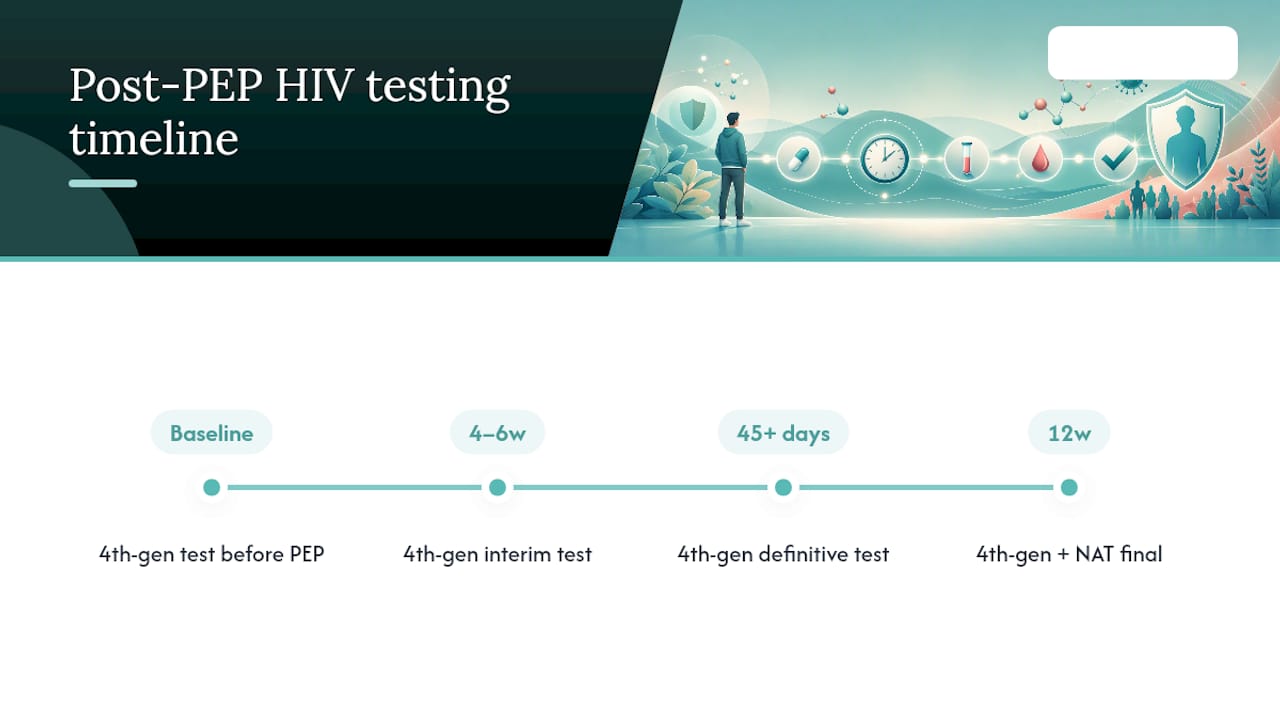
Baseline test, taken at or before you start PEP, checks whether you already had HIV before this exposure. A non-reactive baseline doesn’t clear you of the current exposure. It just rules out a pre-existing infection.
First follow-up, around 4 to 6 weeks after exposure, is sometimes offered as an interim check, particularly for occupational exposures where BHIVA’s guidance notes occupational health teams often coordinate testing to fit workplace reporting needs.
Definitive test, at a minimum of 45 days after completing your 28-day PEP course, is the point BASHH considers reliable enough to trust. WHO guidance similarly points to testing around 4 and 12 weeks depending on the exposure type.
Final check, at 12 weeks post-exposure, is standard for sexual exposures, aligning with syphilis screening and offering maximum reassurance according to patient-facing guidance from i-Base.
Ask for a fourth-generation Ag/Ab test at each stage, and a NAT where available at your final check for the earliest, most confident result.
Can you test for HIV while still taking PEP?
Not usefully, no. A rapid test taken during your PEP course, or in the days right after finishing it, is checking whether you already had HIV, not whether the current exposure has been ruled out.
Here’s what testing during PEP can and can’t tell you:
- Can do: confirm you weren’t already living with HIV before this exposure (your baseline)
- Can do: support routine clinical monitoring if your clinic requests it
- Cannot do: give a definitive answer about the recent exposure while ARVs are still active in your system
- Cannot do: replace the 45-day post-PEP or 12-week post-exposure test
If you develop symptoms like fever, rash, sore throat or fatigue during or after PEP, these can occasionally signal acute HIV infection and warrant urgent reassessment rather than waiting for your scheduled test.
What if you missed doses or stopped PEP early?
Missing doses doesn’t mean you’ve failed, but it does mean your timeline needs a second look. Here’s what to do.
- Contact your clinic or occupational health service straight away and tell them exactly what you missed and when.
- Continue the remaining course if you’re advised to, rather than stopping altogether.
- Write down which doses you missed and roughly when, so your clinician has the full picture.
- Expect your follow-up testing schedule to shift, since incomplete adherence may mean earlier interim tests are recommended alongside your final check.
Your clinician will tailor the plan from there. There’s no universal fix for a missed dose, only a conversation with someone who can see your specific case.
What happens if your post-PEP test comes back reactive?
A reactive result isn’t a diagnosis. It’s a prompt for confirmation, and the process from here is well established.
- Don’t assume the worst. A reactive screening result needs confirmatory lab testing before anything is certain.
- Ask for antibody differentiation testing and an HIV RNA test to confirm or rule out the initial result.
- Your baseline may be repeated to build a fuller clinical picture.
- Contact your clinic promptly so you’re linked into HIV specialist care without delay.
Depending on specialist advice, PEP may continue or HIV treatment may begin, and either path is managed as a matter of routine clinical practice, not emergency guesswork. If you need someone to talk to while you wait for confirmation, most sexual health clinics offer same-day emotional support, and national helplines exist specifically for this moment. Swift confirmation and swift care go hand in hand. That’s the whole point of testing on schedule.
Clinic testing or an at-home kit: which should you choose?
Both routes get you to the same guideline-based checkpoints, but they suit different situations.
Clinic testing gives you access to laboratory-grade Ag/Ab tests, NAT where available, and an immediate confirmatory pathway if a result comes back reactive. It’s the strongest option for your definitive 45-day or 12-week check, particularly if you want everything handled in one place.
At-home rapid tests suit the reader who wants privacy, speed, or simply doesn’t want another clinic visit. WHO guidance on testing strategies for PEP explicitly supports self-testing as part of a legitimate follow-up strategy, not just a stopgap. Rapidtest’s at-home HIV testing kit delivers a result in 15 minutes with no clinic visit and no queue, which makes it a genuinely useful screening option between clinic checkpoints, or for your own peace of mind ahead of your scheduled test.

Before you buy any kit, check three things: the sample type it uses, what window it claims to detect from, and whether it tells you clearly what to do next if the result is reactive.
Pro Tip: Use an at-home kit for reassurance between checkpoints, but treat your 45-day or 12-week guideline test as non-negotiable. A home screen is a good early signal, not a replacement for the definitive check your clinic recommends.
What should you do after your final HIV test?
If your final result comes back negative, this is a good moment to talk to your clinic about ongoing prevention, including condoms, safer practices around injecting drug use, and whether PrEP makes sense if you’re likely to face further exposures.
If your result is positive, the linkage-to-care pathway outlined earlier applies, alongside support around partner notification, which your clinic will guide you through sensitively.
Either way, don’t let this become a one-off conversation. Hiv flags the post-PEP follow-up as a natural point to discuss transitioning onto PrEP if your risk of exposure hasn’t gone away.
Why the follow-up test matters even when you did everything right
Perfect adherence to PEP doesn’t earn you an exemption from testing. BASHH is blunt about this: the scheduled test is standard practice, full stop, not a formality for people who missed doses. I understand the urge to assume you’re fine and skip it. But the whole value of this system is that it removes guesswork from something too important to guess about. Use the follow-up window well. It’s also a natural point to ask about PrEP if this exposure wasn’t a one-off.
How Rapidtest fits into your post-PEP testing plan
Waiting weeks for a definitive answer is genuinely hard, and you shouldn’t have to sit with that alone or make a special trip just to feel less anxious in the meantime. Rapidtest’s at-home HIV test kit gives you a private result in 15 minutes, right from your own home, no clinic queue and no awkward conversation required.
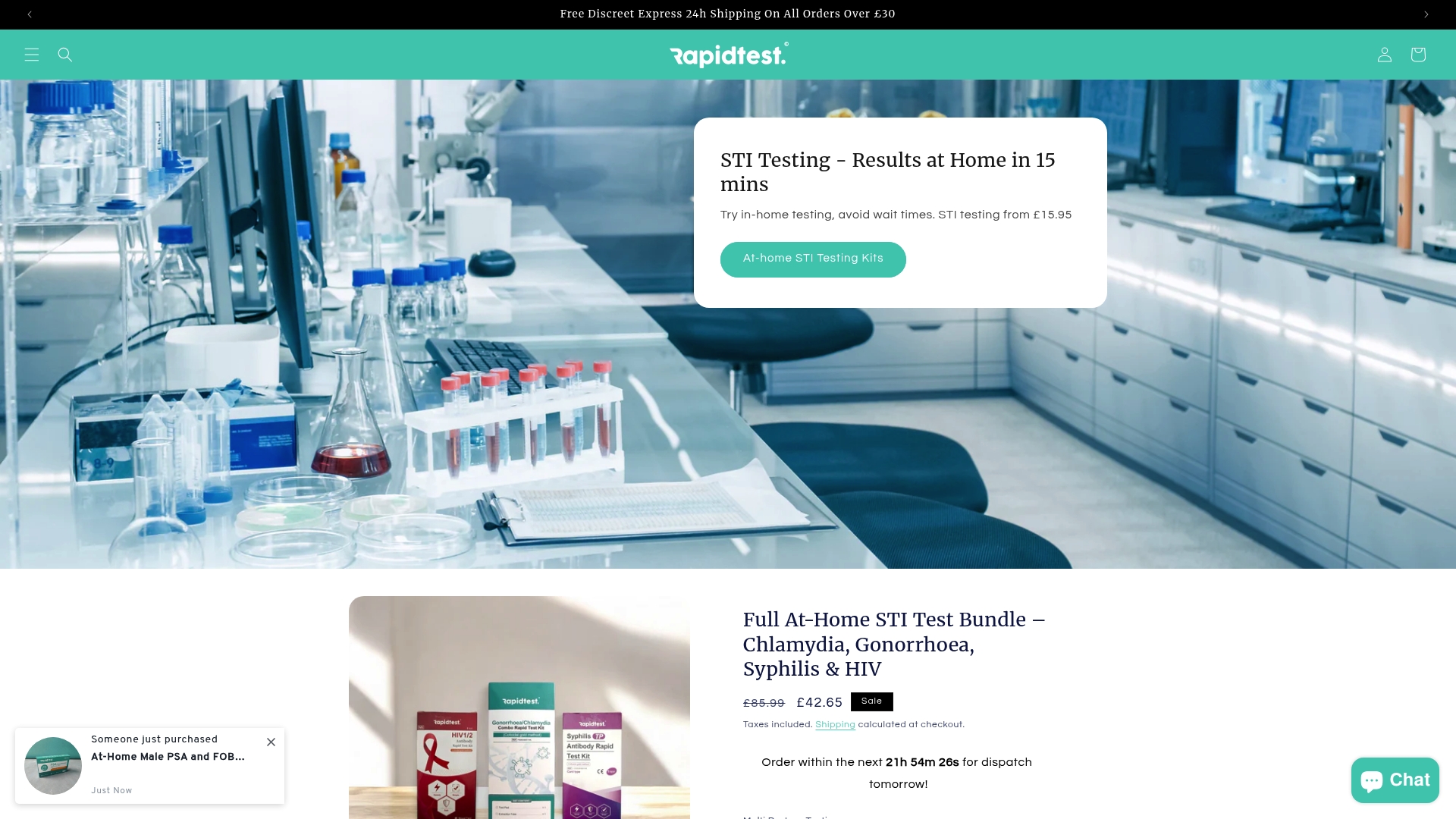
It’s designed as a screening tool to use between your guideline checkpoints, not a replacement for the definitive test your clinic recommends at 45 days or 12 weeks. Order it discreetly, packaging gives nothing away, follow the included instructions, and if your result is ever reactive, get straight onto confirmatory testing with your clinic. If you’d rather cover more ground in one order, the at-home STI testing kits let you screen for several conditions alongside HIV in a single discreet delivery. Order today and you’ll have a result before your kettle’s cold.
Sources
- After completion of a PEP course - Right Decisions
- WHO consolidated guidance on PEP (WHO)
- CDC MMWR — Antiretroviral postexposure prophylaxis (2025)
- BHIVA — PEP guidelines
- Hiv
FAQ
When can I take an HIV test after PEP?
The earliest reliable test is 45 days after completing your 28-day PEP course, roughly 73 days after exposure, with many clinics recommending a final check at 12 weeks for sexual exposures.
How long do I need to wait to test after taking PEP?
At least 45 days from your last PEP dose, though testing at 12 weeks post-exposure gives the most complete reassurance, particularly after a sexual exposure.
Can I still get HIV if I take PEP?
PEP significantly lowers the risk when started promptly and taken as directed, but it isn’t guaranteed protection, which is exactly why the follow-up test at 45 days or 12 weeks matters.
Can I get an HIV test immediately after exposure?
You can, but a test taken immediately only checks for pre-existing infection as a baseline. It can’t rule out the recent exposure, since antibodies and viral markers take time to develop and PEP can delay them further.
Can I use an at-home kit instead of a clinic test?
An at-home kit like Rapidtest’s HIV kit works well for screening between checkpoints, but your definitive 45-day or 12-week test is best done through a clinic pathway that includes confirmatory testing if needed.