


Hepatitis C test accuracy: what the evidence really shows
Hepatitis C antibody tests are remarkably reliable. Pooled data from systematic reviews and meta-analyses put sensitivity at roughly 97 to 98% and specificity at 99 to 100%, whether you’re looking at a laboratory EIA or a finger-prick rapid diagnostic test (RDT). That means the vast majority of people with hepatitis C exposure will get a reactive result, and the vast majority of people without it will get a clear negative.
Here’s the bit that trips people up, though. A reactive antibody result doesn’t mean you have hepatitis C right now. It means your immune system has met the virus at some point. Antibodies can linger for years after an infection has cleared on its own or been successfully treated. So a positive antibody test is really the start of the conversation, not the end of it. It needs an HCV RNA test to confirm whether the virus is still active in your blood.
You’ll come across three main types of test: laboratory enzyme immunoassays (EIAs), which take hours to days and are run on venous blood; point-of-care RDTs, which use a finger-prick sample and give a result in around 20 minutes; and oral-fluid self-tests, which you can do entirely at home in a similar timeframe. All three sit in a similar accuracy bracket when used correctly.
- Sensitivity (pooled): approximately 97 to 98% across antibody test types
- Specificity (pooled): approximately 99 to 100% across antibody test types
- Confirmatory step: any reactive result needs HCV RNA testing before a diagnosis of current infection is made
Pro Tip: Think of the antibody test as the smoke detector and the RNA test as checking whether there’s actually a fire. One flags a signal worth investigating. The other tells you what’s really going on.
Key Takeaways
| Point | Details |
|---|---|
| Pooled accuracy is high | Sensitivity sits around 97 to 98% and specificity around 99 to 100% across lab and rapid antibody tests. |
| Reactive doesn’t mean infected | A positive antibody result shows exposure only; HCV RNA testing confirms whether the virus is currently active. |
| Prevalence changes what a result means | Positive predictive value swings from around 49% in low-prevalence screening to around 96% in higher-risk groups. |
| Timing affects reliability | Antibodies typically appear within eight to twelve weeks of exposure; testing too early risks a false negative. |
| Rapidtest supports the full pathway | Rapidtest’s at-home Hep C antibody kit gives results in minutes and points you towards RNA confirmation if reactive. |
Table of Contents
- How accurate is a hepatitis C test, really?
- Does the sample type change hepatitis C test reliability?
- When can a hepatitis C test give a false negative?
- What causes false positives and false negatives?
- I tested positive for hepatitis C antibodies. What now?
- How reliable are at-home hepatitis C self-tests?
- Why do experts trust these accuracy figures?
- How Rapidtest thinks about accurate Hep C testing
- Ready to check your hepatitis C status privately?
- Sources
- FAQ
How accurate is a hepatitis C test, really?
Sensitivity and specificity are the two numbers that decide whether you can trust a result, and they measure different things entirely. Sensitivity tells you how good a test is at correctly flagging people who genuinely have hepatitis C antibodies. Specificity tells you how good it is at correctly clearing people who don’t.
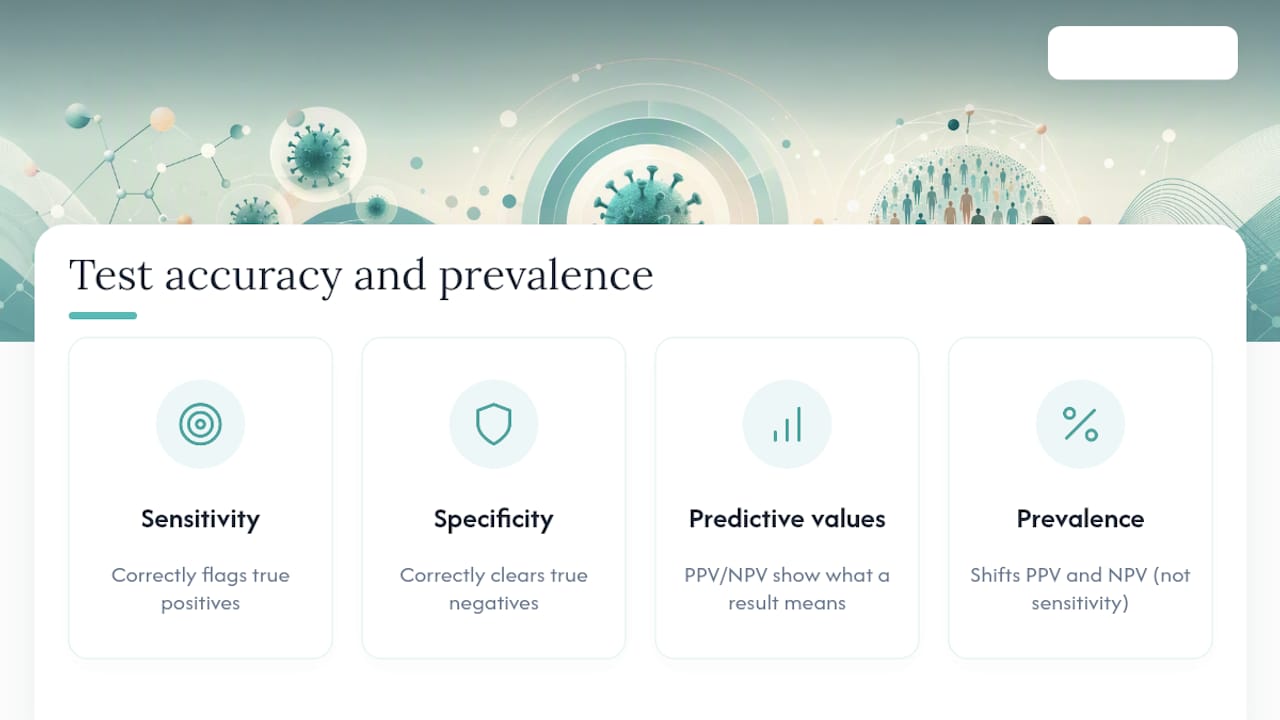
Neither number, on its own, tells you what a positive or negative result means for you. That’s where predictive values come in, and this is the part most testing guides skip over.
Positive predictive value (PPV) is the probability that someone who tests positive actually has the condition. Negative predictive value (NPV) is the probability that someone who tests negative genuinely doesn’t. Both shift depending on how common hepatitis C is in the group you belong to, known as pre-test probability or prevalence. This is a genuinely counterintuitive point: the test’s sensitivity and specificity don’t change, but what a result means changes enormously depending on who’s being tested.
Worked example one: general population screening
Imagine hepatitis C prevalence in a general low-risk population sits around 0.5%. Using a test with 98% sensitivity and 99.5% specificity:
- Out of 10,000 people tested, roughly 50 genuinely have hepatitis C antibodies.
- The test correctly flags about 49 of them (98% sensitivity) and misses 1.
- Of the 9,950 people without antibodies, 99.5% specificity means around 50 get a false positive.
- So of roughly 99 total positive results, only about 49 are true positives. That’s a PPV of around 49%.
That’s not a flaw in the test. It’s basic probability at work in a low-prevalence setting, and it’s exactly why every reactive result gets followed by RNA confirmation rather than treated as a diagnosis on the spot.
Worked example two: higher-risk group
Now take a clinical referral cohort, or people who inject drugs, where prevalence might run at 10%. Same test, same sensitivity and specificity:
- Out of 10,000 people, 1,000 genuinely have antibodies.
- The test correctly identifies about 980 of them.
- Of the 9,000 without antibodies, roughly 45 get a false positive.
- PPV jumps to around 96%, because there are so many more true positives relative to the small number of false ones.
| Scenario | Prevalence | Approx. PPV | Approx. NPV |
|---|---|---|---|
| General population screening | ~0.5% | ~49% | 99 to 100% |
| Higher-risk / clinical referral cohort | ~10% | ~96% | 99 to 100% |
Negative predictive value barely moves between these two scenarios, and that’s the reassuring part. Because sensitivity is so high, a negative result stays highly trustworthy across almost any prevalence level you’re likely to fall into, provided you’re outside the window period (more on that shortly).
Likelihood ratios explain the mechanics behind this. Meta-analytic data on point-of-care tests confirms this pattern holds across most commercially used RDTs, which is exactly why they remain suitable as a first-line screening tool even in low-prevalence settings, as long as confirmatory testing follows.
Does the sample type change hepatitis C test reliability?
Yes, and the differences are worth understanding before you choose how to test. Pooled data across test classes tells a fairly consistent story, but specimen type introduces real variation underneath the headline numbers.
- Laboratory EIA (serum/plasma): the reference standard most other tests are measured against, generally sitting at the top end of the sensitivity range.
- Point-of-care RDT (finger-prick whole blood): pooled sensitivity around 97.4%, specificity around 99.5%, though with notable heterogeneity between individual brands.
- Oral-fluid self-tests: field evaluations of tests like OraQuick report sensitivity around 97 to 98% and specificity around 99 to 100%, with results in 20 to 40 minutes.
Whole blood from a finger-prick can behave differently to venous plasma in the lab, and this is one of the more overlooked findings in the evidence base. A multicentre prospective study found sensitivity for some rapid antibody assays dropped to around 86 to 91% in whole blood samples, compared with 97 to 98% in matched plasma or serum from the same people. Sensitivity tended to recover in samples where viral load was detectable, which suggests the gap is partly about antibody concentration rather than a fundamental problem with finger-prick testing itself.
Why the gap at all? A few practical reasons. Whole blood contains cellular material that can interfere with the reaction on a lateral flow strip in a way plasma doesn’t. Sample volume matters too. Finger-pricks are less forgiving than a venous draw, and if you don’t get quite enough blood into the device, or squeeze too hard and dilute it with tissue fluid, the result can skew. User technique plays a genuine role here, not just the biology.
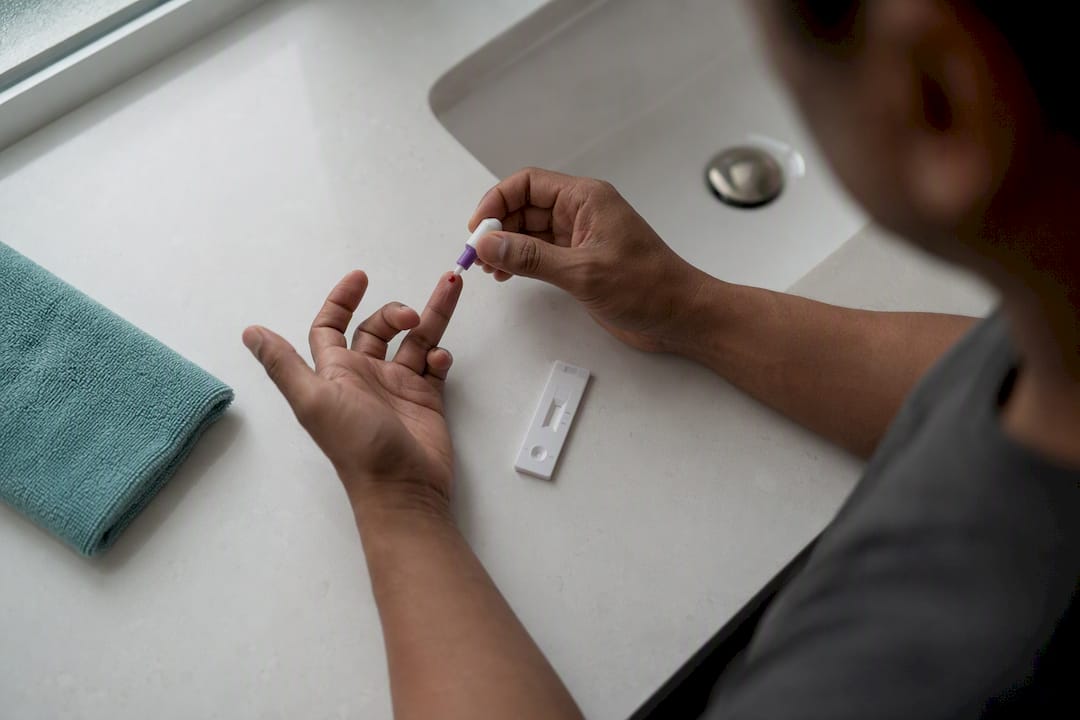
None of this means finger-prick or oral-fluid tests are unreliable. It means they’re slightly more sensitive to how they’re used than a lab draw is. Modern RDTs and WHO-prequalified self-tests generally perform close to laboratory standards in field evaluations, and the heterogeneity that shows up in meta-analyses is mostly driven by a handful of underperforming brands rather than the format itself. Choosing a well-validated kit and following the instructions precisely closes most of that gap.
Pro Tip: If you’re using a finger-prick kit, don’t squeeze the fingertip hard to force blood out. It dilutes the sample with tissue fluid and can genuinely weaken a faint line that should be there.
When can a hepatitis C test give a false negative?
There’s a window between catching hepatitis C and your body producing enough antibodies to register on a test. This is the antibody window period, and it’s the single biggest reason someone can test negative and still carry the virus.
Most people develop detectable antibodies within eight to twelve weeks of exposure, though seroconversion can occasionally take longer. That range varies partly because immune response speed differs from person to person, and partly because the sensitivity of the specific test used affects how early it can pick up low antibody levels. This is genuinely different to HIV or hepatitis B window periods, so don’t assume the same timeline applies across the board.
HCV RNA, the virus’s actual genetic material, can often be detected in blood before antibodies appear, sometimes within one to two weeks of exposure. That’s why RNA testing has a specific role for early diagnosis rather than replacing antibody testing wholesale. It’s more expensive and less widely available as a screening tool, but it closes the gap antibody tests can’t reach in the earliest days after exposure.
Here’s practical guidance on what to do, depending on your situation:
- If you’ve had a recent high-risk exposure and have symptoms, ask about HCV RNA testing directly rather than waiting for antibody seroconversion.
- If you’ve had a recent exposure but no symptoms, an antibody test at eight to twelve weeks post-exposure is a reasonable first check.
- If that test is negative but the exposure was significant, a repeat antibody test at the twelve-week mark, or RNA testing sooner, closes the door more firmly.
- If you test positive for antibodies at any point, move straight to RNA confirmation rather than repeating the antibody test.
You can read more detail on how seroconversion timing works and when tests actually turn positive if you want to map out your own testing window more precisely.
What causes false positives and false negatives?
Even with specificity sitting at 99% or higher, no test is flawless, and understanding what drives the occasional wrong result helps you know when to trust a result and when to double-check it.
False positives, though rare at population level, tend to stem from a handful of recurring causes:
- Cross-reactivity with antibodies from other conditions, including certain autoimmune diseases, can occasionally trigger a reactive line.
- Immunosuppression or other chronic illnesses can sometimes alter antibody behaviour in ways that confuse the assay.
- User or technical error, such as reading a test outside its stated window or misinterpreting a smudge as a line.
False negatives usually trace back to different mechanisms:
- The window period, covered above, remains the most common cause by far.
- Low antibody titres, sometimes seen in immunosuppressed people or those tested very early in seroconversion.
- Prior cleared infection with waning antibodies, though this is more often linked to false positives in older assays than false negatives in current ones.
A specificity of 99.5% sounds close to perfect, and at population level, it is. But run that same test across ten million screenings and you’ll still generate tens of thousands of false positives in absolute terms. That’s not a reason to distrust the test. It’s the entire reason confirmatory RNA testing exists as a mandatory second step, not an optional extra.
If your result doesn’t sit right with your own risk history, the fix is straightforward: don’t self-diagnose from a single reactive line, and don’t dismiss a negative if you know you tested within the window period. Repeat testing at the right interval, or move to RNA testing, resolves almost every ambiguous case.
I tested positive for hepatitis C antibodies. What now?
A reactive antibody result confirms one thing only: your immune system has encountered hepatitis C at some point. It does not tell you whether the virus is currently active in your body, and this distinction matters enormously for how you respond emotionally as much as clinically.
The next step is HCV RNA testing, also called a viral load or NAT test. This looks for the virus’s genetic material directly rather than your antibody response to it. If RNA is detected, the infection is active and treatment can be planned. If RNA is not detected, it usually means a past infection that has already cleared, either naturally or following treatment, and your antibodies are simply the lingering evidence.
Point-of-care RNA assays have improved this pathway considerably. Pooled data puts their sensitivity and specificity both around 99%, which makes them a genuinely reliable option for confirming infection without the delays of sending samples away to a central lab. That matters practically, because every extra day between a reactive screen and a confirmed result is a day someone might disengage from care entirely.
Here’s the typical pathway from reactive screen to treatment:
- Reactive antibody result from a lab EIA, clinic RDT, or at-home self-test.
- HCV RNA confirmatory test, ideally arranged within days rather than weeks, either at a lab or via a point-of-care RNA assay where available.
- RNA positive confirms active infection and moves you into treatment discussions, which for hepatitis C now typically involve short courses of highly effective antiviral medication.
- RNA negative confirms past exposure without current infection, and no treatment is needed.
The gap between screening and confirmation is where people most often fall through the cracks, not because the tests are unreliable, but because life gets in the way of following up. Linkage to care after a reactive result matters just as much as the accuracy of the test itself.
How reliable are at-home hepatitis C self-tests?
At-home antibody self-tests have closed most of the gap with laboratory testing, but they still ask something of you that a phlebotomist’s steady hand would otherwise handle: correct sample collection and honest interpretation of the result.
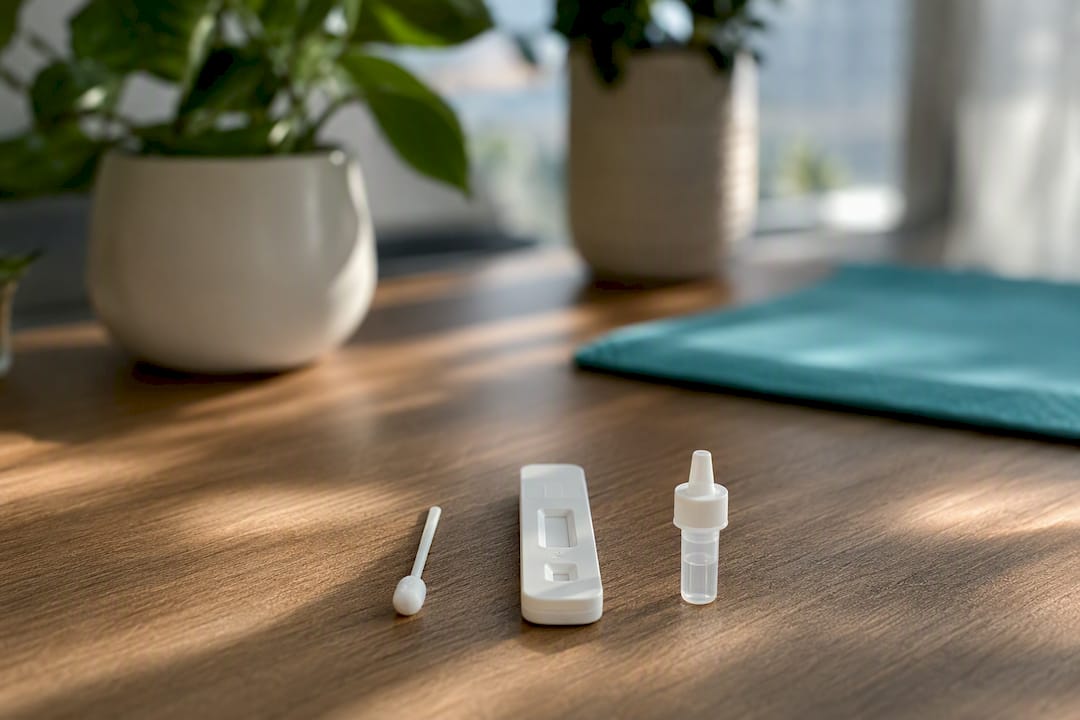
Real-world usability data is genuinely encouraging. Field studies on oral-fluid self-tests report completion rates above 85%, with acceptability above 90% in key populations, meaning most people can use these kits correctly without professional supervision. The World Health Organization’s guidelines on HCV self-testing explicitly support this approach as a way to reach people who might otherwise avoid clinic-based testing altogether, provided self-testing is paired with a clear route into confirmatory care.
That last part is the condition, not an afterthought. Self-testing alone doesn’t close the diagnostic gap. It only works if reactive results actually lead somewhere.
A short checklist gets you the most accurate result possible from an at-home kit:
- Read the instructions fully before you start, not while you’re mid-test with a timer running.
- Check the lighting before reading your result. Faint lines are easy to miss in dim rooms or under yellow bulbs.
- Time it precisely. Reading too early can miss a genuine faint positive; reading too late can produce a false one as the strip dries.
- Don’t over-squeeze a finger-prick site. Gentle pressure gives a cleaner sample than forcing blood out.
- If a line is faint or ambiguous, treat it as reactive and follow up rather than assuming it’s an artefact.
Pro Tip: Photograph your test strip at the exact time stated in the instructions, even if you’re confident in the reading. If you need to discuss it with a health professional afterwards, that photo is far more useful than a memory of “it looked a bit faint.”
Why do experts trust these accuracy figures?
The confidence behind hepatitis C antibody test numbers doesn’t rest on one study. It comes from multiple independent systematic reviews reaching broadly the same conclusion using different pools of studies, different populations, and different test brands.
The meta-analysis published covering diagnostic accuracy across many studies puts pooled sensitivity at 97 to 98% and specificity at 99 to 100%. Separately, a systematic review and meta-analysis focused specifically on point-of-care tests found pooled sensitivity of 97.4% (95% CI: 95.9 to 98.4%) and specificity of 99.5% (95% CI: 99.2 to 99.7%). Two different research teams, two overlapping but distinct sets of studies, and the numbers land within a percentage point of each other.
- Confidence intervals across these reviews are consistently tight, which signals a stable, well-replicated effect rather than a fluke result from one lucky study.
- WHO guidance treats self-testing as fit for purpose specifically because these pooled figures hold up across diverse settings and populations.
- Heterogeneity between individual brands is the main caveat researchers flag. Some point-of-care tests underperform the pooled average, which is why using a validated, well-regarded kit matters more than the category average alone suggests.
- Sensitivity dips seen in some whole-blood and early-window-period studies represent genuine subgroup effects, not a reason to distrust the headline figures for the general testing population.
Pooled sensitivity above 97% and specificity above 99% across multiple independent reviews is about as strong a signal as diagnostic evidence gets outside of a handful of gold-standard screening tools. The caveat worth remembering isn’t whether the tests work. It’s that individual brand performance and specimen handling can still move the needle within that otherwise reassuring range.
The honest limitation running through all of this evidence is variability at the margins, not doubt about the core numbers. That’s precisely why the two-step model, antibody screening followed by RNA confirmation, remains the backbone of how hepatitis C is diagnosed everywhere from a hospital lab to a kitchen table.
How Rapidtest thinks about accurate Hep C testing
Understanding these numbers is one thing. Acting on them calmly is another, and that’s the gap Rapidtest tries to close for people using an at-home hepatitis C antibody kit. The evidence is genuinely reassuring: pooled sensitivity and specificity figures for well-validated antibody tests sit in the high nineties, whichever review you look at.
What we try to do differently is make sure you’re never left holding a reactive result with nowhere to go. A positive line on an antibody test means exposure, not necessarily active infection, and we say that plainly in our product guidance rather than burying it in small print. If your result comes back reactive, the next step is HCV RNA confirmation through your GP or sexual health clinic, and we point you towards that pathway directly.
We also publish window period guidance so you’re not testing too early and second-guessing a result that was always going to be inconclusive. If you’ve had a recent exposure, understanding your own testing timeline matters more than the kit itself.
— Jack
Ready to check your hepatitis C status privately?
Waiting weeks for a clinic appointment isn’t the only route to a reliable answer. Rapidtest’s at-home kits give you a result in around 15 minutes, using the same antibody detection approach behind the pooled accuracy figures covered above, without a GP referral or a waiting room.
If you’re weighing up a hepatitis C check alongside other sexual health screening, our at-home Hep C rapid test sits within a wider range of health marker screening kits, so you can test for what’s relevant to you in one discreet delivery. Every kit comes with full instructions and clear guidance on what a reactive result means and what to do next, including how to arrange RNA confirmation. There’s no ambiguity left to guesswork on your end. If you’d rather cover a broader panel at the same time, the at-home STI testing range covers chlamydia, gonorrhoea, syphilis, HIV, and more in a single order. Order your kit today and get a private, evidence-backed answer within the hour.
This article is general information, not a substitute for advice from a qualified doctor. Consult a qualified healthcare professional about your own circumstances before acting on anything here.
Sources
- Diagnostic accuracy of tests to detect Hepatitis C antibody: a meta-analysis and review of the literature
- OraQuick hepatitis C virus self-test: A new frontier in hepatitis C screening
- Diagnostic Accuracy of Point-of-Care Tests for Hepatitis C Virus Infection: A Systematic Review and Meta-Analysis
- Diagnostic accuracy of point-of-care HCV viral load assays (systematic review)
FAQ
Can a positive hepatitis C test be wrong?
Rarely, but yes. This is exactly why every reactive result needs HCV RNA confirmation rather than being treated as a final diagnosis.
How accurate are hepatitis C tests overall?
Meta-analyses put pooled sensitivity at roughly 97 to 98% and specificity at 99 to 100% for antibody tests, whether laboratory-based, point-of-care, or oral-fluid self-tests. Accuracy can vary slightly by specimen type and individual test brand.
What does a faint or borderline line mean on a hepatitis C test?
A faint line still counts as reactive and should be treated the same as a strong positive line. Photograph the result within the timeframe stated in the instructions and arrange HCV RNA confirmation rather than assuming it’s an error.
Can you test negative for hepatitis C but still have it?
Yes, if you’re tested within the window period, typically the first eight to twelve weeks after exposure, before your body has produced detectable antibodies. If you’ve had a recent high-risk exposure, retesting later or asking about HCV RNA testing closes that gap.