


HSV-2 test accuracy: what your result really means
Modern HSV-2 IgG tests are generally reliable, but “generally” carries real weight here. Here is what the evidence says:
- Top-performing assays (Roche, Bio-Rad) show sensitivity and specificity above 96–99% for HSV-2 IgG in head-to-head comparisons, while others perform substantially worse.
- HerpeSelect at the standard manufacturer cutpoint has pooled sensitivity of roughly 99% but specificity of only around 81%, meaning a meaningful share of positives in low-prevalence populations are false, according to a systematic review.
- The CDC does not recommend routine testing for people without symptoms, because test limitations and low prior probability combine to increase the chance of a wrong result in low-risk groups.
- Immediate action: if you have received a positive or equivocal result, contact an NHS sexual health clinic or your GP before drawing conclusions. Confirmatory testing is available and often warranted.
Key takeaways
HSV-2 IgG test accuracy varies significantly by assay, timing, and the population being tested, making confirmatory testing essential for any low-positive or unexpected result.
| Point | Details |
|---|---|
| Assay choice matters | Roche and Bio-Rad IgG assays show 96–99% sensitivity and specificity; others, like DiaSorin, perform worse. |
| Low index values are unreliable | Results with an index below 3.0 carry a high false positive risk and should be confirmed before acting on them. |
| Timing affects accuracy | IgG antibodies may not appear for up to 12 weeks; a negative result before that window cannot rule out infection. |
| Prevalence changes your odds | In low-risk populations, even a high-specificity test can produce more false positives than true positives. |
| Rapidtest for initial screening | Rapidtest’s at-home HSV-2 kit offers a private, 15-minute preliminary screen; confirm any positive with laboratory testing. |
Table of Contents
- What types of HSV-2 tests are there, and how do they differ?
- How accurate are HSV-2 tests? Published ranges by test type
- Why HSV-2 tests can mislead you: false positives, false negatives, and hidden factors
- When should you test, and when should you retest?
- How clinicians interpret your result and what to do next
- Where do at-home rapid HSV-2 kits fit in?
- An honest note on why this guide exists
- Private HSV-2 screening without the waiting room
- Sources
- FAQ
What types of HSV-2 tests are there, and how do they differ?
Not all HSV-2 tests work the same way. The right test depends on whether you have symptoms right now or are checking for past exposure.
Direct detection tests (PCR/NAAT and viral culture)
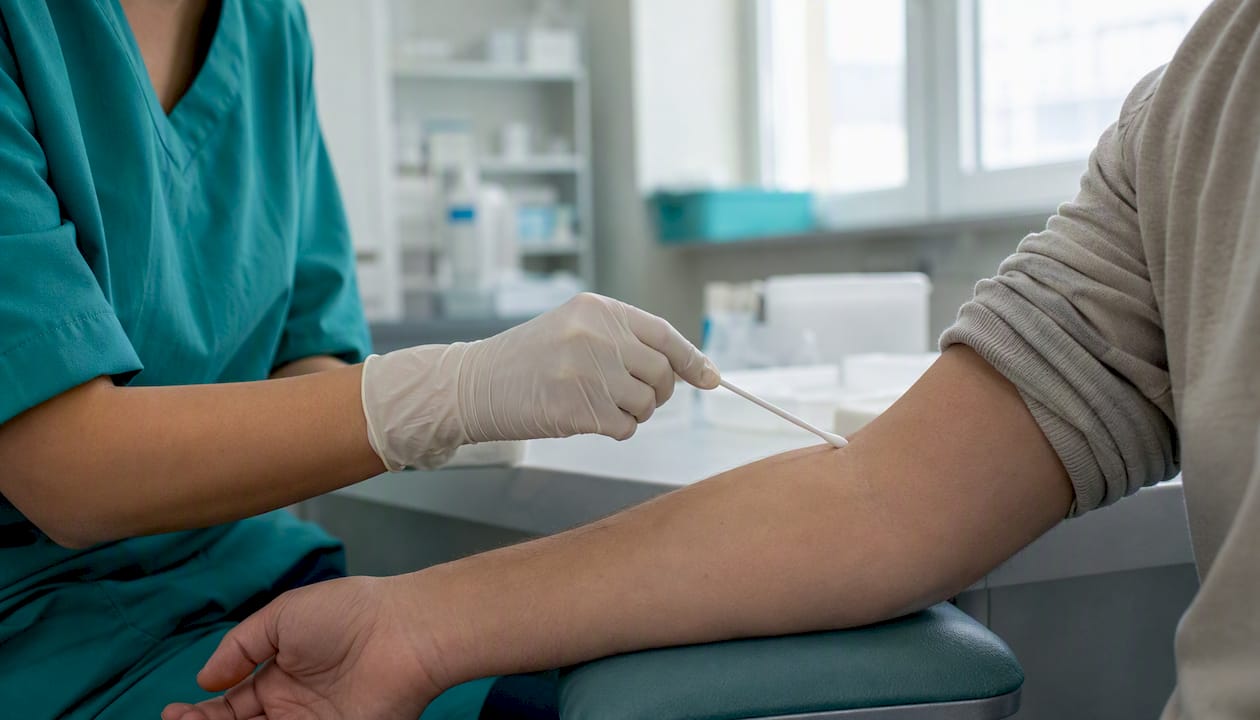
PCR and NAAT (nucleic acid amplification testing) on a lesion swab are the preferred methods when you have an active outbreak. They detect the virus’s genetic material directly, so they are most reliable while sores are present. Viral culture also requires a lesion swab but is considerably less sensitive than PCR, particularly if the lesion is healing, and is now rarely used in UK sexual health clinics.
Type-specific IgG serology
Blood-based IgG tests detect antibodies your immune system has made against HSV-2. They do not tell you whether you have an active infection right now; they tell you whether you have been exposed at some point in the past. Antibodies typically take up to 12 weeks to reach detectable levels after initial exposure, sometimes longer.
Why IgM tests are not recommended
IgM tests are often marketed as early-detection options, but they cannot reliably distinguish HSV-1 from HSV-2, and they produce a high rate of false positives. Clinical guidelines do not recommend them for type-specific diagnosis.
| Test type | Sample required | Primary use case | When result is reliable |
|---|---|---|---|
| PCR / NAAT | Lesion swab | Active outbreak, symptomatic diagnosis | Immediately during active lesions |
| Viral culture | Lesion swab | Active outbreak (less sensitive) | During active lesions only |
| Type-specific IgG serology | Blood | Past exposure, asymptomatic screening | Up to 12 weeks after exposure |
| IgM serology | Blood | Not recommended for type assignment | Unreliable at any point |
How accurate are HSV-2 tests? Published ranges by test type
PCR on an active lesion swab is the most accurate method available. Sensitivity is very high when the sample is taken from a fresh lesion, though it drops as the lesion heals. Specificity is also high, making a positive PCR result during an outbreak highly reliable.
For type-specific IgG serology, the picture is more complicated. A large head-to-head study found substantial differences between automated assays. Crucially, low-positive index values (below 3.0) were associated with a disproportionate number of false positives across assays.
HerpeSelect (Focus Diagnostics), one of the most widely studied assays, illustrates the cutpoint problem clearly. Euroimmun and Abbott assays are used in UK laboratories and show broadly comparable patterns, though direct published comparisons are fewer.
Pro Tip: Ask the laboratory or clinic which assay was used and what index value your result returned. A result with an index value below 3.0 on any assay warrants confirmatory testing before acting on it.
Why HSV-2 tests can mislead you: false positives, false negatives, and hidden factors
Understanding why a test gets it wrong is just as useful as knowing when it gets it right.
Prevalence and positive predictive value
Positive predictive value (PPV) tells you the probability that a positive result is a true positive, and it depends heavily on prevalence.
Here is a worked example.
- True positives: roughly 76 (95% of 80 infected people)
- False positives: roughly 101 (11% of 920 uninfected people)
That means more than half of all positive results in this scenario would be false positives. The systematic review evidence illustrates a similar dynamic using HerpeSelect at standard cutpoints in a population with 16% prevalence, where false positives approached the number of true positives.
Other causes of incorrect results
- Testing too soon. IgG antibodies may not appear for up to 12 weeks after exposure. A negative result during this window does not rule out infection.
- Cross-reactivity. HSV-1 antibodies can cross-react with HSV-2 assays, particularly at low index values. Clinical reviews have documented this as a long-standing technical pitfall in serology.
- Low index values near the cutoff. A result just above the positive threshold is far less reliable than a strongly positive one.
- Immune suppression. People who are immunocompromised may produce fewer antibodies, increasing the chance of a false negative.
- Recent antiviral use. Antivirals such as aciclovir suppress viral shedding, which can reduce the sensitivity of direct detection tests if taken before a swab is collected.
- Assay variation. As the head-to-head data above shows, the assay used matters enormously.
The psychosocial dimension
A false positive HSV-2 result can cause significant distress, affect relationships, and lead to unnecessary treatment. The FDA has formally warned clinical laboratories and healthcare providers about the potential for false reactive results and has recommended confirmatory testing alongside appropriate patient counselling. Pre-test and post-test counselling is not optional; it is a clinical standard.
When should you test, and when should you retest?
Timing is one of the most common reasons people get a misleading result.
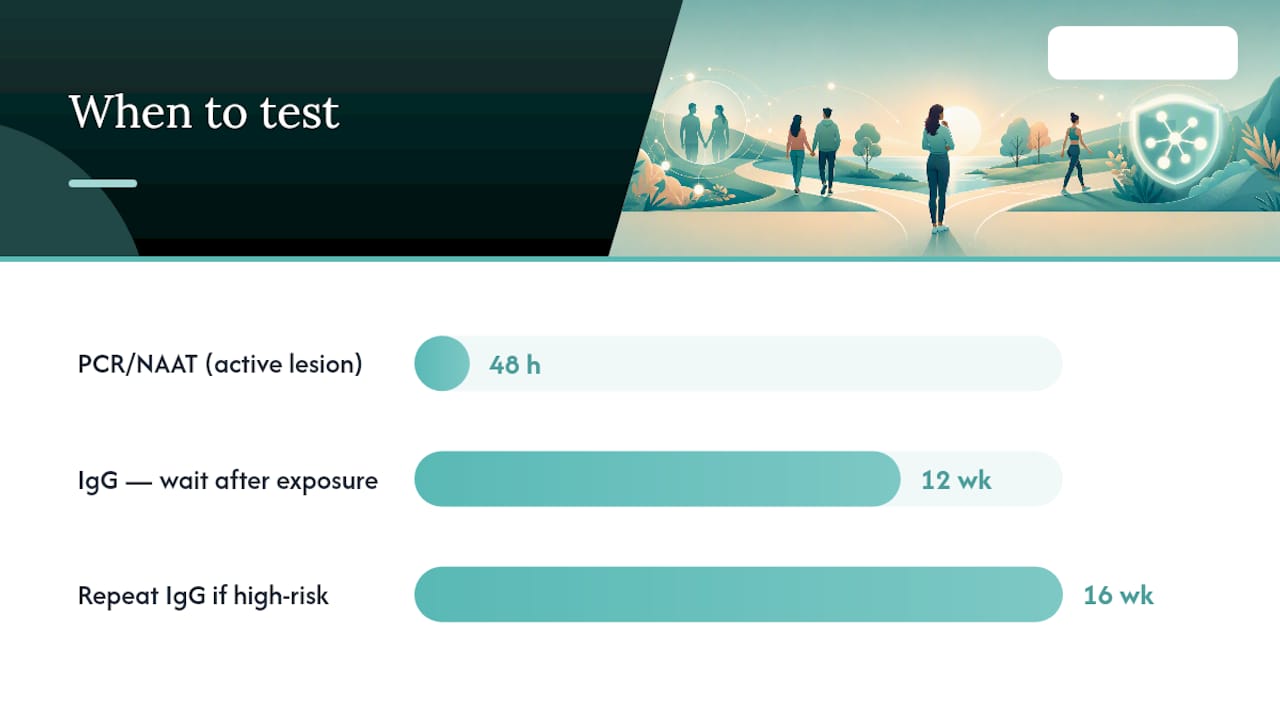
- Active lesions present: get a PCR/NAAT swab as soon as possible, ideally within 48 hours of the lesion appearing. Sensitivity drops quickly as lesions heal.
- Recent exposure, no symptoms: wait at least 12 weeks before relying on a negative IgG result. Some guidelines suggest retesting at 16 weeks if the initial test at 12 weeks is negative and exposure was high-risk.
- Equivocal or low-positive IgG result: do not act on it alone. Retest with a different assay or request confirmatory testing (see below).
- Pregnancy: if you are pregnant and concerned about HSV exposure, contact your midwife or GP promptly. Neonatal herpes is rare but serious, and clinical management differs from the standard pathway.
- New severe symptoms: if you have widespread lesions, systemic symptoms, or are immunocompromised, seek urgent NHS care rather than waiting for a home or postal test result.
For UK readers, NHS sexual health clinics offer free PCR testing during outbreaks and can arrange laboratory IgG testing with clinical interpretation. You do not need a GP referral.
How clinicians interpret your result and what to do next
A test result is not a diagnosis on its own. Clinicians combine the result with your symptoms, sexual history, and the specific assay’s performance characteristics before reaching a conclusion.
| Result | Likely meaning | Suggested next step |
|---|---|---|
| Strongly positive IgG (index >3.0) | Likely true positive | Clinical assessment, partner notification, discuss treatment options |
| Low-positive IgG (index 1.1–3.0) | Uncertain; false positive possible | Confirmatory testing: Western blot or repeat with a different high-specificity assay |
| Equivocal | Borderline; inconclusive | Retest in 4–6 weeks or request Western blot |
| Negative IgG (tested within window) | Cannot rule out infection | Retest at 12–16 weeks post-exposure |
| Positive PCR (active lesion) | Highly reliable | Clinical assessment, antiviral treatment discussion, partner notification |
Studies using Western blot as the reference standard consistently recommend a two-tier approach for cases where the initial assay result is uncertain.
For partner notification, NHS sexual health clinics offer a confidential contact-tracing service. You can also self-refer to any NHS sexual health clinic in England via the NHS website without a GP referral.
Where do at-home rapid HSV-2 kits fit in?
At-home rapid kits, including Rapidtest’s HSV-2 home test kit, serve a specific and genuinely useful role: private, accessible screening for people who want a quick preliminary check without a clinic appointment. Understanding where they fit, and where they do not, helps you use them responsibly.
- Home rapid kits use a finger-prick blood sample to detect HSV-2 IgG antibodies. They are designed for screening and deliver a result in around 15 minutes. They are best suited to people who want a private initial check and are outside the window period.
- Clinic PCR remains the most accurate method for active outbreaks. If you have symptoms, a swab-based test at an NHS sexual health clinic is the right first step.
- Laboratory IgG assays (HerpeSelect, Roche, Bio-Rad) offer quantitative index values and the option of confirmatory testing. They are the appropriate route for asymptomatic screening where a definitive answer is needed.
Pro Tip: If your at-home rapid test returns a positive or unexpected result, treat it as a prompt to seek laboratory confirmation rather than a final answer. A positive screen is the beginning of the diagnostic process, not the end.
For guidance on using at-home STI tests safely and accurately, including correct sample collection, Rapidtest’s resource hub covers the practical steps clearly. This article is general information and not a substitute for professional clinical advice. For clinical management, diagnosis, or treatment, contact an NHS sexual health clinic or your GP.
An honest note on why this guide exists
At Rapidtest, we believe that understanding your result is as important as getting one. At-home testing should open doors, not create confusion. This guide exists because the gap between “your test came back positive” and “here is what that actually means” is where people fall through the cracks. If you have questions about your result or want to talk through next steps, NHS sexual health services are free, confidential, and available without a GP referral. Rapidtest’s role is to give you a fast, private first step. The clinical conversation that follows is just as important.
Private HSV-2 screening without the waiting room
Getting a result in 15 minutes, at home, without booking an appointment or sitting in a waiting room, is exactly what Rapidtest is built for. The at-home STI testing kits cover HSV-2 alongside a full range of STIs, with discreet packaging and clear instructions included. No awkward conversations, no queues, no waiting days for a postal result.
For people who want a private preliminary screen before deciding whether to book a clinic appointment, Rapidtest gives you that answer quickly and confidentially. If your result is positive or unexpected, the next step is laboratory confirmation at an NHS sexual health clinic, and this guide has shown you exactly how to navigate that. Order your HSV-2 rapid test kit today and take the first step on your own terms.
Sources
The following sources informed this article. NHS pages are UK-specific; the others are international clinical guidance or peer-reviewed studies.
- Performance characteristics of highly automated HSV-1 and HSV-2 IgG testing | Journal of Clinical Microbiology
- Serological Screening for Genital Herpes
- HSV-2 Tests for Genital Herpes Can Produce False Reactive Results - Letter to Clinical Laboratory Staff and Health Care Providers | FDA
- Ncbi
FAQ
Can an HSV-2 test give a wrong result?
Yes. Both false positives and false negatives are possible. False positives are particularly common with low-positive index values or in low-prevalence populations; the FDA has formally flagged this risk and recommends confirmatory testing.
Can you test negative for HSV-2 and still have it?
Yes. If you test within 12 weeks of exposure, your body may not yet have produced detectable IgG antibodies, making a negative result unreliable. Retesting at 12–16 weeks after a suspected exposure gives a much more accurate picture.
What does a low-positive index value mean?
A low-positive index value (typically between 1.1 and 3.0) sits close to the assay’s detection threshold and carries a significantly higher risk of being a false positive. It should always be followed up with confirmatory testing such as Western blot or a repeat test using a different high-specificity assay.
Which HSV-2 test is most accurate?
PCR on an active lesion swab is the most accurate method during an outbreak.
Where can I get tested for HSV-2 in the UK?
NHS sexual health clinics offer free PCR testing during outbreaks and laboratory IgG testing with clinical interpretation. You can self-refer without a GP referral. For a private preliminary screen at home, Rapidtest’s at-home STI kits deliver results in 15 minutes.