


Hepatitis C window period: when tests actually turn positive
If you’ve had a recent exposure, here’s the answer you need: HCV RNA can show up in your blood within 1 to 2 weeks, while hepatitis C antibodies typically take 50 to 60 days to develop, with more than 90% of people testing positive by 12 weeks. So what should you actually do right now?
- Recent high-risk exposure (last few weeks)? Ask about an HCV RNA test now, rather than waiting.
- Want a definitive answer either way? Plan on repeat antibody testing at the 3 month mark.
- Antibody test came back positive? You’ll need reflex RNA testing to confirm whether the virus is actually active.
Bodies mentioned here, like Hepatitis C Online and the ECDC, publish the clinical guidance behind these numbers, and we’ll walk through exactly what they mean for your testing timeline below.
Key Takeaways
Hepatitis C detection depends entirely on test choice and timing: RNA testing closes the gap to roughly two weeks, while antibody testing needs up to 12 weeks to reach full reliability.
| Point | Details |
|---|---|
| Antibody window | Seroconversion averages 50–60 days, with over 90% positive by 12 weeks. |
| RNA testing is faster | HCV RNA can be detected within 1–2 weeks of exposure, useful for recent risk. |
| Reflex testing matters | Any positive antibody result should trigger an automatic RNA confirmation test. |
| Retest at 3 and 6 months | Negative early results need follow-up antibody or RNA testing before ruling out infection. |
| Cure is measurable | SVR is confirmed by undetectable RNA 12 weeks or more after finishing DAA treatment. |
| Start with a private check | Rapidtest’s at-home hepatitis C antibody kit gives a fast first read before lab confirmation. |
Table of Contents
- What does the hepatitis c window period actually mean?
- Hepatitis c testing timeline: RNA, antigen and antibody compared
- When should you retest after a possible hepatitis C exposure?
- What do your hepatitis c results actually mean?
- Why does the window period vary so much between people?
- What should you do right after a possible exposure?
- The evidence in one place
- Get a confidential first check without the waiting room
- Sources
- FAQ
What does the hepatitis c window period actually mean?
The window period is the stretch of time between catching an infection and the point a test can reliably pick it up. Test too early, and you risk a false negative, not because the virus isn’t there, but because your body hasn’t produced enough of a signal for the test to catch yet.
With hepatitis C, this gets more complicated than with most infections, because there are two entirely different things a test can look for. One is the virus itself, HCV RNA, which your blood carries almost as soon as you’re infected. The other is your immune system’s antibody response, which takes weeks to ramp up. Test for antibodies during that early gap and you’ll get a clean negative even if you’re actively infected. That’s the trap.
Pro Tip: If your exposure was recent, or you’re immunocompromised, or you’re already showing symptoms like fatigue or jaundice, ask specifically for an RNA test rather than a standard antibody screen. Antibody tests are excellent for routine screening, but they’re the wrong tool for catching an infection in its first few weeks.
Hepatitis c testing timeline: RNA, antigen and antibody compared
Not all hepatitis C tests are racing on the same clock. Each one detects something different in your blood, and that difference decides how early it can catch an infection.
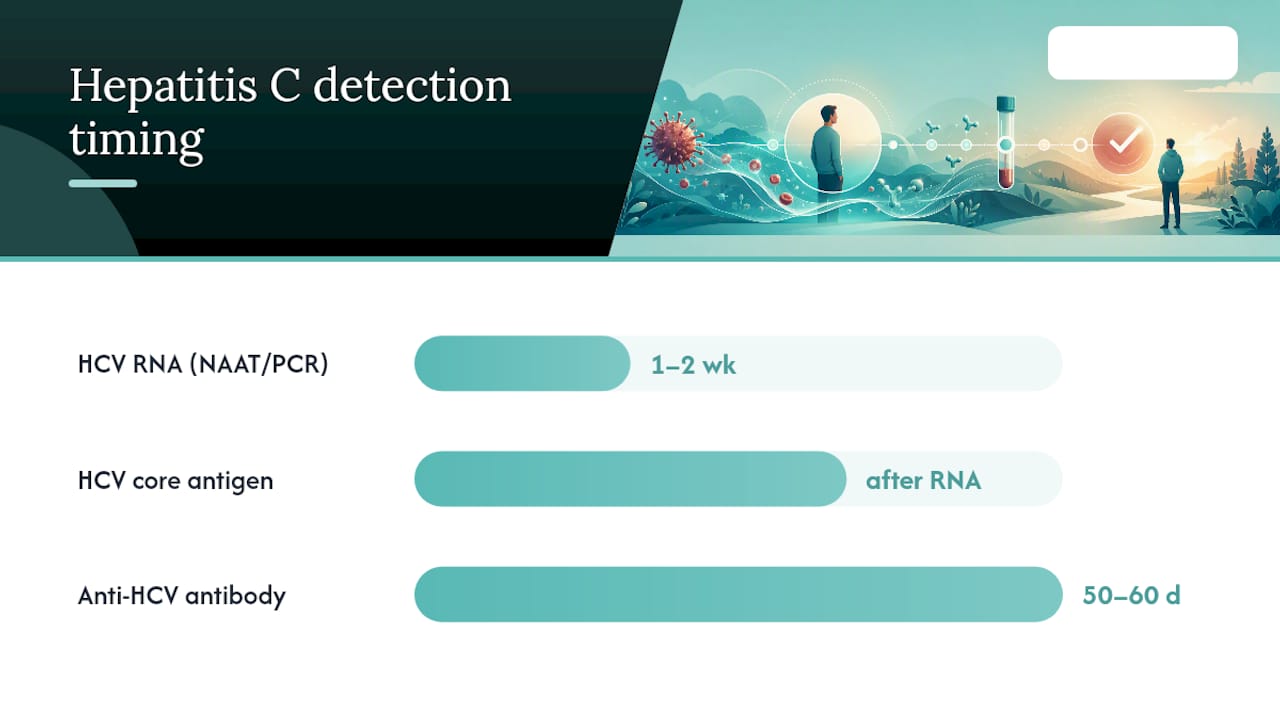
HCV RNA (NAAT/PCR) is the fastest to react. It detects the virus’s actual genetic material, which circulates in your blood within 1 to 2 weeks of exposure. This is why it’s the preferred choice for anyone who knows they’ve had a recent exposure and doesn’t want to wait months for an answer.
HCV core antigen tests sit somewhere in between. They detect a viral protein rather than genetic material, and while they’re not used as widely as RNA or antibody testing in routine practice, they can pick up infection earlier than antibody tests, offering a useful middle ground where RNA testing isn’t readily available.
Anti-HCV antibody tests are the slowest but the most commonly used for general screening. Your immune system needs time to build a detectable antibody response, typically 50 to 60 days, with a range stretching from 20 to 150 days. The ECDC puts the average seroconversion window at around eight weeks, extending to 12 weeks for most people.
| Test type | Earliest detection | Typical/average window | Notes |
|---|---|---|---|
| HCV RNA (NAAT/PCR) | 1–2 weeks | 1–2 weeks | Detects virus directly; best for recent exposure |
| HCV core antigen | Several days to weeks after RNA | Intermediate | Less widely used; alternative when RNA unavailable |
| Anti-HCV antibody | ~3 weeks (earliest cases) | 50–60 days (up to 12 weeks) | Immune response marker; >90% positive by 12 weeks |
One practical limitation worth knowing: point-of-care antibody tests, including finger-prick kits, don’t always match the sensitivity of a full laboratory assay. They’re a reliable screening tool once enough time has passed since exposure, but they follow the same seroconversion timeline as any other antibody test. A negative result taken too early tells you nothing definitive.
When should you retest after a possible hepatitis C exposure?
A single test at the wrong moment can leave you with more questions than answers. Here’s a sequence that reflects how clinicians actually approach this:
- Immediately after a known exposure. If the exposure was high-risk and recent, ask your GP or sexual health clinic about a baseline HCV RNA test rather than waiting.
- 2 to 4 weeks post-exposure. RNA testing at this stage can already return a meaningful result, particularly useful if you’re anxious for early information or you’re immunocompromised.
- 6 weeks to 3 months. This is the window where antibody testing starts becoming reliable. Most people who are going to seroconvert will have done so by 8 to 12 weeks.
- 6 months. Guidance from HCVGuidelines recommends that anyone exposed within the prior six months who hasn’t yet tested get either an RNA test or a follow-up antibody test at this stage, with RNA testing brought forward for anyone immunocompromised.
- Any positive antibody result, at any stage. This should automatically trigger a reflex RNA test to confirm whether the infection is active.
If you’re the sort of person who wants a fast, private first check before booking anything with a clinic, that’s worth knowing when you’re mapping out this timeline, and it’s something we’ll come back to. For now, the point stands: timing your test to the exposure window matters more than which specific test you happen to reach for first.
What do your hepatitis c results actually mean?
Once results come back, four combinations are possible, and each tells a different story.
- RNA positive, antibody negative. This usually means you’re in the early acute phase, infected recently enough that antibodies haven’t developed yet. The virus is present and active.
- RNA positive, antibody positive. Confirmed active infection, whether newly acquired or ongoing.
- RNA negative, antibody positive. This typically indicates a past infection that has cleared, either spontaneously or following treatment, though it can occasionally reflect testing timed just after a viral dip.
- Both negative. No current evidence of infection, assuming enough time has passed since exposure for antibodies to have developed if they were going to.
Public health authorities are consistent on one point regarding that second scenario:
Reflex testing, automatically running an RNA test after any reactive antibody result, reduces both diagnostic delay and the anxiety of waiting for a second appointment. It’s increasingly the default approach recommended across ECDC guidance.
Confirmed RNA positivity means linkage to care and, in most cases, a course of direct-acting antiviral (DAA) treatment. These regimens typically run 8 to 12 weeks, and a cure, known as sustained virologic response (SVR), is confirmed when RNA remains undetectable 12 weeks or more after treatment finishes.
Why does the window period vary so much between people?
The 50 to 60 day average hides a lot of individual variation, and some of it matters clinically.
- Immunosuppression. People on long-term dialysis or living with advanced HIV may never mount a reliable antibody response, which makes antibody testing alone risky in this group regardless of how much time has passed.
- HIV co-infection. A weakened or altered immune response can delay or blunt seroconversion, pushing the reliable testing window later than the standard timeline suggests.
- Assay sensitivity. Not every antibody test is built the same. Point-of-care kits and laboratory assays can differ slightly in how early they pick up a genuine positive.
- Specimen and lab factors. RNA testing sensitivity depends on the assay and lab used, which is why local laboratory practice still guides the exact cut-offs a clinician applies.
Pro Tip: If you fall into any of these higher-risk categories, don’t wait out the standard antibody timeline. Ask directly for RNA testing regardless of how long it’s been since exposure.
What should you do right after a possible exposure?
The first six months after a suspected exposure is the period where decisions matter most. Here’s a practical checklist:
- Contact a GP or sexual health clinic promptly rather than waiting to see if symptoms develop.
- Ask specifically about HCV RNA testing if the exposure was within the last few weeks.
- Use safer-sex practices and standard harm-reduction measures in the interim, since RNA positivity generally correlates with infectiousness.
- Book a follow-up antibody test at 3 months if your first RNA result was negative and the exposure risk was genuine.
- Don’t treat a single negative test taken early as the final word. Follow-up testing is part of the process, not optional extra caution.
Cure is measured precisely: undetectable RNA 12 weeks after finishing treatment confirms SVR, at which point someone is no longer considered infectious. That’s a specific, evidence-backed threshold, not a general sense of “feeling better.”
The evidence in one place
Pulling the clinical picture together: antibody seroconversion averages 50 to 60 days, over 90% of infected people test antibody-positive by 12 weeks, and RNA testing closes that gap to as little as 1 to 2 weeks. Reflex RNA testing after any positive antibody result is now standard recommended practice.
A short checklist worth keeping:
- Recent exposure → ask for RNA testing now, don’t wait for antibodies to develop.
- Immunocompromised or on dialysis → RNA testing regardless of timing.
- Antibody positive → automatic reflex RNA to confirm active infection.
- Antibody negative but exposure was recent → retest at 3 months before ruling anything out.
- RNA positive → linkage to care and DAA treatment discussion.
- Post-treatment → SVR confirmed at 12 weeks undetectable RNA.
A note on testing choices
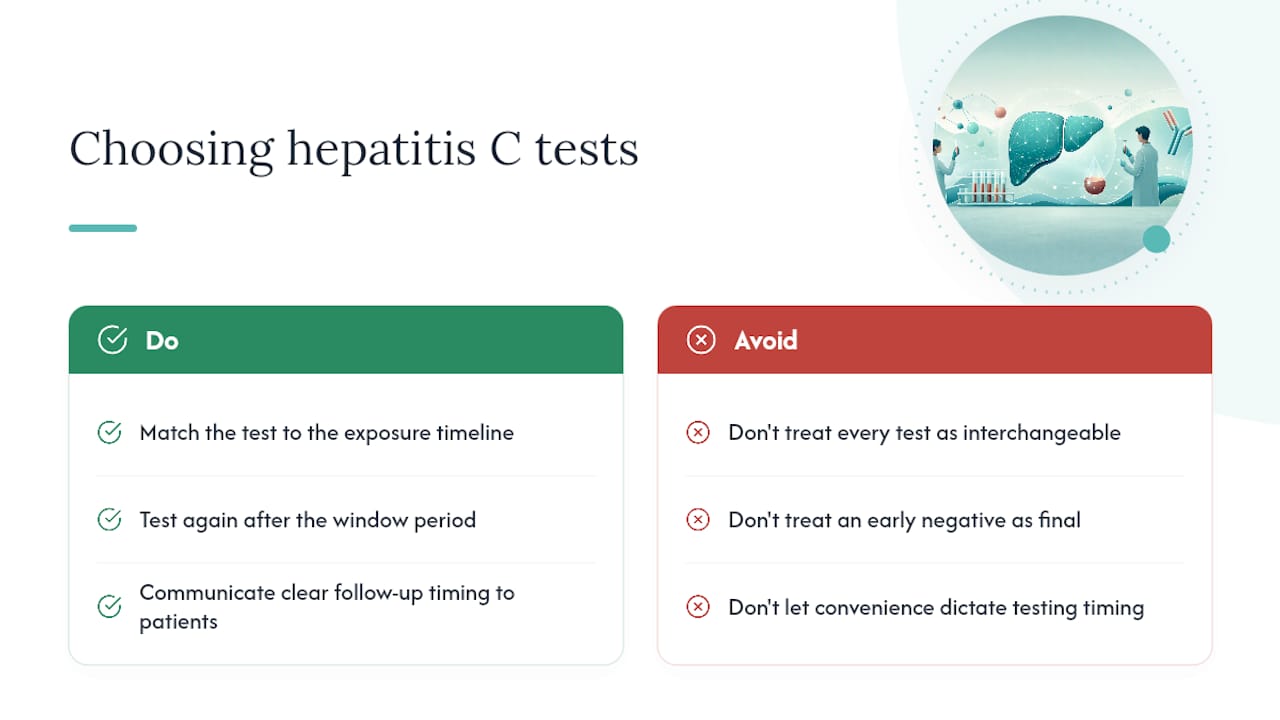
There’s a temptation to treat every hepatitis C test as interchangeable, and it isn’t. Antibody screening is genuinely excellent for the job it’s designed for: catching established infections in people who aren’t in that immediate post-exposure window. Where it falls short is speed, and pretending otherwise does patients a disservice.
What gets underestimated, I think, is how much confusion the early negative antibody result causes. Someone tests two weeks after an exposure, gets a negative, and assumes they’re in the clear. They’re not necessarily wrong to feel relieved, but they’re wrong to treat that result as final. The honest answer is always “test again,” and clear communication about that follow-up timing matters more than which specific assay someone reaches for first. If I had to pick one habit to encourage, it’s this: match the test to the timeline, not the timeline to whichever test happens to be convenient.
Get a confidential first check without the waiting room
If a clinic appointment feels like a step too far right now, or you’d rather get a first read privately before deciding what’s next, that’s exactly the gap an at-home option fills.
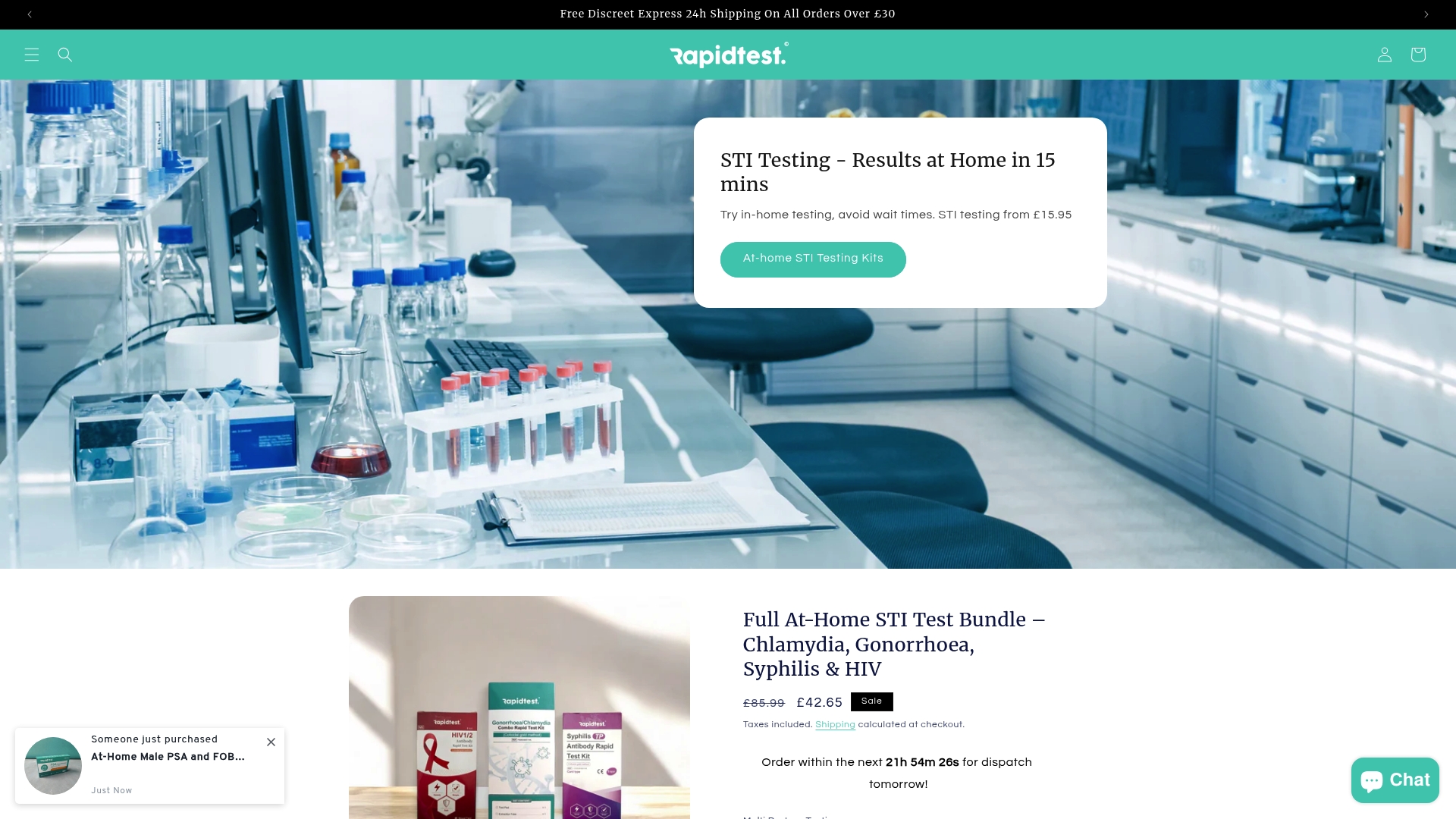
The Rapidtest hepatitis C rapid test screens for hepatitis C antibodies from a finger-prick sample, with results in 15 minutes, no clinic visit, no waiting on a lab. It’s built for the same use case as the antibody testing discussed throughout this article: reliable once your body has had time to seroconvert, but not a substitute for RNA testing if your exposure was recent. A reactive result on this kit, or on the related hepatitis B screen if you need broader viral hepatitis screening, should always be followed by laboratory confirmation and a conversation with a GP or sexual health clinic. If you’d rather test in person from the outset, Zest Clinic’s sexual health services are a solid route too.
For anyone who’s had multiple recent exposures or wants broader screening alongside hepatitis C, Rapidtest’s at-home STI testing kits cover several infections in one discreet order, delivered in plain packaging with full instructions included. Order one, test on your own schedule, and use the result to decide your next step with confidence rather than guesswork.
Sources
- Core concepts — diagnosis of acute HCV infection — Hepatitis C Online
- Factsheet for health professionals about hepatitis C — ECDC
- HCV testing and linkage to care — HCVGuidance
- Gov
- Hepatitis C screening — Mayo Clinic
FAQ
Can you ever fully get rid of hepatitis C?
Yes. Hepatitis C is curable with direct-acting antiviral treatment, and cure is confirmed when RNA remains undetectable 12 weeks or more after finishing treatment, known as sustained virologic response.
Can you test for hepatitis C after 2 months?
Yes, and this is close to the average seroconversion point. Antibody tests typically become reliable around 50 to 60 days post-exposure, though a small proportion of people take longer, so a negative result at exactly two months isn’t always final.
When is hepatitis C no longer contagious?
Someone is generally considered no longer infectious once they’ve achieved SVR, meaning undetectable RNA 12 weeks or more after completing treatment. RNA positivity is the main marker of ongoing transmissibility.
What are the first signs of having hepatitis C?
Many people have no symptoms at all in the early stages, which is why testing timing matters so much. When symptoms do appear, they can include fatigue, nausea, joint pain, and jaundice, usually appearing weeks after exposure rather than immediately.
Should I get an antibody test or an RNA test after a recent exposure?
If your exposure was within the last few weeks, ask for an RNA test, since it can detect the virus within 1 to 2 weeks, well before antibodies develop. Rapidtest’s at-home antibody kit is better suited to routine screening once more time has passed since exposure.