


Had unprotected sex? Here's what to do next
Unprotected sex is defined as sexual intercourse without effective contraception or barrier protection, leaving you exposed to two immediate risks: pregnancy and sexually transmitted infections (STIs). If you’ve had unprotected sex and are wondering what to do, the answer is clear. Act quickly, stay calm, and work through a short checklist. The steps below cover emergency contraception, STI testing, self-care, and pregnancy monitoring. None of them require a doctor’s appointment to get started.
Had unprotected sex? Your first decisions matter most
The two risks to address right away are pregnancy and STI exposure. They require different responses, and timing affects both.
Emergency contraception is your first priority if pregnancy is a concern. STI testing is your second, but the window for testing is longer, so do not let urgency around one distract you from the other. Both are manageable when you know what to do.

What emergency contraception options are available?
Emergency contraception (EC) prevents pregnancy after unprotected sex. It works by delaying ovulation and does not terminate an existing pregnancy, so it is distinct from abortion. That distinction matters, and it is worth knowing clearly.
Oral emergency contraceptive pills
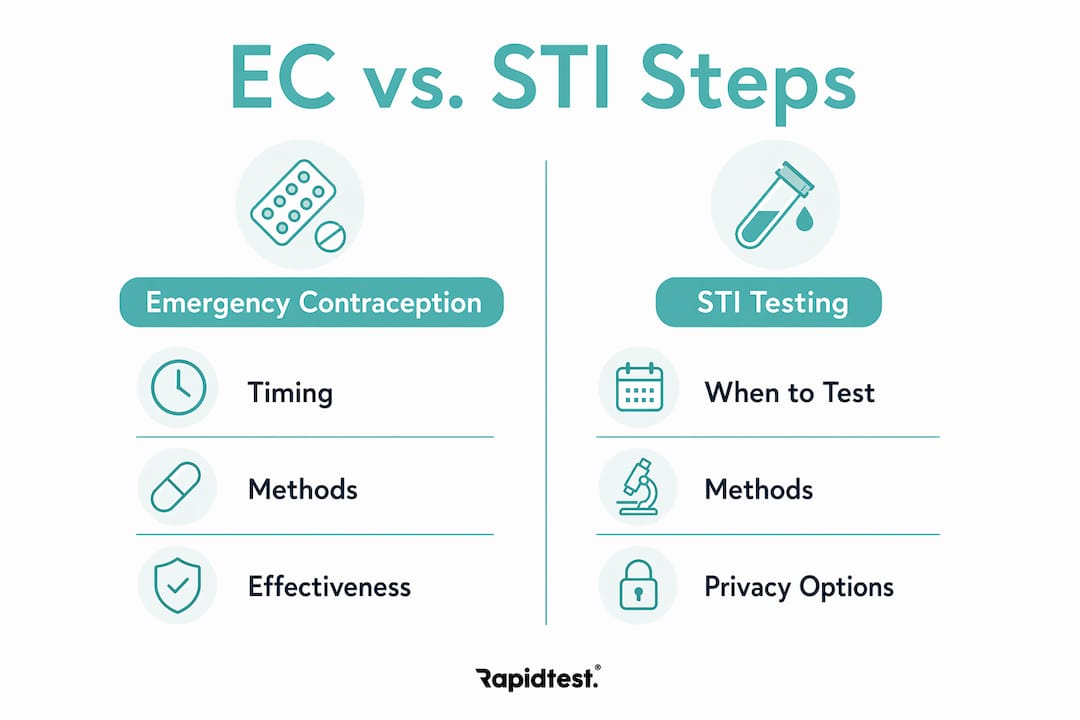
Two types of pill are available in the UK. Levonorgestrel (sold as Levonelle) works best within 72 hours of sex. Ulipristal acetate (sold as ellaOne) extends that window to 120 hours. Both are available from pharmacies without a prescription. EC pills carry a 1–3% failure rate, which is low but not zero.
Emergency IUD
The copper IUD is the most effective form of emergency contraception available. IUDs have over 99.9% effectiveness when inserted within 120 hours of unprotected sex. That makes them approximately 10 times more effective than oral pills. A GP or sexual health clinic can fit one quickly, and it can remain in place as ongoing contraception if you choose.
| Method | Window | Effectiveness | Prescription needed? |
|---|---|---|---|
| Levonorgestrel pill | Up to 72 hours | ~97–99% | No |
| Ulipristal acetate pill | Up to 120 hours | ~97–99% | No |
| Copper IUD | Up to 120 hours | Over 99.9% | Clinic fitting required |
Emergency contraception may also disrupt your menstrual cycle, causing your next period to arrive earlier or later than expected. That is a normal side effect, not a sign that something has gone wrong.
Pro Tip: The sooner you take emergency contraception, the more effective it is. Do not wait to see if your period arrives on time. Act within 24 hours if possible.
When and how should you get tested for STIs?
STI testing after unprotected sex is not optional if you want to be certain about your health. Many STIs are completely asymptomatic, meaning you can carry and transmit an infection without any visible signs at all. No rash, no discharge, no pain. Nothing to warn you.
The recommended testing window depends on the infection. Initial testing is advised 3–5 days after exposure, but some infections take longer to show up in tests. HIV, for example, may require repeat testing up to 3 months after exposure for a fully reliable result. Testing too early can produce a false negative.
Here is a practical checklist for STI testing after unprotected sex:
- Test at 3–5 days for infections like chlamydia, gonorrhoea, and syphilis.
- Test at 4–6 weeks for a more reliable HIV result, then again at 3 months for confirmation.
- Be honest with your clinic or test kit about the date of exposure so results are interpreted correctly.
- Test even if you feel fine. Feeling well is not evidence of a clear result.
- Repeat testing if you have had multiple exposures or if your first test was taken very early.
You can check the optimal testing timeline on Rapidtest’s dedicated guide, which covers specific windows for each common STI.
Pro Tip: Testing even when you trust your partner is not a sign of distrust. Many people carry STIs without knowing. Asymptomatic infections are the norm, not the exception.
At-home STI test kits are a practical option if you want results quickly and privately. Rapidtest kits deliver results in 15 minutes with no clinic visit required.
Immediate self-care steps after unprotected sex
Practical hygiene steps after sex reduce certain risks, but they do not replace contraception or testing. Knowing what actually helps, and what does not, saves you from acting on myths.
Urinating after sex reduces the risk of a urinary tract infection (UTI) by flushing bacteria near the urethra. It does not affect sperm already in the vagina and does not prevent pregnancy or STI transmission. Do it for UTI prevention, not as a substitute for contraception.
Avoid douching or using harsh soaps internally. These disrupt the natural bacterial balance and can actually increase vulnerability to infection. Warm water is sufficient for external cleaning.
Emotional aftercare is just as real as physical care. Sexual aftercare supports emotional wellbeing by helping you process the experience and reduce anxiety. That might mean talking with your partner, taking time to rest, or simply acknowledging how you feel without judgement.
Aftercare is not a luxury. After unprotected sex, anxiety is common and completely normal. Giving yourself space to feel and process is part of looking after your health.
Signs that warrant prompt medical attention include unusual discharge, burning when urinating, sores or blisters on the genitals, pelvic pain, or a fever. These may indicate an infection that needs treatment sooner rather than later.
How to monitor for pregnancy signs after unprotected sex
Pregnancy cannot be detected immediately after sex. A reliable pregnancy test requires around 2–3 weeks after intercourse, because fertilisation and implantation take time before the hormone hCG reaches detectable levels. Testing too early produces inaccurate results.
Follow these steps to monitor effectively:
- Note the date of unprotected sex. This is your reference point for all timing decisions.
- Track your next expected period. A period arriving on time is a strong indicator that pregnancy has not occurred.
- Account for EC effects. Emergency contraception can shift your cycle, so a late period after taking EC does not automatically mean pregnancy.
- Take a pregnancy test if your period is more than 3 weeks late. EC-related cycle disruption is common, but a delay beyond 3 weeks warrants a test.
- If the test is positive, contact your GP or a sexual health clinic to discuss your options. If it is negative but your period still has not arrived, test again after a few more days.
Early pregnancy symptoms include breast tenderness, nausea, fatigue, and light spotting. These can appear as early as one to two weeks after conception, but they are not reliable indicators on their own. A test is the only way to confirm.
Rapidtest offers at-home fertility and pregnancy test kits that give results in 15 minutes, with no appointment needed.
Key takeaways
Acting quickly after unprotected sex reduces both pregnancy risk and STI exposure, but each risk requires a different response on a different timeline.
| Point | Details |
|---|---|
| Emergency contraception timing | Take EC within 72 hours for pills, or up to 120 hours for an IUD, for best results. |
| IUD is most effective | Copper IUDs have over 99.9% effectiveness, far higher than oral EC pills. |
| STI testing window | Test at 3–5 days for most STIs; repeat HIV testing at up to 3 months. |
| Asymptomatic infections are common | No symptoms does not mean no infection. Testing is the only reliable check. |
| Pregnancy testing timing | Wait 2–3 weeks before testing; EC can shift your cycle and delay your period. |
Let’s be real about what this moment actually feels like
Unprotected sex happens. Sometimes it is a decision made in the moment, sometimes a contraceptive failure, sometimes a situation that felt outside your control. Whatever the reason, the moment after can bring a rush of worry that makes it hard to think clearly. I have spoken with enough people navigating this to know that the anxiety is often worse than the situation itself, once you actually know what to do.
The medical steps are straightforward. Take EC if needed, test for STIs at the right time, monitor your cycle. What people underestimate is how much the emotional side matters too. Sitting with uncertainty for two or three weeks while waiting to test is genuinely hard. Talking to your partner, a friend, or a counsellor during that window is not weakness. It is sensible.
One thing I have noticed is that people often delay testing because they are afraid of the result. That fear is understandable, but an early diagnosis is always better than a late one. Most STIs are straightforward to treat when caught early. The ones that cause lasting harm are almost always the ones that were left undetected.
You are not defined by one unprotected encounter. You are defined by what you do next.
— Jack
Rapidtest has you covered for quick, private results
Waiting for a clinic appointment when you need answers quickly is frustrating. Rapidtest’s at-home STI testing kits give you results in 15 minutes, from your own home, with no queues and no awkward conversations.
Whether you need an HIV test or a broader STI screen, Rapidtest kits are accurate, affordable, and completely private. You collect the sample, follow the simple instructions, and read your result in the time it takes to make a cup of tea. No lab, no appointment, no waiting room.
FAQ
How soon after unprotected sex can I take a pregnancy test?
A pregnancy test is reliable around 2–3 weeks after unprotected sex. Testing earlier risks a false negative because hCG levels are not yet detectable.
Does peeing after sex prevent pregnancy or STIs?
Urinating after sex reduces UTI risk by flushing bacteria near the urethra, but it does not prevent pregnancy or STI transmission.
How long after unprotected sex should I get an STI test?
Most STIs are detectable 3–5 days after exposure. HIV may require repeat testing up to 3 months after exposure for a fully accurate result.
Can I have an STI without any symptoms?
Yes. Many STIs are completely asymptomatic, meaning you can carry and transmit an infection with no visible signs. Testing is the only reliable way to know.
Does emergency contraception cause an abortion?
No. Emergency contraception works by delaying ovulation and does not terminate an existing pregnancy. It is not the same as an abortion.