


Retest in 48–72 Hours After a Faint Positive Pregnancy Test — UK
A faint coloured line within your test’s reading window is, in the vast majority of cases, a genuine positive. It usually means there’s just enough hCG in your urine to show up, which typically points to a very early pregnancy. The main exceptions are evaporation lines, recent fertility medication, or a very recent pregnancy loss. Either way, the next step is the same: retest in 48 hours or ask for a blood test to confirm.
TL;DR:
- A faint positive usually indicates early pregnancy when hCG levels are just beginning to rise, but it can also result from diluted urine, recent miscarriage, or fertility medications containing hCG.
- Testing too early before the missed period or with non-first-morning urine increases the likelihood of faint, misleading, or evaporation lines, which are typically grey or colorless.
- The sensitivity of the test affects detection; tests claiming 25 mIU/ml detect pregnancy around the expected period, while less sensitive ones may give inconsistent results.
- Most faint lines become darker within 48 to 72 hours if pregnancy progresses normally, but repeat testing or a blood test is recommended if results remain uncertain.
- A faint line accompanied by severe pain, heavy bleeding, dizziness, or shoulder pain could signal an ectopic pregnancy requiring urgent medical attention.
Table of Contents
- What does a faint positive pregnancy test actually mean?
- How do home pregnancy tests detect hCG?
- Common causes of a faint line: a quick checklist
- Is it a faint positive or an evaporation line?
- What should you do next after a faint line?
- When is a faint line a red flag rather than reassurance?
- A practical perspective on faint lines
- Confirming a faint line with an at-home hCG test
- Sources
- FAQ
What does a faint positive pregnancy test actually mean?
The line is pale because there isn’t much hCG (human chorionic gonadotropin) in your urine yet. Your body starts producing this hormone after a fertilised egg implants in the uterine lining, and levels climb from there. Early on, concentrations sit right at the edge of what your test can detect, so the line appears washed out rather than bold. That’s not a sign of a weak or failing pregnancy on its own. It’s simply a timing issue.
A faint line usually comes down to one of these:
- Early pregnancy, where hCG hasn’t built up enough for a strong colour change yet
- Diluted urine, which lowers the concentration of hCG the test can pick up
- A recent miscarriage or chemical pregnancy, where hCG is falling rather than rising
- Fertility medicines that contain hCG, which can trigger a positive independent of pregnancy
- A faulty, expired, or incorrectly used test
Most of the time, it’s simply too early to get a strong result. The NHS advises testing from the first day of a missed period for exactly this reason.
How do home pregnancy tests detect hCG?
Every home pregnancy test works on the same basic principle. Urine flows across a strip containing antibodies that bind to hCG. A control line appears regardless, confirming the test itself has worked. A second line only appears if hCG is present in sufficient quantity, and how much is “sufficient” depends on the test’s analytical sensitivity, measured in mill-international units per millilitre (mIU/ml).
This is where test choice genuinely matters. A laboratory evaluation of home pregnancy test performance found that tests claiming a 25 mIU/ml sensitivity reliably detect pregnancy from around the day of your expected period, while some other marketed sensitivity claims proved inconsistent in practice.
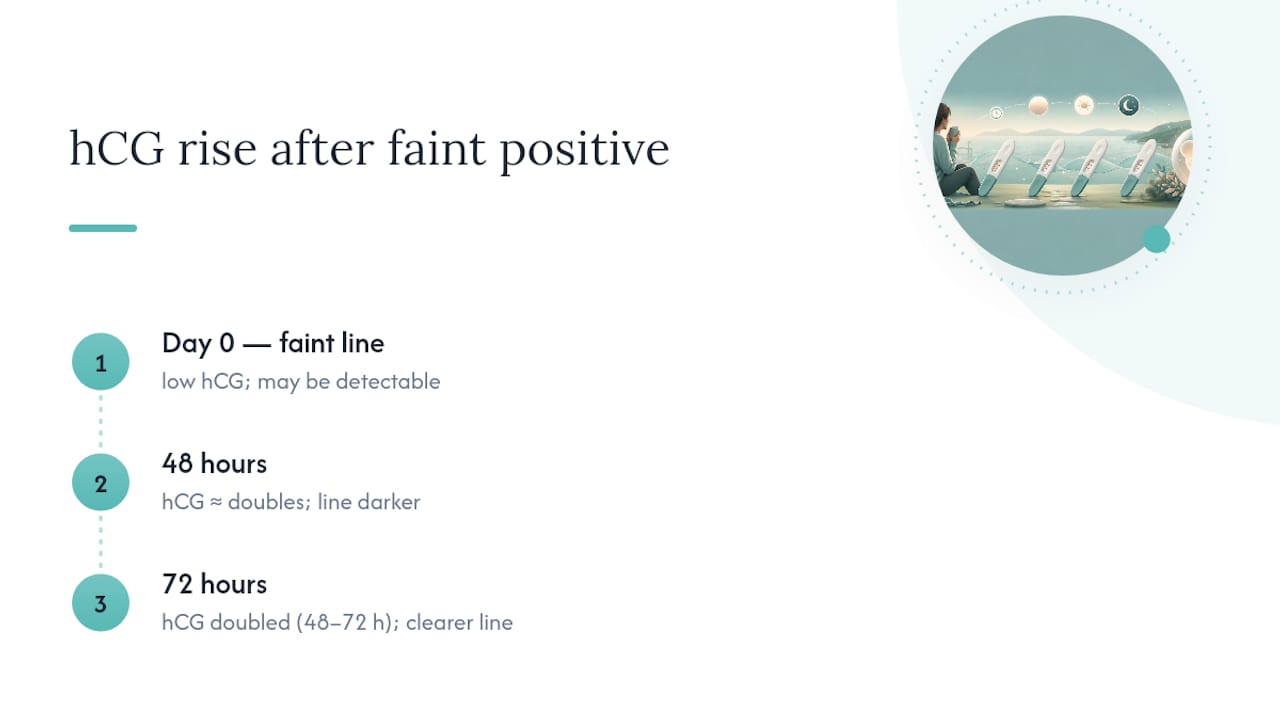
hCG typically doubles every 48 to 72 hours in early pregnancy, according to Mayo Clinic. That rapid rise is exactly why a faint line today can look noticeably darker in two or three days, and why patience often clarifies far more than a second brand of test does.
Common causes of a faint line: a quick checklist
Before you spiral into worry, run through this list. Most causes are ordinary and nothing to panic about.
- You tested too early. Implantation timing varies, and testing before your missed period increases the odds of a faint or false negative result.
- Your urine was diluted. Drinking a lot of fluid beforehand lowers hCG concentration, so use first-morning urine when you can.
- You’re looking at an evaporation line. These appear after the manufacturer’s reading window and are usually colourless or grey.
- You’ve had a recent pregnancy loss or fertility treatment. Residual hCG can linger in your system for days or weeks.
- The test itself is faulty. Expired strips, damaged packaging, or reading the result at the wrong time can all distort what you see.
Pro Tip: Photograph your test the moment the timer goes off. Lines can fade or darken slightly as urine continues to evaporate, and a photo taken exactly on time gives you (or a clinician) the clearest reference point later.
Is it a faint positive or an evaporation line?
Timing is everything here. Check the strip strictly within the window stated in the instructions, usually somewhere between three and ten minutes.
- A true faint positive shows a coloured line, pink or blue depending on the brand, appearing within that window.
- An evaporation line tends to show up later, once the urine has started to dry, and it’s typically grey or colourless rather than tinted.
- If you’re genuinely unsure which you’re looking at, don’t obsess over the same strip. Repeat the test in 48 to 72 hours, or switch to a digital test that gives you a plain “pregnant” or “not pregnant” readout instead of a line to interpret.
What should you do next after a faint line?
Repeat your urine test in 48 to 72 hours using first-morning urine and following the instructions exactly. If hCG is genuinely rising, the line should be noticeably darker by then, not fainter.
If you get faint or inconsistent results more than once, ask your GP for a quantitative serum beta-hCG blood test. This measures the actual hCG level rather than a rough over/under threshold, and clinicians often repeat it 48 hours later specifically to check whether the number is doubling as expected. That comparison is the real clinical gold standard when a urine test leaves any doubt.
Early ultrasound scans, usually offered from around 6 to 8 weeks, aren’t always useful before that point, since there may simply not be enough to see yet. If you’ve recently used fertility medication containing hCG, wait the recommended interval, generally 9 to 14 days after injection, before testing again, as leftover medication can otherwise mimic a positive result.
When is a faint line a red flag rather than reassurance?
A faint positive on its own is rarely dangerous. But get urgent medical help if you also experience:
- Severe, one-sided abdominal pain
- Heavy vaginal bleeding, heavier than a normal period
- Dizziness or fainting
- Unexplained shoulder-tip pain
These symptoms can point to an ectopic pregnancy, where the embryo implants outside the uterus. Ectopic pregnancies still produce hCG, so they can present with exactly the same faint line as a normal early pregnancy. That’s precisely why the symptoms matter more than the line itself. If any of these appear, contact NHS 111, your nearest A&E, or an urgent gynaecology service straight away rather than waiting to retest.
A practical perspective on faint lines
Faint lines cause more needless panic than almost any other part of early testing, mostly because people expect certainty from a strip of paper. It rarely gives you that on day one. Photograph your result, test again with first-morning urine, and keep the used strip somewhere safe if you’re planning to show a clinician. For more on timing, our guide to pregnancy test timing is worth a read.
— Jack
Confirming a faint line with an at-home hCG test
Rapidtest’s at-home fertility and hCG test kits give you a fast, private way to double-check a faint result without booking a GP appointment first. They tell you whether hCG is present, in the same way any urine test does, but they can’t measure the exact quantitative level or confirm a pregnancy’s location and viability the way a serum blood test or early scan can.

That makes an at-home kit the sensible first move when you’re staring at a faint line and want a quick answer, while a GP visit or blood test remains the right call if your results stay inconsistent or any red-flag symptoms appear. Browse the fertility and HCG test kits to order one for results at home in minutes, with no queues and no awkward waiting room.
This article is general information, not a substitute for advice from a qualified doctor. Consult a qualified healthcare professional about your own circumstances before acting on anything here.
Sources
- Doing a pregnancy test - NHS
- Evaluation of home pregnancy test performance (PMC article)
- Home pregnancy tests: Can you trust the results? - Mayo Clinic
- Evaporation line pregnancy test — Healthline
FAQ
How common is a faint positive pregnancy test?
Very common, especially in the days right around a missed period, when hCG levels are still low and rising rather than fully established.
Can a faint line still be negative?
Genuine hCG-related lines with colour are positive results, but a colourless or grey mark appearing after the reading window is an evaporation line, not a true positive.
Is a very faint positive a sign of being 5 weeks pregnant?
A faint line is consistent with roughly 4 to 5 weeks pregnant for many people, since hCG is often still climbing at that stage, though exact timing varies between individuals.
How many weeks pregnant does a very faint line usually suggest?
Most faint lines appear in the first two weeks after a missed period, as hCG is doubling roughly every 48 to 72 hours during this window and hasn’t yet reached the concentration needed for a bold result.