


Men: Wait 48 Hours After Ejaculation Before a PSA Test
Yes, ejaculation can raise your PSA reading, sometimes by a wide margin, and the effect is temporary. The safest move is to avoid ejaculation for 24 to 48 hours before a PSA blood test, since that’s the window most studies and NHS guidance point to. If your result comes back unexpectedly high and you’d had sex recently, don’t panic. A repeat test after a proper abstinence window usually tells a clearer story.
TL;DR:
- Most men should wait at least 48 hours after ejaculation before getting a PSA test to avoid artificially high readings.
- PSA levels can rise by an average of 41% within one hour after ejaculation, with most returning to baseline within 24 to 48 hours.
- Men with enlarged prostates or higher baseline PSA are more likely to experience larger, more impactful PSA fluctuations after ejaculation.
- Avoid vigorous exercise, recent prostate procedures, or infections before testing, as these can also elevate PSA independently of ejaculation.
- Using an at-home rapid PSA test can help determine if levels have stabilized after recent sex before scheduling a formal lab test.
Table of Contents
- What the research shows about ejaculation and PSA levels
- How long does PSA stay elevated after ejaculation?
- Which men see the biggest PSA rise after ejaculation?
- How should I prepare for a PSA blood test?
- What should I do if my PSA is high after recent ejaculation?
- Why the standard advice on PSA testing undersells the ejaculation problem
- Where an at-home PSA check fits into all this
- Sources
- FAQ
What the research shows about ejaculation and PSA levels
Here’s the thing nobody tells you when you book a PSA test: your GP surgery probably won’t ask about your sex life, but the science says they should. Ejaculation genuinely does move the needle on your PSA reading, and the numbers are bigger than most men expect.
The most widely cited study on this, published in the 1990s, found that ejaculation caused a mean PSA rise of 0.8 ng/mL at one hour, a relative jump of roughly 41%, in a group of 64 men aged 49 to 79. That’s not a rounding error. For a man sitting near a borderline PSA result, a 41% swing is the difference between “keep an eye on it” and “let’s talk about a biopsy.”
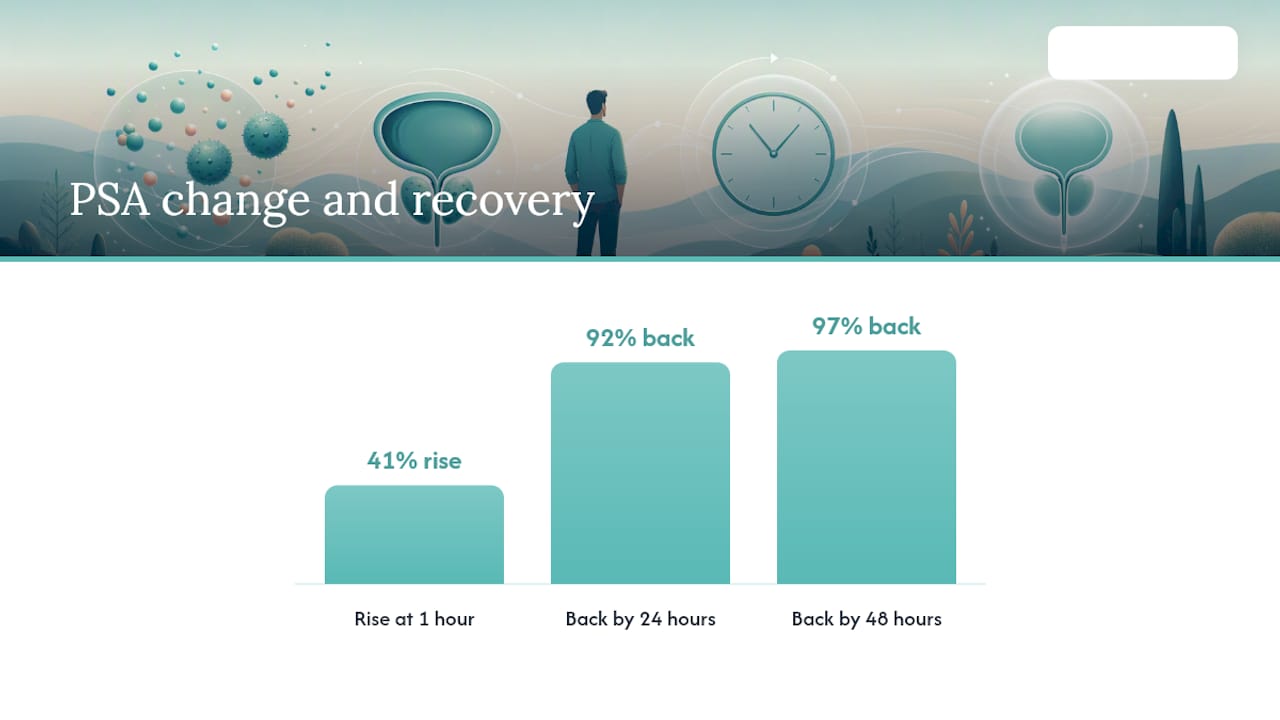
The same study tracked how quickly things settled. Most men were back to their normal baseline within a day or two, though not everyone recovered at the same pace, which matters more than it sounds.
A separate study looking at men with benign prostatic hyperplasia (an enlarged but non-cancerous prostate) found a similar pattern: both total PSA and free PSA rose significantly at one and five hours after ejaculation, with levels returning to baseline by 24 hours in most participants. A further study, this one measuring PSA out to 72 hours in 98 men, found much the same early spike and gradual normalisation, though the exact recovery timeline varied by individual.
Why do the numbers wobble between studies? A few reasons:
- Sample size and age range differ, and older men with naturally higher baseline PSA tend to show bigger absolute swings.
- Timing of the blood draw matters enormously. A test at one hour post-ejaculation looks very different from one at 24 hours.
- Baseline PSA itself influences how much a rise stands out. A jump from 1.0 to 1.4 ng/mL barely registers; the same jump from 3.5 to 4.9 ng/mL could tip you over a biopsy threshold.
PSA rise after ejaculation: one prospective study recorded a mean 0.8 ng/mL increase (about 41%) at one hour, with 92% of men back to baseline by 24 hours and 97% by 48 hours.
Not every form of PSA behaves the same way, either. Total PSA (tPSA) and free PSA (fPSA) both climb after ejaculation, but complexed PSA (cPSA) is affected less consistently across studies. Clinical reviews suggest free PSA sometimes normalises faster than total PSA, which matters if your GP is using the free-to-total PSA ratio to help decide next steps. If you’re being monitored with a specific PSA fraction rather than the standard total figure, it’s worth asking your GP whether the same abstinence advice applies just as strictly.
How long does PSA stay elevated after ejaculation?
You want a number, so here’s the honest one: most men return to baseline within 24 to 48 hours, but “most” isn’t “all.”
- At 1 hour, PSA is typically at or near its peak, with average rises of around 0.8 ng/mL in the key study, a roughly 41% jump on average.
- At 6 hours, levels are usually still elevated, though beginning to fall in most men, according to studies tracking multiple time points.
- At 24 hours, the same research found 92% of participants had returned to their normal baseline.
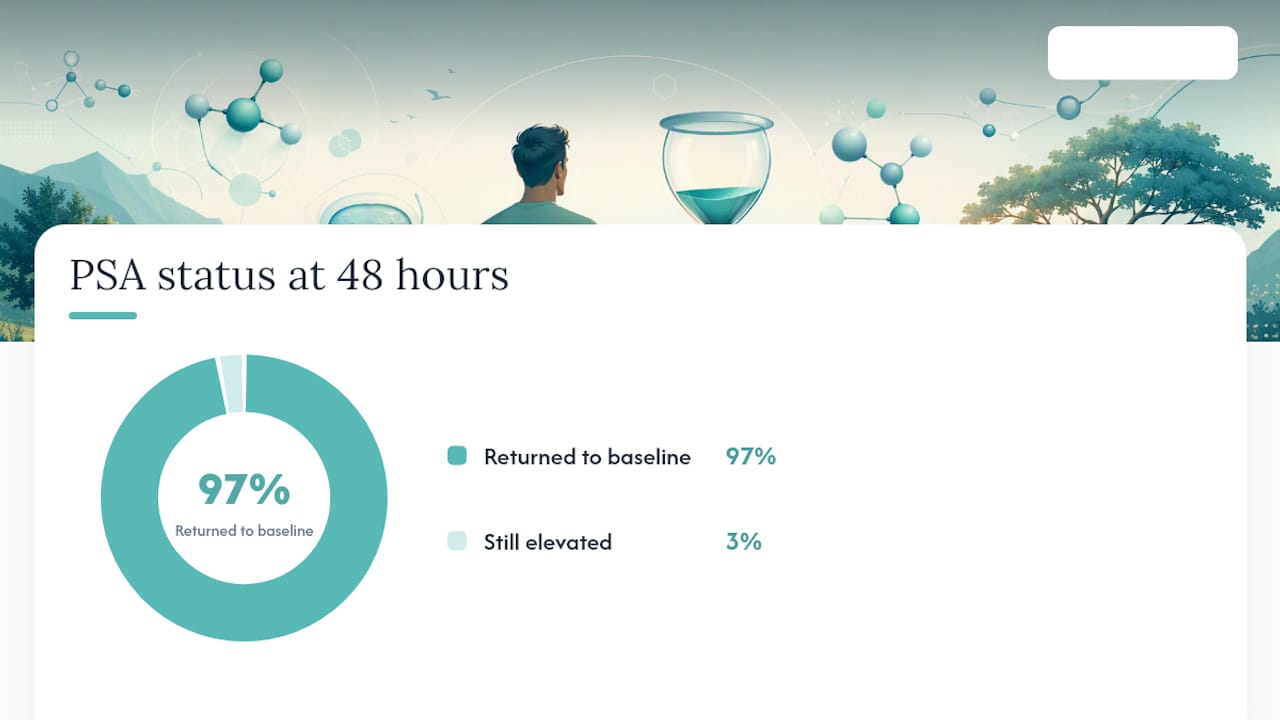
- At 48 hours, that figure rose to 97%, effectively covering nearly everyone tested.
That last three percent is the reason clinicians lean towards the more conservative window rather than the shorter one. If you can wait 48 hours before a PSA test rather than 24, do it. It costs you nothing and closes the gap on the small number of men who take longer to settle.
Age and baseline prostate size seem to play a part in who falls into that slower-recovering group, which is worth bearing in mind if you’re over 60 or already know you have an enlarged prostate. If you’re at all able to plan the timing of a test around your personal circumstances, treat 48 hours as the number to write on the calendar, not 24.
Which men see the biggest PSA rise after ejaculation?
Not every man’s PSA behaves the same way after ejaculation, and knowing where you sit matters more than the general average.
Two things drive the size of the rise: your baseline PSA and your prostate volume. Men with benign prostatic hyperplasia, an enlarged but non-cancerous prostate common with age, tend to produce and release more PSA overall, so a transient spike sits on top of an already higher number. Older men fall into this category more often simply because prostate volume tends to increase with age.
The practical upshot is that a rise which barely nudges a 25-year-old’s PSA can genuinely shift the picture for a 65-year-old whose baseline already sits closer to typical biopsy thresholds (commonly cited around 3 to 4 ng/mL, though your GP will interpret this alongside age and other factors).
Some scenarios deserve extra caution:
- Your last PSA reading was already close to your clinic’s referral threshold.
- You’re due a PSA test as part of ongoing monitoring after treatment, where even small fluctuations get scrutinised.
- You have a family history of prostate cancer and your GP is tracking your numbers more tightly than average.
- You’ve noticed your PSA creeping up over successive tests, where an ejaculation-related blip could be mistaken for a genuine trend.
Pro Tip: If you know your prostate runs on the larger side, or your last few PSA readings have crept upward, mention this to whoever orders your test. It changes how much weight they’ll put on a single reading taken too soon after sex.
How should I prepare for a PSA blood test?
Preparation isn’t complicated, but skipping it is the single most common reason men get a confusing result. Here’s the actual checklist, based on the same guidance NHS and Prostate Cancer UK give patients.
- Avoid ejaculation for 48 hours before your test. This is the single biggest lever you control, and both Prostate Cancer UK and the NHS recommend it explicitly.
- Skip vigorous exercise for 48 hours beforehand, particularly cycling. Sitting on a saddle for long stretches physically compresses the prostate, and the National Cancer Institute lists this alongside ejaculation as a temporary cause of elevated PSA.
- Wait if you’ve had a recent prostate procedure. A biopsy, catheterisation, or even a digital rectal exam can push PSA up artificially. Clinics typically recommend waiting several weeks (commonly cited as 2 to 6 weeks after a biopsy) before retesting.
- Delay testing if you have a urinary tract infection or prostatitis. Inflammation raises PSA independently of anything cancer-related, and testing during an active infection muddies the result.
- Tell whoever orders the test if you’ve ejaculated recently. This sounds obvious, but most men don’t mention it because nobody asks. If you say so upfront, your GP can decide whether to wait and retest rather than react to a number that might settle on its own.
Getting this right the first time saves you a second appointment, an awkward conversation, and the low hum of worry that comes with an unexplained high number. If you want the fuller breakdown of what to do in the 48 hours before a PSA test, it’s worth a read before you book.
What should I do if my PSA is high after recent ejaculation?
First, don’t assume the worst. A high PSA reading taken shortly after ejaculation is genuinely one of the more common, and most fixable, causes of a confusing result.
If you know you ejaculated within the last 48 hours, the standard next step is straightforward: wait out a proper abstinence window, then repeat the test. Studies consistently found that most PSA elevations settle within 24 to 48 hours, so a retest after that point gives you a much more reliable picture than acting on the first number.
Not every rise carries the same weight, though. Context matters:
- A small rise on a PSA that was already comfortably low is unlikely to change anything your GP would do.
- A rise that pushes you near or over a typical referral threshold deserves a proper conversation with your GP, ideally with the ejaculation timing mentioned explicitly.
- A borderline result with no obvious explanation is exactly the situation where clinicians will ask about recent sexual activity, recent exercise, or infection before considering further investigation, since even a modest statistical increase can matter near a cut-off.
Guidance from multiple clinical reviews suggests that even small PSA increases can be clinically significant for men already sitting close to biopsy thresholds, which is why asking about recent ejaculation has become a routine part of interpreting a borderline result.
This is where an at-home rapid PSA check earns its place, not as a diagnostic verdict, but as a sensible way to see whether a number has settled before you go back for a formal blood test. It won’t replace a laboratory result when a genuine decision needs to be made, but it can spare you an unnecessary trip if the number was simply reacting to timing.
Why the standard advice on PSA testing undersells the ejaculation problem
Most patient leaflets mention the 48 hour rule as a footnote, buried under advice about caffeine or medication. That’s backwards. Ejaculation produces one of the largest, most consistent, and most preventable sources of PSA distortion in the research, a mean rise of 41% at one hour is not a minor caveat.
The bigger failure is that almost nobody asks the question at the point it matters. Clinics rarely prompt men to disclose recent sexual activity before drawing blood, so a transient spike gets treated as a real trend, and that can trigger anxiety, repeat appointments, or discussions about biopsy that a simple 48 hour wait would have avoided entirely.
If there’s one thing worth prioritising, it’s this: treat the 48 hour window with the same seriousness you’d give fasting before a cholesterol test. It’s not a nice-to-have. And if a result does come back high, ask about timing before you ask about anything else. Repeat testing at home, followed by proper GP-led lab confirmation when it counts, is a sensible, evidence-backed sequence, not a shortcut.
— Jack
Where an at-home PSA check fits into all this
Rapidtest exists for exactly this kind of situation: you need an answer, you don’t want to wait weeks for a GP appointment, and you’d rather check quietly at home than sit in a waiting room explaining why your last result was odd. Our PSA Rapid Test gives you a result in 15 minutes, with no lab returns and no awkward conversations, delivered discreetly to your door.
It’s not a replacement for a GP-ordered laboratory test when a genuine clinical decision is on the table. Think of it as your sensible first check: if you had sex recently and want to see whether your number has settled before booking a formal retest, this is the quickest way to find out. Explore the full men’s health screening range and order your kit today.
This article is general information, not a substitute for advice from a qualified doctor. Consult a qualified healthcare professional about your own circumstances before acting on anything here.
Sources
- Ejaculation increases the serum prostate-specific antigen concentration (PubMed record)
- The PSA blood test (Prostate Cancer UK)
- PSA fact sheet (National Cancer Institute)
- PSA test (NHS)
FAQ
How long does it take for PSA to go down after ejaculation?
Most men return to their baseline PSA within 24 to 48 hours. One key study found 92% had recovered by 24 hours and 97% by 48 hours, which is why 48 hours is the safer window to plan around.
Does ejaculating help lower PSA?
No. Ejaculation causes a short-term rise in PSA, not a reduction, with studies showing average increases of around 41% at one hour post-ejaculation. Any apparent “lowering” effect you might read about elsewhere isn’t supported by the research on this topic.
How many times should a man ejaculate in a week for prostate health?
There’s no single research-backed number for ejaculation frequency and prostate health, and claims of a specific weekly figure aren’t supported by strong clinical evidence. What the evidence does support clearly is the opposite question: avoid ejaculation for 48 hours specifically before a PSA test, regardless of your usual frequency.
What does ejaculation feel like with prostate cancer?
Ejaculation itself doesn’t typically feel different in early prostate cancer, and changes to ejaculation aren’t a reliable symptom on their own. Some men with more advanced prostate conditions report discomfort or blood in semen, but this needs proper GP assessment rather than self-diagnosis, and it’s a separate issue from the temporary PSA rise ejaculation causes before a blood test.
Can I use an at-home PSA test to check a result after ejaculation?
Yes, an at-home PSA rapid test like the one from Rapidtest can give you a quick repeat check with results in 15 minutes. It’s a useful way to see whether a number has settled, though a laboratory-confirmed test through your GP remains the standard for any significant clinical decision.