


72 Hour Window: Early HIV Tests Can Be False Negatives in the UK
Yes, a negative HIV test taken soon after exposure can absolutely be a false negative. This happens because your body hasn’t yet produced enough detectable virus or antibodies. That’s called the window period. If your exposure was recent—within a few days—contact a sexual health clinic urgently and ask about PEP. If it’s been longer, you’ll need a retest at the right time to trust your result.
TL;DR:
- Nucleic acid tests can detect HIV infection within 10 to 33 days, making them the earliest and most sensitive option but are rarely used routinely due to cost.
- Fourth-generation lab assays detect infection from 18 to 45 days by testing for both p24 antigen and antibodies, outperforming rapid antibody-only tests during early infection.
- Using at-home antibody tests before 90 days post-exposure results in high false-negative risk, especially for individuals on PrEP, PEP, or ART.
- Conducting tests at specific intervals—within three weeks with NAT, at 4-6 weeks with fourth-generation tests, and at three months for confirmation—maximizes accuracy.
- Early negative results should be treated with caution, requiring retesting and confirmation because medications, sample types, and immune responses can delay detectable markers.
Table of Contents
- Why early HIV false negatives happen: the window period explained
- Which HIV tests detect infection earliest, and how much can you trust them?
- What raises your chance of a false negative?
- Your testing timetable: PEP, retesting, and confirmation
- Using at-home HIV kits responsibly
- Where to check the science and get support
- What actually matters here, and where the usual advice falls short
- Sources
- FAQ
Why early HIV false negatives happen: the window period explained
Every HIV test hunts for a specific biological marker, and none of those markers appear the moment infection occurs. That gap between exposure and a detectable marker is the window period, and it’s the single biggest reason someone tests negative while actually carrying the virus.
Within the first week or so, you’re in what’s called the eclipse phase. The virus is replicating quietly, but at levels too low for any test, even the most sensitive lab assay, to pick up. Nothing will show positive here, regardless of test type.
After that, your body works through a fairly predictable sequence. HIV RNA appears first, followed by a protein called p24 antigen, and only later does your immune system start producing detectable antibodies. That antibody stage is seroconversion, and it’s often accompanied by flu-like symptoms, though plenty of people feel nothing at all.
Roughly, the markers show up like this:
- HIV RNA (viral genetic material): detectable earliest, often within 10 to 33 days
- p24 antigen: typically detectable from around 18 days onward
- Antibodies: can take anywhere from a few weeks up to 90 days to reach detectable levels, depending on the test
Test early enough, using the wrong test, and you’re testing before your body has caught up. The result isn’t wrong, it’s just premature because it occurs before the virus or antibodies are detectable.
Which HIV tests detect infection earliest, and how much can you trust them?
Not all HIV tests are chasing the same evidence, which is exactly why two people testing on the same day after the same type of exposure can get different levels of reassurance from a negative result.
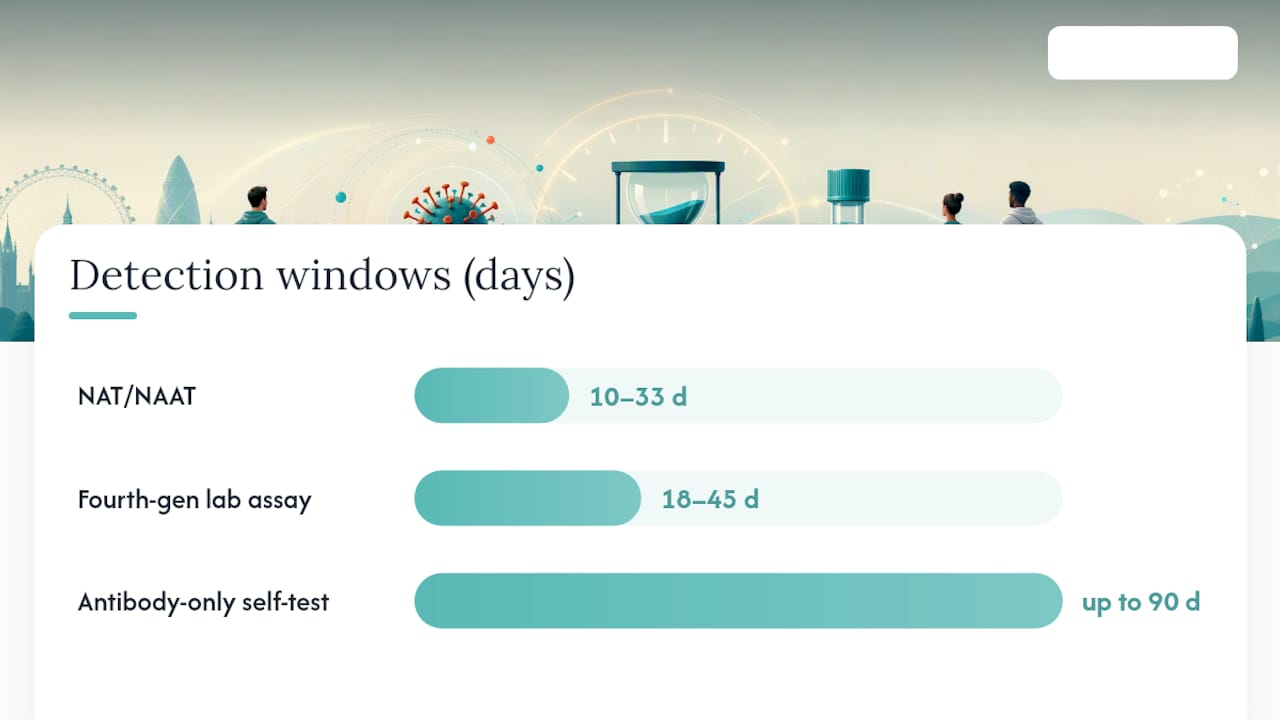
Nucleic acid tests (NAT/NAAT) look directly for the virus’s genetic material, which makes them the earliest and most sensitive option available, often catching infection within 10 to 33 days. They’re rarely used for routine screening, though, because they need laboratory processing and cost considerably more than antibody-based alternatives.
Fourth-generation lab assays are the practical middle ground and the test most sexual health clinics rely on for early detection. These check for both p24 antigen and antibodies simultaneously, with a typical detection window of roughly 18 to 45 days. Evidence from CDC evaluations shows fourth-generation assays substantially outperform antibody-only rapid tests during early infection.
Point-of-care and rapid fourth-generation tests bring that same antigen/antibody logic into a clinic setting with results in minutes rather than days. They’re more useful early on than older rapid tests, but their sensitivity in the first few weeks still trails a proper lab-based fourth-generation assay.
Self-tests and antibody-only rapid tests, including most at-home kits, only look for antibodies. That pushes their reliable detection window out to around 90 days in some cases. A negative result from one of these tests in week two or three after exposure tells you very little.
- NAT/NAAT: earliest window, 10 to 33 days, lab-only
- Fourth-generation lab assay: 18 to 45 days, clinic standard
- Point-of-care fourth-generation: similar concept, slightly less sensitive early on
- Antibody-only self-test: up to 90 days, highest early false-negative risk
What raises your chance of a false negative?
A handful of factors can stretch that window period even further, and it’s worth checking whether any apply to you before you put too much weight on a single result.
- PrEP, PEP or ongoing ART use. Antiretrovirals can suppress viral replication and delay antibody production, which means someone on these medications may test negative well past the usual window, according to aidsmap’s analysis of self-testing accuracy.
- Specimen type. Oral fluid carries lower antibody concentrations than blood, so an oral swab test can lag behind a blood test by several days or weeks. Fingerstick blood samples also differ slightly from venous blood draws in sensitivity.
- User error with at-home kits. Too little sample, testing before the recommended time, or misreading a faint line are common, avoidable causes of an inaccurate result.
- Individual immune response. Some people simply produce detectable antibodies more slowly than others, and a lower initial viral load can delay every marker’s appearance.
If any of these apply to you, treat an early negative with real caution rather than relief.
Your testing timetable: PEP, retesting, and confirmation
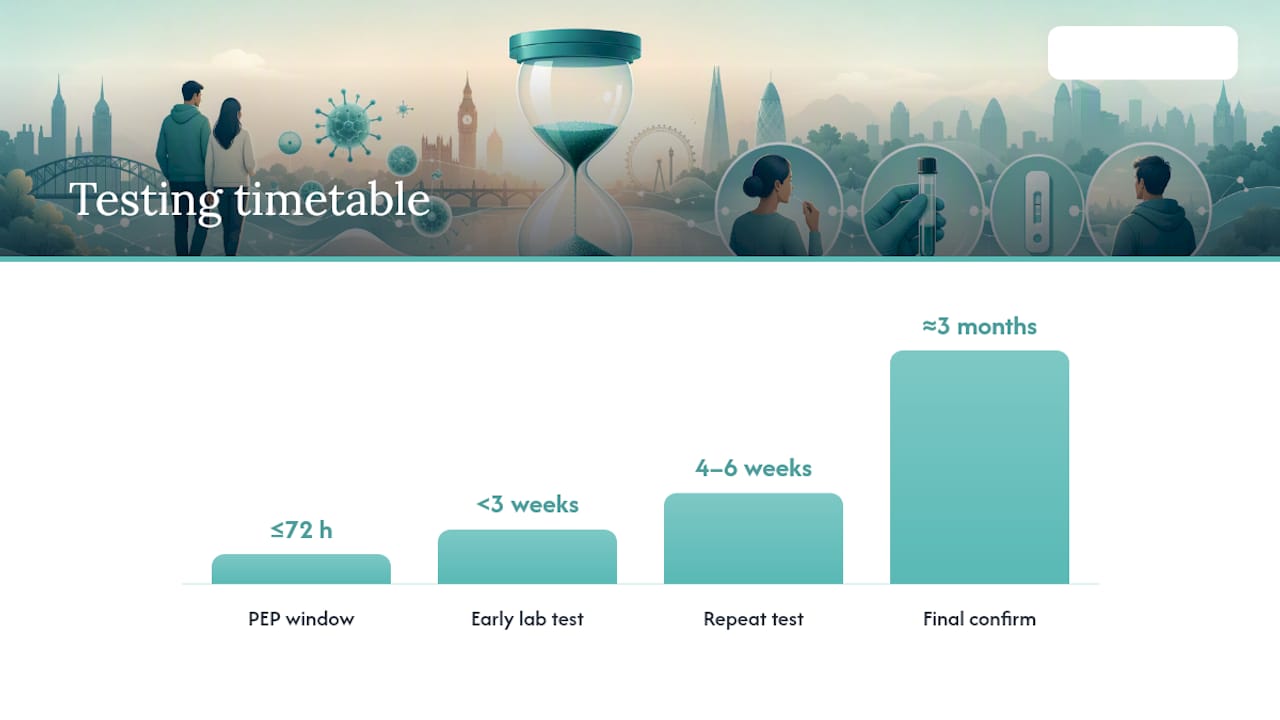
Timing decides almost everything here, so start with the clock. If your exposure happened within the last 72 hours, contact a sexual health clinic or emergency department without delay and ask about PEP (post-exposure prophylaxis). It only works within that window, and every hour you wait reduces its effectiveness.
Outside that 72-hour window, focus on testing at the right moments rather than testing immediately and hoping for certainty:
- Under 3 weeks since exposure: a NAT or lab-based fourth-generation test gives you the most information available this early.
- 4 to 6 weeks since exposure: repeat with a lab-based fourth-generation test.
- Around 3 months after exposure: a final confirmatory test at this time generally closes the window period for most people not on antiretrovirals.
If you’ve already used an at-home rapid test and it came back negative early on, don’t treat that as the final word. Follow it up with a lab-based fourth-generation test to be confident. Any reactive result, from any test type, needs a confirmatory lab test before it means anything definitive; testing algorithms are deliberately built with a sensitive first-line test followed by a more specific confirmatory one to avoid both missed diagnoses and false positives.
Pro Tip: When you contact a clinic or use Rapidtest’s guidance on testing after unprotected sex, mention exact exposure timing and whether you’re on PrEP, PEP, or ART. That detail changes how a clinician interprets your result.
Using at-home HIV kits responsibly
At-home kits are genuinely useful for convenient screening, but they have a real limitation: they’re antibody-based, so they’re weakest exactly when anxiety runs highest, in the days and weeks right after a suspected exposure. A negative result that early is not the same as a confirmed all-clear.
Accuracy for self-tests hinges almost entirely on following the instructions precisely, since user adherence is the main quality control at home, unlike a laboratory, which runs internal checks you never see.
- Read every instruction before you start, not partway through.
- Time the test exactly as directed. Reading too early is a common cause of a false negative.
- Use enough sample. Insufficient blood or fluid gives an unreliable result.
- Treat any reactive line as a signal to get lab confirmation, not a diagnosis.
Rapidtest’s HIV rapid test kit gives you results in 15 minutes and works well as a screening step, but if your exposure was recent, pair it with the lab testing timetable above rather than relying on it alone.
Where to check the science and get support
For deeper reading beyond this article, the World Health Organization’s consolidated HIV testing guidelines, aidsmap’s guide to false negative results, and MedlinePlus’s HIV screening test overview are solid, current starting points.
- WHO/NCBI consolidated testing guidance
- aidsmap for UK-relevant explainers on test accuracy
- MedlinePlus and CDC for test-type detail
For PEP or any reactive result, contact your local sexual health clinic or NHS service directly. A reactive result always needs confirmatory lab testing before it means anything final.
What actually matters here, and where the usual advice falls short
Most explainers on this topic bury the useful part. They’ll tell you window periods exist, then leave you to work out what that means for your own situation. The honest answer is that timing beats everything else. Test type matters, sample type matters, medication history matters, but none of it matters as much as knowing exactly how many days have passed since exposure and matching your test to that number.
The conventional advice to “just test and see” undersells how easily an early negative can mislead someone into relaxing prevention efforts too soon. If you’re on PrEP or recently finished PEP, that risk is higher still, because suppressed viral markers can quietly push your real window period further out than the standard guidance assumes.
Prioritise the retest schedule over the first result. A single early negative is a data point, not a verdict. Build your confidence from a properly timed lab-based fourth-generation test, and treat any at-home result in the first month as provisional, not proof.
— Jack
This article is general information, not a substitute for advice from a qualified doctor. Consult a qualified healthcare professional about your own circumstances before acting on anything here.
Sources
- HIV screening test | MedlinePlus
- False negative results on HIV tests | aidsmap
- CDC evaluation of rapid tests and early infection sensitivity (peer-reviewed study)
FAQ
How Likely Is a False Negative for HIV?
False negatives are most likely during the window period, in the first few weeks after exposure, and become extremely rare afterwards in people not taking antiretrovirals. Testing too early, or using an antibody-only test too soon, are the main drivers of a wrong result.
Why Do I Keep Thinking I Have HIV?
Persistent worry after a low-risk or already-negative test is common and usually reflects anxiety about the window period rather than a genuine ongoing risk. If reassurance from a correctly timed test doesn’t ease the worry, speak to a GP or sexual health clinic about the anxiety itself.
Can HIV Be Cured at the Early Stage?
No, HIV cannot currently be cured at any stage, early or otherwise. Antiretroviral treatment started early can control the virus very effectively and allow a near-normal life expectancy, which is why prompt, accurate testing matters so much.
When Is an HIV Test Accurate?
Accuracy depends entirely on matching the test to the time since exposure: NAT works from around 10 to 33 days, lab-based fourth-generation tests from about 18 to 45 days, and antibody-only tests may need up to 90 days to be reliable. Testing at 3 months with a fourth-generation assay gives most people a confident, final result.