


Can H pylori cause anxiety? What the evidence says
Helicobacter pylori infection is associated with a significantly increased risk of anxiety disorders, with a 2026 meta-analysis reporting an odds ratio of approximately 2.5 among infected individuals. That figure means infected people are roughly two and a half times more likely to develop anxiety than those without the infection. The question of whether H pylori can cause anxiety is not straightforward, though. The relationship runs in both directions: anxiety can also worsen gastric conditions, creating a cycle that is difficult to break without addressing both sides. This article explains what the research actually shows, why the biology makes sense, and what you can do about it.
Can H pylori cause anxiety? Understanding the infection first
Helicobacter pylori is a spiral-shaped bacterium that colonises the stomach lining. It is one of the most common chronic bacterial infections in the world, affecting a large proportion of the global population. Most people carry it without knowing, because symptoms are often absent or easy to dismiss.
When H pylori does cause problems, it damages the gastric mucosa, the protective lining of the stomach. This damage triggers local inflammation, which can progress to gastritis, peptic ulcers, and in some cases more serious complications. The infection is not confined to the stomach, though. It produces systemic effects that reach well beyond the digestive tract.
Common signs that H pylori may be present include:
- Persistent bloating or a feeling of fullness after small meals
- Burning or gnawing stomach pain, particularly when the stomach is empty
- Nausea, especially in the morning
- Frequent burping
- Unexplained fatigue or low mood
These symptoms overlap significantly with anxiety, which is part of why the connection between the two conditions is so easy to miss.
What does the research say about H pylori and mental health?
The evidence linking H pylori to anxiety has grown considerably in recent years. A 2026 meta-analysis found an odds ratio of ~2.5 for anxiety disorders among people with confirmed H pylori infection. That is a clinically meaningful association, not a marginal one.
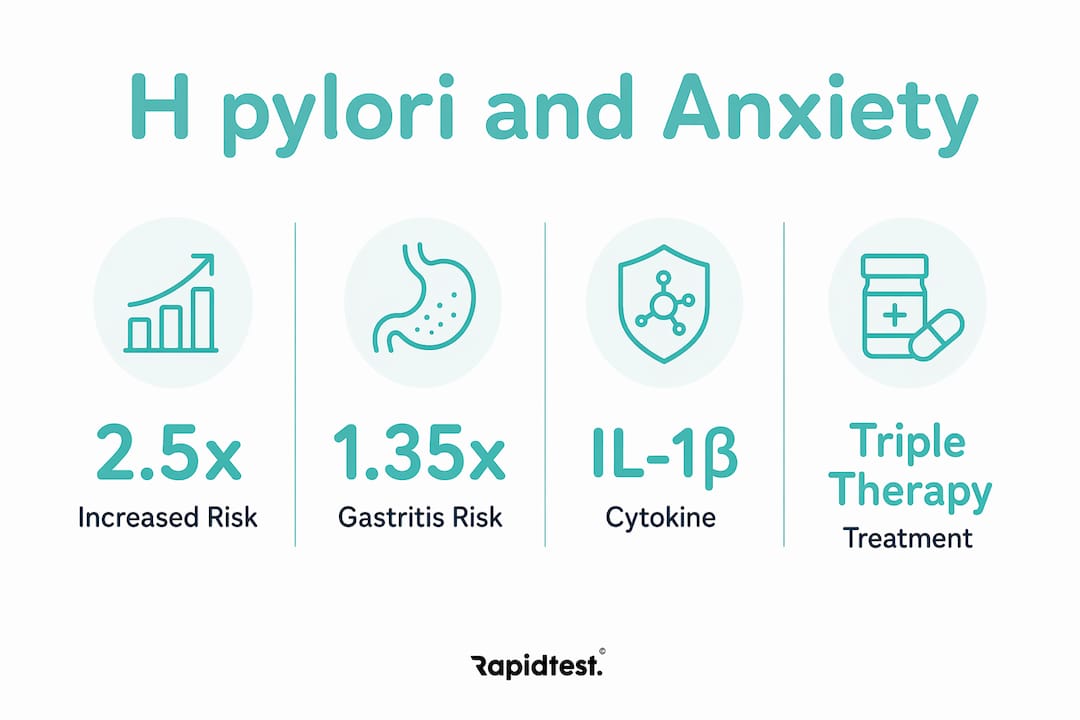
A separate large cohort study involving 502,357 participants found that gastritis, which is frequently caused by H pylori, doubles the risk of anxiety with a hazard ratio of 2.21. The scale of that study makes the finding hard to dismiss. When you see consistent results across both meta-analyses and population-level cohort data, the association becomes difficult to attribute to chance.
Clinical data supports this picture too. A study of 120 endoscopy patients found a significant correlation between H pylori positivity and elevated scores on the Beck Anxiety Inventory, a validated clinical tool used to measure anxiety severity. The p-value was 0.034, which meets the standard threshold for statistical significance.
“H. pylori is best regarded as a modifiable contributor to anxiety within a broader biopsychosocial framework, not as a sole cause. Treating the infection addresses one piece of a more complex picture.”
The relationship is also bidirectional. Anxiety disorders increase gastritis risk by roughly 1.35-fold on an adjusted basis. So the infection can worsen anxiety, and anxiety can worsen the conditions that allow H pylori to thrive. This feedback loop is one reason why people with both conditions often feel stuck.
| Study type | Key finding | Measure |
|---|---|---|
| 2026 meta-analysis | H pylori linked to anxiety disorders | Odds ratio ~2.5 |
| Cohort study (502,357 participants) | Gastritis doubles anxiety risk | Hazard ratio 2.21 |
| Clinical study (120 patients) | H pylori positivity correlates with anxiety scores | p = 0.034 |
| Population-based study | Anxiety increases gastritis risk | Adjusted OR = 1.35 |
What biological mechanisms connect stomach bacteria to anxiety?
The gut-brain-immune axis is the key pathway here. H pylori does not need to travel to the brain to affect your mood. It triggers a chain of biological events that do the work instead.

The infection causes the body to produce pro-inflammatory cytokines, including IL-1β, IL-6, and TNF-α. These signalling molecules cross into the central nervous system and interfere with neurotransmitter metabolism. Serotonin, dopamine, and cortisol regulation are all affected. Since serotonin is central to mood stability, disrupting its production has direct consequences for how you feel.
H pylori also interferes with hormones produced in the gut, particularly ghrelin and leptin. These hormones do not just regulate appetite. They also influence stress responses and emotional regulation. When their levels are thrown off by chronic infection, the downstream effects include mood changes, sleep disruption, and heightened anxiety responses.
The microbiome connection matters too. Disrupted gut flora reduces serotonin production and destabilises mood. H pylori actively disturbs the balance of gut bacteria, which compounds the inflammatory effects and creates a less stable environment for brain health.
Key biological pathways involved:
- Cytokine production: IL-1β, IL-6, and TNF-α interfere with brain neurotransmission and raise cortisol levels
- Serotonin disruption: Gut microbiome imbalance reduces serotonin synthesis, directly affecting mood
- Hormonal dysregulation: Altered ghrelin and leptin levels affect stress responses and emotional stability
- Vagus nerve signalling: Gut inflammation sends distress signals to the brain via the vagus nerve, amplifying anxiety responses
Pro Tip: If you experience persistent low mood alongside digestive symptoms like bloating or stomach pain, ask your GP about testing for H pylori. The two symptom clusters are often treated separately when they may share a common root.
How does anxiety affect H pylori infection and gastric health?
Anxiety does not just follow from H pylori infection. It can also precede and worsen it. This is the part of the story that often gets overlooked.
Psychological stress changes the gastric environment in ways that favour bacterial growth and mucosal damage. Stress hormones like cortisol suppress immune function, making it harder for the body to control existing infections. Chronic anxiety also alters gut motility and acid secretion, both of which affect how H pylori behaves in the stomach.
The practical implications of this are significant:
- Anxiety raises gastric vulnerability. Stress weakens the mucosal barrier, giving H pylori easier access to the stomach lining.
- Immune suppression slows recovery. Chronic psychological stress reduces the immune response needed to keep the infection in check.
- Stress worsens symptoms. Even after successful eradication, ongoing anxiety can perpetuate gastric symptoms that feel identical to active infection.
- The cycle reinforces itself. Gastric discomfort increases anxiety, which worsens gastric conditions, which increases anxiety further.
Pro Tip: Managing anxiety through evidence-based approaches like cognitive behavioural therapy or structured relaxation can reduce the physiological stress load on your gut. This is not a replacement for treating H pylori, but it is a meaningful part of recovery.
Understanding this cycle matters because it changes how you approach treatment. Eradicating the infection alone may not be enough if chronic anxiety continues to drive inflammation and mucosal damage.
What should you know about treatment and managing anxiety linked to H pylori?
Standard H pylori treatment uses triple therapy, which combines a proton pump inhibitor with two antibiotics, typically clarithromycin and amoxicillin, taken over 7–14 days. This regimen is effective at clearing the infection in most cases. However, eradication does not guarantee anxiety resolution.
Anxiety symptoms may persist after treatment for several reasons. The microbiome takes time to rebalance. Inflammation does not clear overnight. And if anxiety has become a conditioned response, it can continue independently of the original physical trigger. Patients who expect immediate mood improvement after eradication are often disappointed, and that disappointment can itself worsen anxiety.
There is also a lesser-known treatment consideration worth flagging. Clarithromycin, one of the antibiotics in standard triple therapy, can cross the blood-brain barrier. In rare cases, it causes reversible neuropsychiatric effects including psychosis and hallucinations. These effects typically appear within days of starting treatment and resolve after the antibiotic is stopped. They are uncommon, but worth knowing about if you or someone you care for is starting triple therapy.
Practical guidance for managing this period:
- Tell your doctor about existing anxiety. It affects treatment planning and helps your GP monitor for neuropsychiatric side effects.
- Support your microbiome during and after treatment. Probiotic-rich foods and, where appropriate, probiotic supplements can help restore gut balance.
- Do not expect a quick fix for mood. Anxiety linked to H pylori often improves gradually over weeks to months, not days.
- Seek mental health support in parallel. Treating the infection addresses one contributor. Therapy or structured stress management addresses others.
- Follow up after eradication. Confirm the infection has cleared with a follow-up test, since incomplete eradication is a common reason symptoms persist.
Key takeaways
H pylori infection is a genuine, modifiable contributor to anxiety, and treating it is one concrete step towards better mental wellbeing alongside gut health.
| Point | Details |
|---|---|
| H pylori raises anxiety risk | A 2026 meta-analysis found an odds ratio of ~2.5 for anxiety disorders in infected individuals. |
| The relationship is bidirectional | Anxiety also increases gastritis risk, creating a cycle that requires addressing both conditions. |
| Inflammation is the key mechanism | Cytokines like IL-1β and IL-6 disrupt serotonin and cortisol, directly affecting mood. |
| Eradication helps but is not a cure-all | Anxiety symptoms may persist after treatment due to microbiome imbalance and multifactorial causes. |
| Testing is the logical first step | Confirming infection status gives you and your GP the information needed to act. |
Why I think most people are asking the wrong question about H pylori and anxiety
People come to this topic asking “can stomach bacteria cause anxiety?” and they want a yes or no. The honest answer is: yes, but that framing undersells the complexity. What I have seen, reading through the research and thinking about how people actually experience this, is that H pylori is rarely the sole cause of anxiety. It is more often the thing that tips someone over the edge when other stressors are already present.
The gut-brain connection is real and well-evidenced. But the mistake is treating it as a simple cause-and-effect chain. Eradicate the bacteria, fix the anxiety. That is not how it works. The gut-brain-immune axis involves inflammation, hormones, the microbiome, and psychological history all at once. Pulling one thread does not unravel the whole knot.
What I find genuinely useful in the research is the concept of H pylori as a modifiable contributor. That framing is empowering. You cannot always change your stress history or your genetic predisposition to anxiety. But you can test for an infection, treat it, and give your gut the best chance of recovery. That is a concrete action in a situation that often feels out of control.
If you are experiencing anxiety alongside digestive symptoms, do not wait for one to resolve before addressing the other. Get tested. Talk to your GP about both. And be patient with your body. Recovery from a chronic infection takes time, and so does mood stabilisation.
— Jack
Check your gut health from home with Rapidtest
If you have been reading this and wondering whether H pylori could be a factor in how you have been feeling, the most useful thing you can do right now is find out whether you have the infection.
Rapidtest’s at-home H pylori test kit gives you a clear result in 15 minutes, with no GP appointment, no lab visit, and no waiting room. You collect the sample at home, follow the simple instructions, and get your answer quickly. If the result is positive, you have something concrete to take to your doctor. If it is negative, you can rule out one significant contributor and look elsewhere. Either way, you know. Browse the full range of health screening kits at Rapidtest to see what else you can check from home.
FAQ
Can H pylori directly cause anxiety?
H pylori does not cause anxiety in a simple, direct way, but it significantly raises the risk. A 2026 meta-analysis found an odds ratio of approximately 2.5 for anxiety disorders among infected individuals, driven by inflammatory and hormonal pathways that affect brain function.
How does H pylori affect mood?
H pylori triggers the release of cytokines including IL-1β, IL-6, and TNF-α, which interfere with serotonin and cortisol regulation. Disrupted gut flora from the infection further reduces serotonin production, directly affecting mood stability.
Will treating H pylori improve my anxiety?
Eradication therapy can improve digestive symptoms and may reduce anxiety over time, but it does not guarantee mood improvement. Anxiety symptoms often persist due to microbiome imbalance, ongoing inflammation, and psychological factors that require separate management.
Can anxiety make H pylori worse?
Yes. Anxiety disorders increase gastritis risk by approximately 1.35-fold on an adjusted basis. Chronic stress suppresses immune function and alters the gastric environment, making it harder for the body to control the infection.
How do I know if I have H pylori?
The most practical first step is an at-home test. Rapidtest offers an H pylori home test that delivers results in 15 minutes. A positive result should be followed up with your GP to confirm and discuss treatment options.