


Syphilis window period: when to test and what to do
Most syphilis tests will pick up an infection by 6 weeks after exposure, but sexual health services recommend waiting until 12 weeks (3 months) before trusting a negative result completely. That gap between “likely detectable” and “definitively clear” is the whole story behind the confusing testing timelines you’ll see quoted across NHS pages and clinic leaflets.
If you’ve got a painless sore, ulcer, or rash anywhere near your genitals, mouth, or body, don’t wait for any window period to close. Get seen now.
- Painless sore or chancre present? Seek urgent clinical assessment today. A swab can detect infection before blood tests can.
- Worried but no symptoms? Test at 6 weeks, then confirm at 12 weeks if the first result is negative.
- Just want routine peace of mind? An at-home rapid syphilis test from 6 weeks onward is a sensible first check.
Pro Tip: A negative test at 2 weeks tells you almost nothing useful yet. Your body simply hasn’t had time to build a detectable antibody response.
Key Takeaways
Reliable syphilis detection depends on timing your test to your body’s antibody response, not just the calendar since exposure.
| Point | Details |
|---|---|
| Six weeks is a starting point | Most people develop detectable antibodies within 3 to 6 weeks, making 6 weeks a sensible first test. |
| Twelve weeks confirms a negative | Conservative clinic guidance treats 12 weeks as the point a negative result can be trusted fully. |
| Symptoms override the calendar | A painless chancre or rash needs urgent assessment immediately, regardless of how long since exposure. |
| Retesting catches early false negatives | Roughly 20 to 30% of nontreponemal tests stay negative even with a chancre present, so a single test isn’t enough. |
| Rapidtest fits the 6 week screening step | The at-home syphilis kit gives a result in 15 minutes and works well as a screening check from 6 weeks onward, with clinical confirmation needed for any positive. |
This article is general information, not a substitute for advice from a qualified doctor. Consult a qualified healthcare professional about your own circumstances before acting on anything here.
Table of Contents
- Why the syphilis window period exists: how the tests actually work
- What are the typical syphilis window periods you’ll see quoted?
- What should you do right now if you have symptoms or a recent high-risk exposure?
- When should you retest if your first result was negative?
- How do at-home rapid syphilis tests fit into this timeline?
- What is the syphilis incubation period, and how does it relate to the window period?
- How does the window period differ across primary, secondary, and latent syphilis?
- Can you pass on syphilis during the window period?
- How reliable are syphilis tests during the window period?
- What should you do about risk reduction while you’re waiting to test?
- Sources
- FAQ
Why the syphilis window period exists: how the tests actually work
Syphilis testing relies on two different families of blood test, and understanding the difference explains almost everything about why timing matters. Treponemal tests (TPPA, TPHA, and modern treponemal immunoassays) detect antibodies specific to Treponema pallidum, the bacterium that causes syphilis. Once positive, they usually stay positive for life, even after successful treatment. Non-treponemal tests (RPR, VDRL) measure a more general antibody response and are used to track disease activity and response to treatment, since their levels rise and fall.
Both test types depend on your immune system producing enough antibody to register as “reactive,” and that process, called seroconversion, typically takes roughly 3 to 6 weeks after exposure. Test too early, and your immune system simply hasn’t caught up yet.
A negative result inside the seroconversion window doesn’t rule out infection. It means your body hasn’t finished responding, not that nothing happened.
If a chancre (an ulcer at the site of infection) is visible, clinicians can sometimes detect the bacteria directly through a lesion swab, dark-field microscopy, or PCR, which may pick up infection before blood serology turns positive. This is genuinely useful early on, though it isn’t standard practice at every clinic and depends on lesion accessibility.
A few factors can blunt sensitivity further:
- HIV co-infection or other immunosuppression can delay or blunt antibody response.
- Very early testing (under 2 weeks) has almost no diagnostic value.
- Some clinicians will offer presumptive treatment rather than wait for serology to catch up, particularly for confirmed exposures.
What are the typical syphilis window periods you’ll see quoted?
Ask three different sexual health services when to test for syphilis and you might get three slightly different answers, and it’s not because anyone’s wrong. Guidance genuinely splits into two tiers.
Most services agree that antibodies typically develop within 3 to 6 weeks of exposure, which is why 6 weeks appears so often as a practical first testing point. But “most people will show a positive result by 6 weeks” isn’t the same claim as “a negative result at 6 weeks rules out infection.” That’s why the more conservative clinics, including many UK sexual health services, list 12 weeks as the window for a definitive negative.
Here’s a simple way to think about which timeline applies to you:
- You have symptoms or a visible chancre. Skip the calendar entirely and get assessed now. Timing rules don’t apply when there’s a physical sign to investigate.
- You’re anxious after a specific exposure but have no symptoms. Test at 6 weeks for an early read, then retest at 12 weeks to confirm a negative result definitively.
- You’re testing as part of routine sexual health screening with no known exposure. Follow your clinic’s standard interval for preventive care, and increase frequency if you have multiple partners or other risk factors.
Even when a chancre is present, roughly 20 to 30% of nontreponemal tests can still come back nonreactive at that early stage. That single figure explains why “test once and move on” is bad advice for anyone with a genuine exposure concern.
What should you do right now if you have symptoms or a recent high-risk exposure?
A painless ulcer is the classic early sign of syphilis, and it’s easy to dismiss precisely because it doesn’t hurt. Don’t wait it out.
- Book an urgent appointment at a sexual health clinic (GUM service) rather than a routine GP slot, since they can swab the lesion directly.
- Expect a swab, PCR, or dark-field microscopy test on the lesion itself, alongside standard blood serology.
- Tell the clinician exactly when the exposure happened. This lets them judge whether presumptive treatment makes sense.
Presumptive treatment means starting antibiotics based on exposure history and clinical judgement, before serology confirms anything, and it’s used specifically when waiting for antibodies to develop carries real onward-transmission risk. This applies particularly to confirmed partners of someone recently diagnosed with early syphilis.
Partner notification isn’t optional admin. If you’re diagnosed, recent partners need to know so they can be assessed and, where appropriate, treated within the same exposure window.
Pro Tip: Write down the date of the exposure you’re worried about as soon as you notice it. Clinicians build the entire testing and treatment plan around that single date.
When should you retest if your first result was negative?
One negative test rarely closes the book, especially if it was taken soon after exposure. Sexual health services build retesting into the plan deliberately, not as an afterthought.
- Retest at 2 to 4 weeks after an early test if your first check happened close to the exposure date itself, since this catches early seroconverters.
- Retest at 12 weeks regardless, if there’s genuine concern about a specific exposure, to allow the full antibody response window to close.
- Watch for titre trends, not single results. Clinicians look at seroconversion or a fourfold change in nontreponemal titres across serial tests, since this pattern confirms recent infection far more reliably than one snapshot.
Keep a simple record of test dates and results. If exposure was definite or any symptoms appear later, that record makes follow-up conversations with a clinician far faster.
How do at-home rapid syphilis tests fit into this timeline?
An at-home rapid syphilis test from Rapidtest detects treponemal antibodies from a small finger-prick blood sample and gives a result in around 15 minutes, no clinic visit or lab return required.
The same biology applies here as anywhere else: an at-home kit can’t outrun seroconversion. Testing before your body has produced detectable antibodies will give you a negative result whether you’re in a clinic or your own kitchen.
- Use it as a screening step from 6 weeks after exposure onwards.
- If you’re symptomatic (any sore, ulcer, or rash), don’t rely on an at-home test. See a clinician first.
- A positive result always needs clinical confirmation and treatment, an at-home kit is a screening tool, not a diagnosis.
What is the syphilis incubation period, and how does it relate to the window period?
The incubation period and the window period are related but answer different questions, and mixing them up is where a lot of the confusion online comes from.
Incubation is the time between exposure and the first physical sign of infection, typically the chancre. For syphilis, that’s roughly 10 to 90 days, with a median around 21 to 25 days. The window period, by contrast, is about your immune system’s antibody response, not the appearance of symptoms.
Here’s why that distinction matters practically: a chancre can appear before your blood test would reliably turn positive. Someone exposed on day one might develop a visible sore around day 21, weeks before their antibody levels are high enough for a blood test to register. This is exactly why lesion swabbing exists as a separate diagnostic route, catching infection during that gap between visible symptoms and confirmed serology.
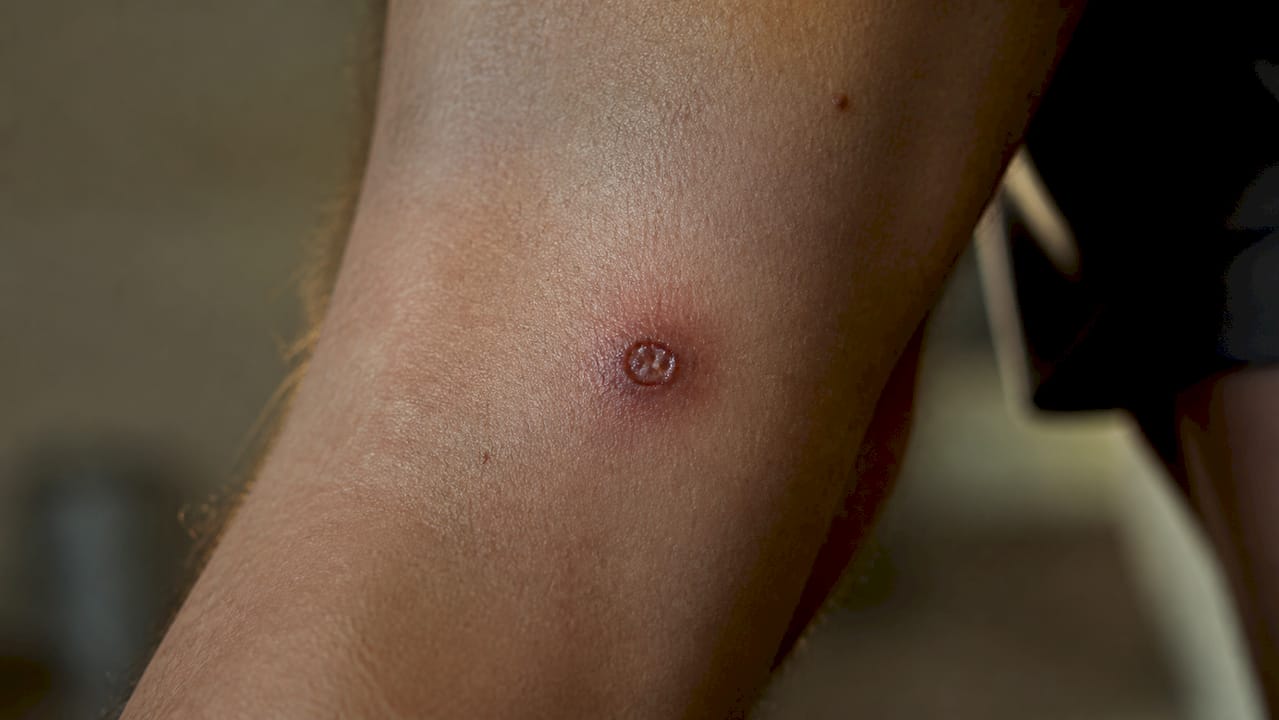
The chancre itself typically resolves within 3 to 6 weeks even without treatment, which creates a genuinely dangerous trap. People see the sore disappear and assume the problem has resolved itself. It hasn’t. The bacterium is still present, the infection has simply moved into a phase with no visible signs, and it will progress to secondary syphilis if untreated. A vanished symptom is not a cleared infection, and it’s one of the more common reasons people delay testing until secondary-stage symptoms force the issue.
How does the window period differ across primary, secondary, and latent syphilis?
Syphilis doesn’t sit still, and the window period question looks different depending on which stage you’re asking about.
Primary syphilis is the chancre stage, roughly 3 to 6 weeks after exposure. This is where the true window period lives, the gap between infection and reliable antibody detection. Testing here can be a coin toss: some people are already reactive, a meaningful minority are not.
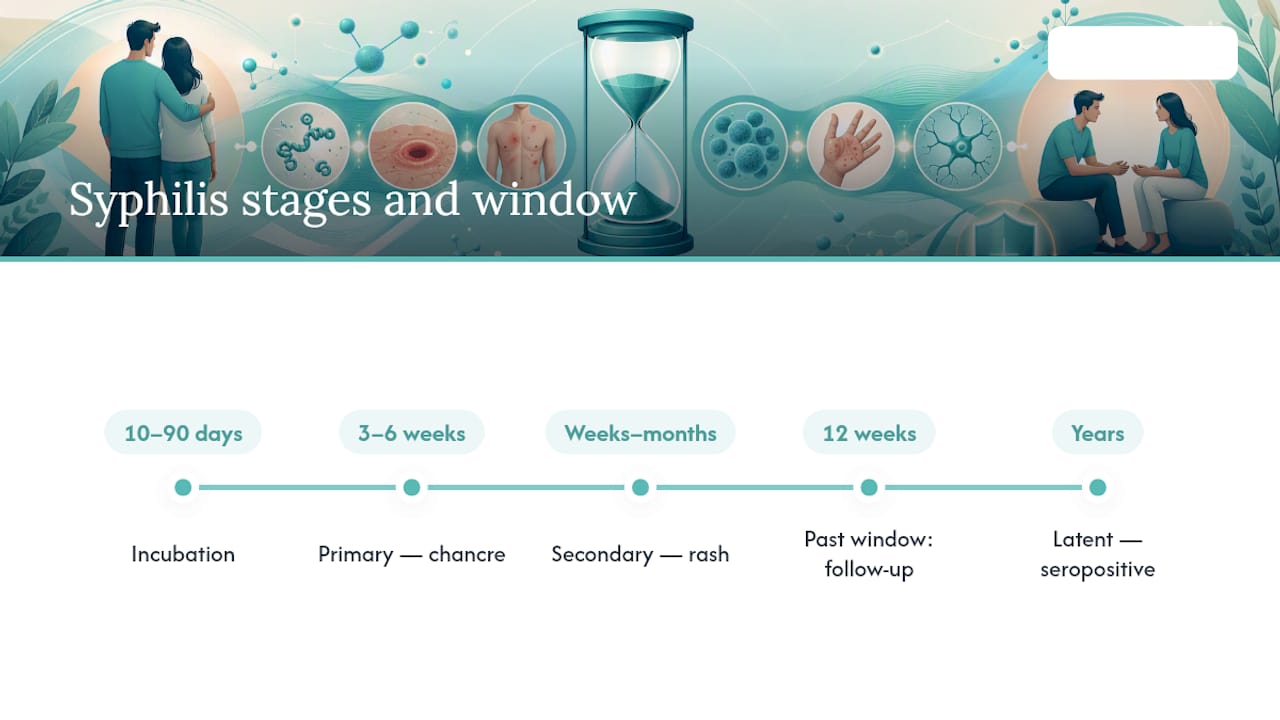
Secondary syphilis typically appears weeks to a few months after the chancre resolves, often as a rash on the palms and soles, alongside fever or swollen glands. By this stage, the window period question is essentially moot. Antibody levels are almost always well established and both treponemal and non-treponemal tests are reliably positive. If anything, secondary-stage symptoms are a strong prompt to test immediately rather than wait for any calendar-based schedule.
Latent syphilis is the stage where there are no symptoms at all, sometimes for years, but the infection remains serologically detectable and still requires treatment. Someone diagnosed at this stage isn’t in a “window period” in the timing sense. They’re well past it. The original exposure may have happened long enough ago that neither the person nor a clinician can pin down an exact date, which is part of why routine screening for anyone sexually active matters, not just testing tied to a specific remembered event.
The practical upshot: window period anxiety belongs almost entirely to the primary stage. Once you’re past 12 weeks with ongoing risk or unresolved symptoms, the conversation shifts from “is it too early to test” to “this needs proper clinical follow-up.”
Can you pass on syphilis during the window period?
Yes, and this is arguably the most overlooked part of window period guidance. Infectivity has nothing to do with whether a blood test can detect antibodies yet.
Syphilis is most transmissible during the primary and secondary stages, precisely when a chancre or rash is present, which is also exactly when someone is most likely to still be within the antibody window period. In other words, the period when you’re least likely to test positive can be the period when you’re most likely to pass the infection on to someone else.
This is the clinical reasoning behind presumptive treatment. If a clinician knows someone had confirmed contact with a diagnosed partner, waiting weeks for serology to catch up before treating means leaving a transmissible infection untreated during the exact stretch when it’s doing the most damage to onward partners. Treating first and confirming with serology afterwards closes that gap.
It’s also the reasoning behind partner notification timelines that reach back further than most people expect. Public health guidance around partner notification for early syphilis typically covers exposures going back 3 months for primary syphilis, precisely because that stretches back through the entire window period where someone might have been infectious without knowing it themselves.
If you’ve been diagnosed, or you’re waiting on results after a known exposure, treat that period as if transmission risk is live, not theoretical. Abstaining from sex, or using barrier protection consistently, until you have a confirmed result and any necessary treatment isn’t overcaution. It’s the only way to interrupt a chain of transmission that testing alone can’t fully account for in real time.

How reliable are syphilis tests during the window period?
No test is uniformly reliable during the early window, and the sensitivity gap is the entire reason retesting exists as formal guidance rather than an optional extra.
Non-treponemal tests (RPR, VDRL) are particularly prone to early false negatives. Even with a chancre visibly present, 20 to 30% can still come back nonreactive. Treponemal tests generally become reactive slightly earlier and stay positive for life, which makes them useful for confirming past infection but less useful for pinpointing exactly when someone was exposed.
Specificity issues run the other way. Non-treponemal tests can occasionally produce false positives unrelated to syphilis at all, triggered by pregnancy, certain autoimmune conditions, or other infections. This is precisely why a reactive non-treponemal result is always followed up with a treponemal-specific confirmatory test rather than treated as a diagnosis on its own.
Swab-based methods (dark-field microscopy, PCR) sidestep the antibody problem entirely by looking for the bacterium directly, but they only work when a lesion is present and accessible, and they’re not part of routine screening for people without symptoms.
Underlying health conditions add another layer. HIV co-infection or other immune suppression can delay antibody development further, stretching the effective window period beyond the usual 6 to 12 week guidance. Anyone with a compromised immune system and a genuine exposure concern should treat 12 weeks as a floor, not a target, and discuss an extended retesting plan with a clinician rather than assuming standard timelines apply.
What should you do about risk reduction while you’re waiting to test?
The waiting period between exposure and a confirmatory test is exactly when the transmission risk conversation above becomes personal. A few practical steps make that stretch safer for you and anyone you’re intimate with.
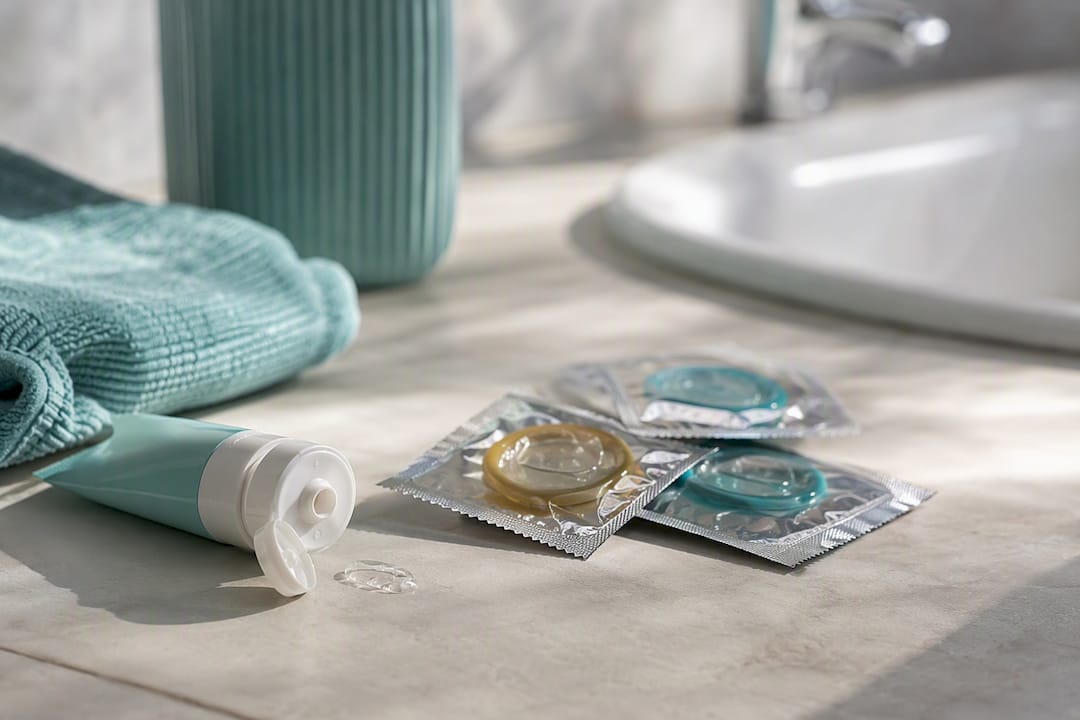
Use condoms or other barrier protection consistently until you have a confirmed negative result, particularly if you had a specific exposure you’re concerned about. Avoid oral, vaginal, or anal sex with new or existing partners without protection during this period, given that syphilis transmits through direct contact with a chancre or rash that isn’t always visible or recognised as such.
Be straightforward with partners about the situation. It’s an uncomfortable conversation, but it’s a far smaller one than the alternative. Telling someone you’re mid-testing after a specific exposure gives them the chance to make an informed decision, and it’s the same courtesy you’d want extended to you.
If you test positive at any point, partner notification isn’t just a formality, it’s how the transmission chain actually gets interrupted. Sexual health clinics can usually help manage this discreetly if you’re uncomfortable doing it directly yourself.
Finally, don’t let one clear test talk you out of ongoing screening if your risk profile hasn’t changed. A single negative result at 12 weeks tells you about that specific exposure. It says nothing about next month.
A straightforward view on the testing timeline
The 6 week versus 12 week debate you’ll see online isn’t really a contradiction, it’s two different questions wearing the same headline. Six weeks tells you when most people will show up positive. Twelve weeks tells you when you can trust a negative. Conflating the two is where most of the anxiety comes from.
My honest read on this: the biggest mistake isn’t testing too early, it’s testing once and stopping. Antibody development is a process, not a switch, and a single result at any point is a snapshot, not a guarantee. If there’s genuine exposure to worry about, build the retest into your calendar from day one rather than treating it as optional.
If you’ve got symptoms, none of this timing math applies to you anyway. See a clinician now.
— Jack
Screening made simple, without the waiting room
There’s a real gap between “I want to check this” and “I want to book a GUM clinic appointment,” and that gap is exactly where a lot of people just… don’t test. Rapidtest closes it. The at-home syphilis rapid test kit gives you a result from a finger-prick sample in around 15 minutes, no referral, no lab return, no sitting in a waiting room explaining yourself to a stranger.
It fits neatly into the timeline covered above: use it as your screening step from 6 weeks after exposure, then follow the same retest logic if you want extra confirmation at 12 weeks. If you get a positive result, or you develop any symptoms at all, treat that as your cue to get clinical confirmation and treatment, not as an endpoint. For a fuller check alongside other common infections, the health screening test kit range covers broader panels if you’d rather test for several things in one go. Order a kit, test on your own schedule, and get a clear answer without rearranging your week around it.
Sources
- Syphilis: screening and diagnostic testing — UpToDate
- West of Scotland sexual health clinical guidelines — primary syphilis
- Syphilis — CDC treatment guidelines
FAQ
Can syphilis show up 3 months later?
Yes. Latent syphilis can remain undetected for months or years without symptoms, which is why 12 weeks is treated as a confirmation point rather than a guarantee that no infection is developing at all beyond it.
Is a 6-week syphilis test accurate?
A test at 6 weeks catches most infections, since antibodies typically develop within 3 to 6 weeks, but it isn’t definitive. Clinics recommend confirming with a second test at 12 weeks if there’s genuine exposure concern.
How soon after exposure can you test positive for syphilis?
Some people test positive within 2 to 3 weeks if a chancre is already present, but antibody-based blood tests generally need 3 to 6 weeks to become reliably reactive.
Is 2 weeks too early for an STI test?
For syphilis specifically, yes. Two weeks falls well within the incubation and seroconversion period, so a negative result at that point carries very little reassurance and shouldn’t be treated as a final answer.
Does a negative test at 6 weeks mean I’m in the clear?
Not entirely. A negative result at 6 weeks is reassuring but sexual health services still recommend retesting at 12 weeks, since a small proportion of people take longer to seroconvert, particularly with certain risk factors.