


LH:FSH in PCOS: Why 1.0–2.5 Cutoffs Aren't Diagnostic
A raised LH:FSH ratio turns up in many cases of PCOS, but it’s not a stand-alone diagnostic test. Guidelines like the Rotterdam criteria don’t require it at all. Studies often use cut-offs above 1.0, 2.0, or 2.5 when blood is drawn on days 1 to 5 of your cycle, yet plenty of women with confirmed PCOS have a perfectly normal ratio. Think of it as a clue, not a verdict.
TL;DR:
- An elevated LH:FSH ratio is common in PCOS but is not definitive for diagnosis and varies depending on testing timing and individual factors.
- The ratio typically exceeds 1.0, 2.0, or 2.5 in some cases, yet many women with PCOS have normal ratios, especially those with higher BMI or insulin resistance.
- Hormonal variations reflect changes in hypothalamic signals, with increased GnRH pulses raising LH and androgen production, but this pattern is not consistent across all women with PCOS.
- The ratio is useful as supporting evidence alongside ultrasound and androgen levels, but it should never be used alone to diagnose or exclude PCOS.
- Accurate assessment requires testing blood on days 1 to 5 of the cycle, and at-home hormone kits can provide preliminary data but should be followed by clinical testing.
Table of Contents
- Understanding the LH FSH ratio and what counts as normal
- Why LH:FSH shifts in PCOS and what’s actually happening hormonally
- What the LH FSH ratio actually proves in a PCOS diagnosis
- Getting LH and FSH tested: timing, methods, and what can throw off your results
- What happens after an abnormal result
- How the ratio actually shapes treatment decisions
- Why the ratio doesn’t look the same for every woman with PCOS
- What LH:FSH ratio tells you about your fertility outlook
- Why context matters more than the number itself
- Screening your hormones at home before you see a clinician
- Sources
- FAQ
Understanding the LH FSH ratio and what counts as normal
Two hormones sit at the centre of this conversation. Luteinising hormone (LH) triggers ovulation, while follicle-stimulating hormone (FSH) encourages your ovaries to develop follicles each cycle. In a typical cycle, they work in a fairly balanced partnership, with FSH rising slightly first to recruit follicles, then LH surging mid-cycle to release an egg.
In women without PCOS, the LH FSH normal range usually sits close to 1:1 during the early follicular phase. That’s the benchmark most labs and clinicians use when they talk about “normal.”
Where it gets murky is the cut-off point used to flag PCOS. You’ll see different numbers depending on which study you read:
- Some use a ratio above 1.0 as a threshold
- Others use above 2.0
- Older and some current research still references above 2.5 as the classic PCOS marker
None of these numbers is universally agreed, partly because labs use different assay methods, and reference ranges shift between machines and manufacturers. That’s one reason testing timing matters so much: blood taken on day 1 to 5 of your cycle, during the early follicular phase, gives the most consistent and comparable reading. Test outside that window, particularly if your cycles are irregular, and the numbers become far harder to interpret.
Why LH:FSH shifts in PCOS and what’s actually happening hormonally
The altered ratio isn’t random. It reflects a genuine change in how your brain talks to your ovaries.
In PCOS, the hypothalamus tends to release gonadotrophin-releasing hormone (GnRH) in faster, more frequent pulses. This shift in GnRH pulse frequency favours LH production over FSH, which is why LH climbs relative to FSH rather than both hormones moving together.
That extra LH doesn’t sit idle. It pushes the ovaries to produce more androgens, the hormones behind acne, excess hair growth, and scalp thinning that many women with PCOS recognise all too well. At the same time, relatively low FSH means follicles struggle to mature properly, often stalling partway through development. This is the follicular arrest that gives polycystic ovaries their characteristic appearance on ultrasound, dozens of small, immature follicles that never quite reach ovulation.
Here’s the part that surprises a lot of people: this pattern doesn’t apply evenly across everyone with PCOS.
- Lean women with PCOS tend to show the classic high LH, low FSH pattern more consistently
- Women with PCOS and a higher BMI often show a smaller gap between LH and FSH, sometimes no elevation at all
- Insulin resistance, common in PCOS regardless of body weight, independently pushes androgen production higher, muddying the picture further
Pro Tip: If your ratio comes back normal but you have other PCOS symptoms, don’t assume you’ve been misdiagnosed. The ratio is one piece of evidence among several, and a normal reading doesn’t rule PCOS out.
What the LH FSH ratio actually proves in a PCOS diagnosis
Here’s where a lot of confusion sets in. The Rotterdam criteria, the framework most clinicians in the UK and beyond use, requires two of three features: irregular or absent ovulation, clinical or biochemical signs of excess androgens, and polycystic-appearing ovaries on ultrasound. LH:FSH ratio doesn’t appear anywhere on that list.
The evidence gap: Research comparing women with PCOS against healthy controls consistently finds substantial overlap in LH:FSH values between the two groups. A raised ratio shows up in many PCOS cases, but a meaningful proportion of women with the condition never show it, and some women without PCOS have elevated ratios too.
That overlap is exactly why clinical research has questioned whether the ratio is sensitive or specific enough to be used alone. A test needs to reliably flag people who have a condition (sensitivity) and reliably clear people who don’t (specificity). LH:FSH does neither job well on its own.
So where does it actually help?
- As supporting evidence alongside ultrasound, androgen levels, and cycle history
- As a talking point when your other results are borderline and a clinician is weighing the full picture
- As a marker worth tracking over time if you’re already diagnosed and monitoring treatment response
Where it shouldn’t be used: as the deciding factor. If a GP or fertility clinic tells you that a normal ratio rules out PCOS, or that a raised one confirms it, that’s an oversimplification the guidelines don’t support.
Getting LH and FSH tested: timing, methods, and what can throw off your results
Getting a useful reading comes down to one thing above all else: timing.
- Test during days 1 to 5 of your cycle. This early follicular window gives the most standardised, comparable result, because hormone levels are relatively stable before the mid-cycle LH surge kicks in.
- Note your cycle day if periods are irregular. With PCOS, cycles often stretch well beyond 35 days or disappear for months. If you can’t pinpoint day 1 to 5, tell your clinician. They may use a random sample alongside progesterone testing to build a fuller picture instead.
- Choose the right test type for the job. A venous blood draw processed in a laboratory gives quantitative values, the actual numbers your ratio is calculated from. At-home LH tests, by contrast, are usually designed to detect the ovulation surge rather than give a precise numeric reading, so they serve a different purpose.
- Flag anything that might interfere. Hormonal contraception, a recent pregnancy, breastfeeding, and perimenopause can all shift LH and FSH levels independently of PCOS. Certain medications interfere too, so mention everything you’re taking.
Pro Tip: If you’re using an at-home test to screen your levels before a GP appointment, write down the exact cycle day you tested. That single detail makes your result far more useful to a clinician than the number alone.
What happens after an abnormal result
An unusual LH:FSH reading, high or low, is rarely the end of the conversation. It’s usually the start of one.
Clinicians typically follow up with a small panel of further tests rather than relying on repeat gonadotrophin checks alone. Testosterone and sex hormone-binding globulin (SHBG) help confirm or rule out androgen excess. A pelvic ultrasound checks for the follicle pattern associated with polycystic ovaries. Given how closely PCOS is tied to metabolic risk, many clinicians also request an oral glucose tolerance test (OGTT) and a lipid profile, since insulin resistance and cholesterol changes are common companions to the hormonal picture.
Certain findings should speed up a referral to gynaecology or endocrinology rather than waiting for routine follow-up:
- Rapid onset of male-pattern hair growth or voice changes (virilisation)
- Very high testosterone levels, which can occasionally point to a rarer adrenal or ovarian cause rather than PCOS
- Persistent absence of periods alongside abnormal scan findings
Once PCOS is confirmed, management goals centre on the symptoms and long-term risks, not on chasing a “normal” ratio back into range. That might mean lifestyle changes to improve insulin sensitivity, medication such as metformin, hormonal treatment to manage androgen symptoms or regulate cycles, or fertility-specific treatment if conception is the goal. Treating the underlying metabolic and androgenic drivers tends to matter far more clinically than the ratio itself ever will.
How the ratio actually shapes treatment decisions
A raised LH:FSH ratio doesn’t dictate a specific prescription, but it does help clinicians build a fuller clinical picture that steers where treatment focuses first.
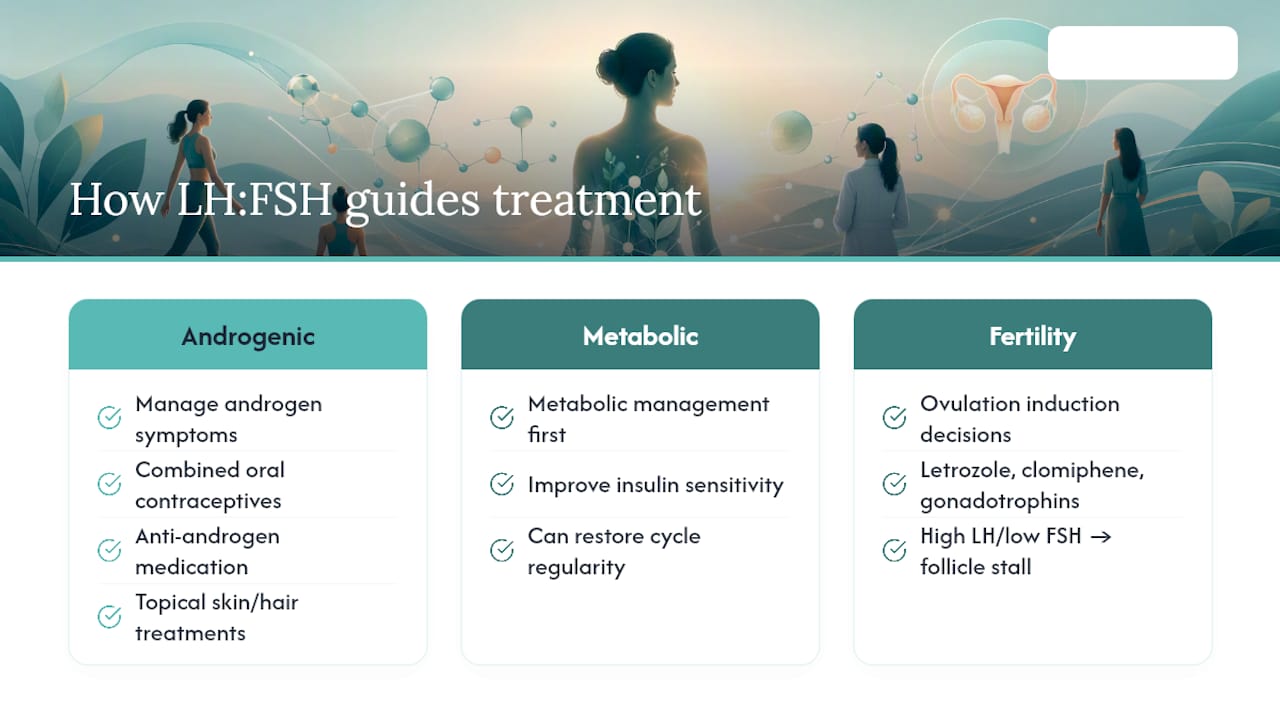
If your ratio is high alongside elevated testosterone, treatment often leans towards managing androgen symptoms directly, combined oral contraceptives, anti-androgen medication, or topical treatments for skin and hair concerns. If insulin resistance markers come back abnormal alongside the hormonal picture, the focus often shifts towards metabolic management first, since improving insulin sensitivity can, in some women, help regulate the underlying hormone imbalance and improve cycle regularity as a knock-on effect.
For women trying to conceive, the ratio feeds into decisions about ovulation induction. A pattern of high LH and low FSH partly explains why follicles stall before maturing, information that helps a fertility specialist choose between treatments like letrozole, clomiphene, or gonadotrophin injections, each of which works on a slightly different part of that same hormonal imbalance.
What it doesn’t do is set a treatment target on its own. No clinician aims to bring your LH:FSH ratio back to 1:1 as an endpoint. The number is a signpost pointing towards which system, reproductive, metabolic, or androgenic, needs the most attention right now. Treat it as one input into a broader conversation about your symptoms, your goals (whether that’s regular cycles, clearer skin, or pregnancy), and your test results as a whole, rather than a score to fix in isolation.
Why the ratio doesn’t look the same for every woman with PCOS
PCOS isn’t one condition wearing different masks. It’s a genuinely varied syndrome, and the LH:FSH ratio reflects that variation rather than smoothing it over.
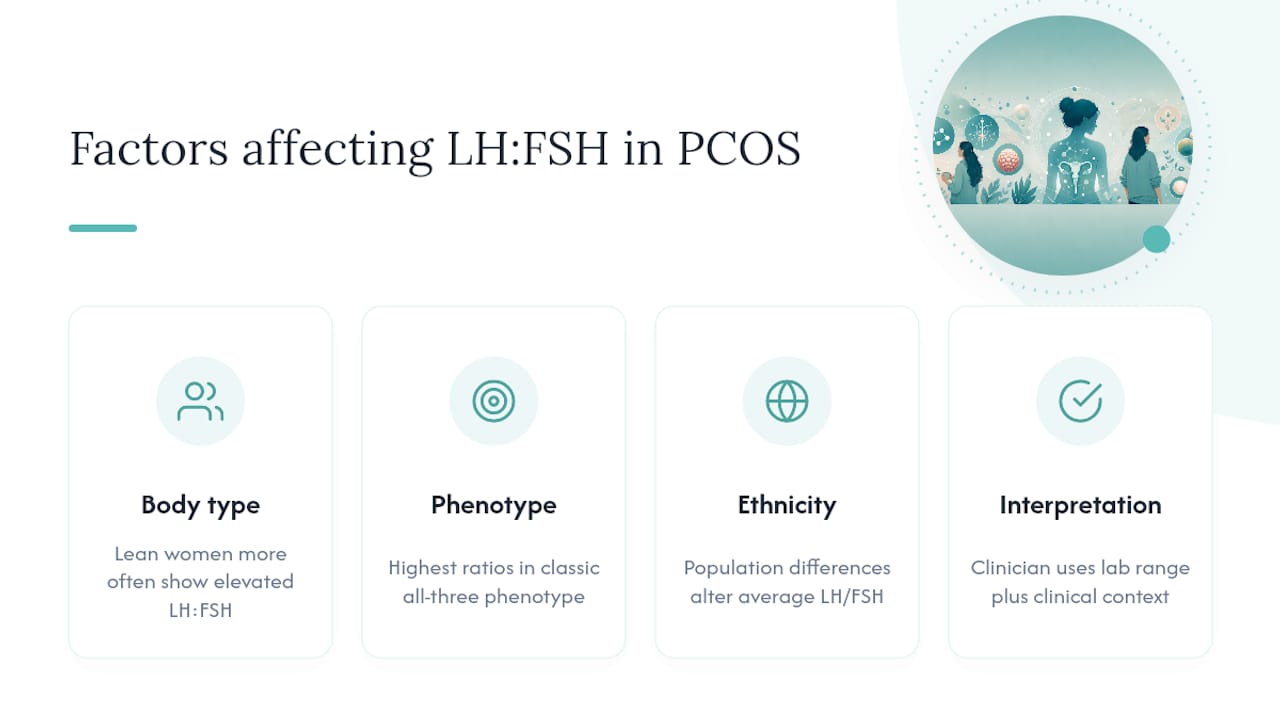
Body composition plays a clear role. Comparisons between obese and non-obese women with PCOS consistently show the classic elevated ratio more often in leaner women, while higher BMI tends to blunt or mask the pattern, partly because excess adipose tissue independently affects hormone metabolism and insulin signalling.
Phenotype matters too. Clinicians increasingly separate PCOS into subtypes based on the specific combination of Rotterdam features present, ovulatory dysfunction with hyperandrogenism, polycystic ovaries with hyperandrogenism but normal ovulation, and so on. Each subtype carries a somewhat different average hormonal fingerprint, and the ratio tends to run highest in the classic phenotype that combines all three Rotterdam features.
Ethnic background adds another layer researchers are still mapping. Population studies show meaningful differences in average LH, FSH, and androgen levels across ethnic groups, which affects where a “normal” or “raised” cut-off should realistically sit for any individual woman. A ratio flagged as high using a reference range built from one population may sit well within normal limits for another.
The practical takeaway: don’t compare your number too literally against a friend’s, a forum post, or a generic online chart. Your clinician interprets your ratio against the reference range used by your specific laboratory, alongside your body type, ethnicity, and symptom pattern, not a single universal number.
What LH:FSH ratio tells you about your fertility outlook
If you’re trying to conceive, the ratio matters less for what it says about your fertility today and more for what it says about the pattern behind your ovulation.
A high LH relative to FSH often lines up with the irregular or absent ovulation many women with PCOS experience, since the hormone imbalance is part of what stalls follicles before they mature and release an egg. That’s a meaningful piece of the fertility puzzle. It is not, on its own, a fertility diagnosis or a prediction of how difficult conception will be.
Plenty of women with a markedly raised ratio conceive without medical intervention, sometimes after cycles become more regular through weight management or metabolic treatment. Others with a near-normal ratio still experience ovulatory struggles driven by other factors within the PCOS picture, like androgen excess or insulin resistance acting on the ovary in ways the ratio doesn’t capture. The number is a marker of the hormonal environment, not a countdown clock.
What genuinely predicts fertility outcomes more reliably is the combination of factors: whether you’re ovulating at all (tracked through cycle regularity, progesterone testing, or ultrasound monitoring), your age, your androgen and metabolic markers together, and how you respond to any treatment started. If fertility is your priority, ask your clinician to focus the conversation there, ovulation confirmation and treatment response, rather than fixating on getting the ratio itself to look “normal.”
Why context matters more than the number itself
The mistake I see repeated most often is treating LH:FSH like a pregnancy test: one line, clear answer. It isn’t built that way, and pretending otherwise sets women up for false reassurance or unnecessary worry.
PCOS is metabolic, reproductive, and psychosocial all at once. A ratio in isolation can’t speak to any of that. Combine accessible testing with a proper clinical conversation, and you get a far more honest picture than either can give alone.
— Jack
Screening your hormones at home before you see a clinician
There’s real value in knowing where your LH and FSH sit before you ever book a GP appointment, and that’s exactly the gap Rapidtest’s Fertility Insight Test Kits are built to fill: private, at-home hormone screening with results in around 15 minutes, no lab return and no waiting room.

The FSH rapid test kit gives you a fast read on your levels from home, and it pairs well with an LH ovulation test kit if you’re also tracking your cycle for ovulation timing. Used on the correct cycle day, with the result logged and shared with your GP, this becomes a genuinely useful starting point rather than a guess.
Be honest with yourself about the limits, though. At-home kits are indicative, not a replacement for a venous laboratory assay when a real diagnosis or treatment decision is on the table. If your result comes back unusual, that’s your cue to book a clinical appointment and mention exactly what you found. Explore the full fertility testing range to see what fits your situation, and let your first at-home result be the start of the conversation, not the end of it.
This article is general information, not a substitute for advice from a qualified doctor. Consult a qualified healthcare professional about your own circumstances before acting on anything here.
Sources
- Follicle Stimulating Hormone (LH: FSH) Ratio in Polycystic Ovary Syndrome (PCOS) - Obese vs. Non-Obese Women
- Polycystic ovary syndrome: An update on diagnosis and management (CCJM)
- LH and FSH (gonadotrophins) — Glo’s Hospitals pathology guidance
- Clinical research discussing limitations of LH/FSH ratio (PubMed record)
FAQ
Can PCOS cause a high LH/FSH ratio?
Yes, PCOS commonly raises the LH:FSH ratio because faster GnRH pulses push the pituitary towards producing more LH relative to FSH. That said, a meaningful proportion of women with confirmed PCOS have a normal ratio, so a high result supports the diagnosis without confirming it alone.
Is PCOS linked to lupus?
PCOS and lupus are distinct conditions with different causes, PCOS is a hormonal and metabolic disorder, while lupus is an autoimmune disease. They aren’t causally linked, though some symptoms like fatigue and irregular cycles can overlap, which is why a clinician should rule out other conditions if your presentation feels atypical.
What age is peak fertility with PCOS?
Fertility with PCOS follows a similar age-related pattern to the general population, with egg quality and quantity naturally declining through your thirties. Many women with PCOS actually have a longer reproductive window than average, since the condition is linked to a later, more gradual decline in ovarian reserve, though ovulatory issues can still make timing conception harder regardless of age.
What hormone levels are high with PCOS?
LH is often elevated relative to FSH, and androgens, particularly testosterone, frequently run high too. Insulin levels can also be elevated even in women who aren’t overweight, reflecting the insulin resistance that commonly accompanies PCOS.
How is LH:FSH ratio tested and does timing matter?
LH and FSH are measured through a blood sample, either at a lab or via an at-home kit, and timing matters enormously. Testing during days 1 to 5 of your cycle gives the most reliable and comparable reading, while testing outside that window or during irregular cycles makes results far harder to interpret.