


How finasteride affects your PSA levels: what to know
Finasteride typically reduces your total serum PSA by about half within six months of starting treatment. That single fact changes everything about how your PSA results should be read. The standard clinical rule, backed by NHS patient guidance and drug labelling, is straightforward: establish a new PSA baseline at around six months on finasteride, and when comparing a single value against standard thresholds, clinicians commonly double the measured result to account for the drug’s effect.
Finasteride is FDA-indicated for men only. Women who are or may become pregnant must not handle crushed or broken finasteride tablets, due to the risk of harm to a male fetus. It can also cause sexual side effects (reduced libido, erectile dysfunction) in a minority of men, which usually resolve after stopping treatment. Discuss these risks with a physician before starting.
Here is what you need to know before your next test:
- Finasteride lowers total PSA by about half within six to twelve months of starting treatment.
- Your clinician should record a new baseline PSA at around six months on the drug.
- For a single PSA reading taken after six months on finasteride, the reported value is often doubled to compare it against thresholds used for untreated men.
- Any confirmed rise from your lowest recorded PSA (your nadir) while on finasteride is clinically significant, even if the number looks reassuringly low.
- Always tell your clinician you take finasteride before a PSA test. Do not stop or change your dose without medical advice.
The 50% rule: Finasteride approximately halves total serum PSA within six months. A result of 1.5 ng/mL on finasteride is clinically read as roughly equivalent to 3.0 ng/mL in an untreated man.
Pro Tip: Write the date you started finasteride in your phone or on a card in your wallet. Your clinician needs that date to time your baseline test correctly and interpret any future results.
Key takeaways
Finasteride typically halves total PSA within six months, and any confirmed rise from your on-treatment nadir requires prompt clinical evaluation even when the absolute number appears reassuringly low.
| Point | Details |
|---|---|
| Finasteride halves total PSA | Expect roughly a 50% reduction in total serum PSA within six to twelve months of starting treatment. |
| Establish a new baseline at six months | Clinicians record a new PSA baseline at around six months on finasteride to set a reliable nadir for future comparison. |
| Double the measured PSA for comparison | After six months on finasteride, clinicians commonly multiply the reported PSA by two to compare it against standard untreated thresholds. |
| A rising nadir is always significant | Any confirmed rise from your lowest on-treatment PSA warrants clinical evaluation, regardless of the absolute value. |
| Rapidtest PSA kit for interim monitoring | Rapidtest’s at-home PSA kit delivers results in 10–15 minutes and supports trend tracking between clinic appointments. |
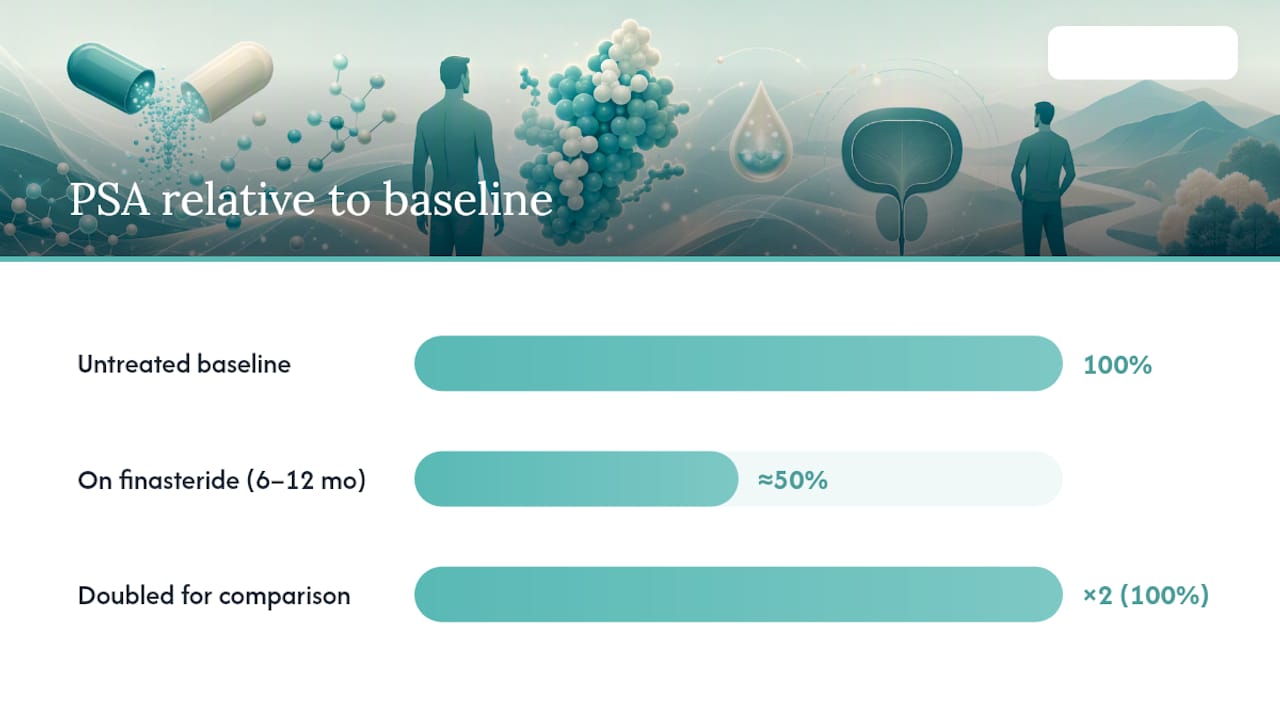
Table of Contents
- What research and UK guidance say about finasteride’s effect on PSA
- When does PSA change after starting finasteride, and when should you get a baseline?
- How clinicians interpret PSA in men taking finasteride
- Should you stop finasteride before a PSA test?
- What a rising PSA on finasteride means and what happens next
- Where at-home PSA testing fits into your monitoring
- What men should actually prioritise when managing PSA on finasteride
- Rapidtest PSA kit: a practical option for monitoring between appointments
- Key UK guidance and studies worth reading
- Sources
- FAQ
What research and UK guidance say about finasteride’s effect on PSA
The evidence here is consistent across drug labelling, phase III trials, and long-term trial data.
Phase III clinical trial data from the North American finasteride study in men with benign prostatic hyperplasia confirmed about half reduction in total serum PSA, with the recommendation that clinicians establish a new baseline at least six months after starting treatment. That finding has since been replicated across multiple analyses.
The Prostate Cancer Prevention Trial (PCPT) adds important long-term nuance. Over longer follow-up, however, the adjustment factor needed to preserve the median PSA crept upward, from approximately 2 at 24 months toward approximately 2.5 by seven years. A simple doubling works well in the early years; for men who have been on finasteride for many years, specialist input on the appropriate adjustment factor is worth seeking.
The PCPT also used corrected PSA values when deciding which participants needed a biopsy, demonstrating that adjusted PSA is not just a theoretical exercise. It is how major trials have preserved cancer-detection ability in men on finasteride.
One reassuring finding: research from Johns Hopkins shows that the ratio of free to total PSA remains approximately constant during finasteride therapy. Percent free PSA does not need a mathematical adjustment the way total PSA does.
“Any confirmed increase in PSA levels while taking finasteride should be evaluated by a clinician, even if the value appears within a normal range for untreated men.” DailyMed finasteride labelling
A BMJ editorial has also discussed the implications of 5-alpha-reductase inhibitors for prostate cancer detection, noting nuances around grade distribution in long trials. The overall picture from the evidence is clear: finasteride suppresses PSA reliably, but that suppression must be actively managed in monitoring, not ignored.
When does PSA change after starting finasteride, and when should you get a baseline?
Timing matters more than most men realise. PSA does not drop overnight.
- Weeks 1–12: PSA begins to fall but the reduction is still partial and variable. Testing in this window gives an unreliable picture.
- Months 3–6: The bulk of the PSA reduction occurs here. Most men reach close to their new suppressed level by month six.
- Month 6 onwards: This is when clinicians recommend establishing your new baseline. Document your adherence carefully at this point.
- Years 1–7: PCPT data show that PSA trends continue to evolve. The adjustment factor that works at year two may underestimate the true PSA at year seven.
- Starting finasteride: Expect PSA to fall over the following months. Any PSA test taken within the first six months should be interpreted with caution and with your clinician’s involvement.
- Stopping finasteride: PSA will rise again as the drug clears your system. Testing immediately after stopping gives a misleading result. Clinicians generally prefer to wait for a stable period before drawing conclusions from a post-cessation result.
Pro Tip: If you have just started finasteride, ask your GP to record your pre-treatment PSA and schedule a follow-up test at six months. That pair of readings is the foundation of safe long-term monitoring.
How clinicians interpret PSA in men taking finasteride
Understanding the rules your doctor uses helps you ask better questions at your next appointment.
-
Double the measured total PSA after six months. After at least six months of continuous finasteride use, clinicians commonly multiply the reported PSA by two to compare it against the thresholds used for untreated men. A reading of 2.0 ng/mL is treated as equivalent to 4.0 ng/mL.
-
Establish and record the nadir. The lowest PSA value recorded while on finasteride is your nadir. This becomes your personal reference point. Any confirmed rise from that nadir, across two or more tests, is clinically significant regardless of the absolute number.
-
Use percent free PSA without adjustment. Because the free-to-total PSA ratio stays approximately constant under finasteride, percent free PSA can be used as a supplementary marker without applying a correction factor. A low percent free PSA still carries the same clinical weight it would in an untreated man.
-
Document dose and adherence. Interpretation differs between 1 mg (used for hair loss, such as Propecia) and 5 mg (used for BPH, such as Proscar). Your clinician needs to know which dose you take, when you started, and whether you have had any gaps. Missed doses alter PSA kinetics and can make serial trends hard to read.
-
Apply time-varying caution for long-term users. For men who have been on finasteride for several years, the simple doubling rule may need revision. PCPT analyses suggest the adjustment factor rises over time, and a specialist opinion is worth seeking for trend-based decisions in long-term users.
Key figure: The North American phase III trial confirmed that clinicians should not compare a finasteride-treated PSA directly against standard untreated thresholds without accounting for the drug’s effect.
Pro Tip: Ask your GP or urologist to record your PSA results alongside your finasteride start date and dose in your notes. If you ever change GP or see a specialist, that documented history prevents misinterpretation.
For a broader look at how PSA values are read in a prostate cancer context, the Rapidtest guide on PSA levels in prostate cancer explains the thresholds clinicians use.
Should you stop finasteride before a PSA test?
The short answer: do not stop without talking to your clinician first.
- Stopping finasteride causes PSA to rise again as the drug’s suppressive effect wears off. Testing shortly after stopping gives a result that reflects neither your true on-treatment baseline nor a reliable untreated value.
- If a clinician does advise stopping before a test, a waiting period is needed for PSA to restabilise. The exact duration depends on your individual kinetics, which is why this decision belongs with your doctor, not a self-managed plan.
- Non-adherence, including missed doses or unplanned breaks, complicates serial PSA interpretation. Clinicians prefer a stable, documented regimen because it is the only way to set a reliable baseline and detect meaningful trends.
- Stopping finasteride solely to produce a higher PSA reading is unsafe and clinically counterproductive. It disrupts the monitoring record your clinician depends on.
“Finasteride can affect PSA testing. Tell your doctor or nurse that you are taking finasteride before having a PSA test. Any changes in your PSA levels will need to be assessed by your doctor.” NHS patient information on finasteride
The NHS guidance is clear: changes in PSA must be evaluated by a clinician, not managed unilaterally. If you are unsure whether to continue finasteride before an upcoming test, a quick call to your GP is the right move.
What a rising PSA on finasteride means and what happens next
A rising PSA while you are on finasteride is a red flag that needs prompt attention.
-
Confirm the rise with a repeat test. A single elevated reading can reflect lab variation or a temporary factor such as a urinary infection. A second test, taken a few weeks later under consistent conditions, confirms whether the trend is real.
-
Check adherence first. If you have missed doses or recently restarted finasteride after a break, the rise may reflect changing drug levels rather than disease. Document any interruptions honestly when you speak to your clinician.
-
Measure percent free PSA. Because percent free PSA needs no adjustment under finasteride, it provides a useful supplementary signal. A falling percent free PSA alongside a rising total PSA is a more concerning pattern.
-
Arrange a digital rectal examination (DRE). A DRE gives your clinician physical information about the prostate that PSA alone cannot provide. It is a standard part of the assessment when PSA trends are concerning.
-
Consider urology referral. If the rise persists across two or more tests and no adherence issue explains it, referral to a urologist for further evaluation, including possible biopsy, is the appropriate next step.
Red flags that should prompt urgent review:
- PSA doubling time of less than three years while on finasteride
- Sustained rise across three or more consecutive tests
- Concerning findings on DRE
- New urinary symptoms, bone pain, or other symptoms that could suggest spread
Longitudinal analyses from the PCPT show that PSA increases preceding a cancer diagnosis can still be detectable even under finasteride suppression, and that the rate of rise tends to be steeper in cases that become cancerous. Serial monitoring, not a single number, is what catches meaningful change. For more on the signs that warrant clinical attention, the Rapidtest article on signs of prostate problems covers the broader picture.
Where at-home PSA testing fits into your monitoring
At-home PSA testing is not a replacement for your GP or urologist. But it can be a genuinely useful tool between clinic visits, particularly for men on finasteride who benefit from more frequent checks.
Here is how it fits in practice:
- Interim monitoring: If your next scheduled clinic test is months away and you want to keep an eye on your trend, an at-home kit gives you a data point to bring to your appointment.
- Tracking your nadir: Regular home readings, recorded with dates and your finasteride dose, help you and your clinician build a clearer picture of your personal baseline over time.
- Spotting unexpected rises early: A home result that looks higher than your recent readings is not a diagnosis, but it is a prompt to contact your GP sooner rather than waiting for a routine appointment.
Limitations to be clear about:
- At-home rapid tests use lateral flow methodology, which differs from the laboratory immunoassay your GP uses. Results should be treated as indicative, not definitive.
- At-home tests are not used for diagnosis. Any result that concerns you needs clinical follow-up with a laboratory-grade test and a clinician’s assessment.
- The doubling adjustment and nadir tracking still apply. A home result needs the same contextual interpretation as a clinic result.
Pro Tip: Every time you use a home PSA kit, photograph the result and note the date, your finasteride dose, and any recent changes to your regimen. Bring that log to your next GP appointment. It costs nothing and gives your clinician far more to work with.
Rapidtest’s PSA Rapid Test kit is designed for exactly this kind of interim monitoring, with results in 15 minutes, no appointment needed, and discreet delivery to your door.

What men should actually prioritise when managing PSA on finasteride
Here is the honest truth about where most men go wrong with this.
The clinical rules around finasteride and PSA are well established. The doubling adjustment, the six-month baseline, the nadir tracking — these are not obscure specialist knowledge. They are in the drug labelling, the NHS guidance, and the PCPT data. The problem is not a lack of guidance. It is that men often do not tell their clinician they are on finasteride, or they stop the drug before a test without advice, or they never establish a proper baseline in the first place.
A PSA result without context is almost meaningless on finasteride. The number on the page only makes sense when your clinician knows your dose, your start date, your adherence history, and your previous readings. Without that, even a careful clinician is working blind.
The most useful thing you can do is document everything and communicate it clearly. That is not a complicated ask. It is just a habit most men have not built yet.
Rapidtest PSA kit: a practical option for monitoring between appointments
If you are on finasteride and want to keep closer tabs on your PSA between GP visits, Rapidtest’s at-home PSA test kit gives you a result in around 10–15 minutes, with no appointment, no waiting room, and no lab return.
It is not a substitute for clinical assessment. When your PSA trend needs proper evaluation, a laboratory test and a clinician’s judgement are what you need. But for building a personal monitoring record between appointments, tracking whether your nadir is holding steady, or simply staying on top of your prostate health without waiting months for a routine check, a home kit is a practical and affordable option.
Order your Rapidtest PSA kit today and get your result at home, on your schedule.
This article provides general health information and is not a substitute for professional medical advice. Always discuss PSA results and any changes to your finasteride regimen with your GP or a qualified clinician.
Key UK guidance and studies worth reading
If you want to go deeper on any of the evidence covered here, these are the sources that matter most:
- NHS patient information on finasteride: The NHS patient page explains how finasteride affects PSA and advises men to tell their clinician before testing. Start here for plain-language UK guidance.
- NHS PSA testing information: Covers how PSA testing works in the UK, what results mean, and when further investigation is recommended.
- DailyMed finasteride labelling: The full prescribing information, including the 50% PSA reduction data and the instruction to establish a new baseline and evaluate any confirmed rise.
- PCPT long-term PSA analysis (PubMed): The key trial paper showing the initial 50% fall and the time-varying adjustment factors over seven years. Essential reading for anyone on long-term finasteride.
- North American phase III trial (PubMed): The original phase III data confirming the PSA halving effect in men with BPH and the baseline recommendation.
- Cancer: A clear summary of how the PCPT used corrected PSA values in practice, useful for understanding how adjusted PSA works in a real trial setting.
Sources
- DailyMed - FINASTERIDE tablet, film coated
- Long-term effects of finasteride on prostate specific antigen levels: results from the prostate cancer prevention trial - PubMed
- Effect of finasteride on serum PSA concentration in men with benign prostatic hyperplasia. Results from the North American phase III clinical trial
- Pure
- About finasteride
- Prostate Cancer Prevention Trial (PCPT): Questions and …
FAQ
How do you adjust PSA for finasteride?
After at least six months of continuous finasteride use, clinicians commonly double the measured total PSA to compare it against thresholds used for untreated men. Percent free PSA does not need adjustment, as the free-to-total ratio remains approximately constant under finasteride.
How long does finasteride take to affect PSA?
PSA begins to fall within the first few months of starting finasteride, with most of the reduction occurring between months three and six. Clinicians recommend establishing a new baseline at around six months, when the suppressive effect has largely stabilised.
Should you stop finasteride before a PSA test?
No, not without discussing it with your clinician first. Stopping finasteride causes PSA to rise again, and testing shortly after stopping gives an unreliable result that reflects neither your on-treatment baseline nor a stable untreated value.
What does a rising PSA on finasteride mean?
Any confirmed rise from your lowest recorded PSA (nadir) while on finasteride is clinically significant and usually prompts further assessment, including a repeat test, a check of adherence, percent free PSA measurement, and possibly a digital rectal examination or urology referral.