


8 to 12 Weeks After Treatment: Book Your Chlamydia Retest in the UK
Retest for chlamydia around 8 to 12 weeks after finishing treatment, not sooner. Routine test-of-cure isn’t usually needed if you took your antibiotics as prescribed and your symptoms have gone. Pregnancy, lingering symptoms, or worries you didn’t take treatment properly change that timeline, so book your follow-up test now, while it’s fresh in your mind, rather than hoping you’ll remember in two months.
TL;DR:
- Retesting for chlamydia should occur around 8 to 12 weeks after treatment, with earlier testing around 8 weeks being more effective for higher attendance.
- A test of cure is only necessary if symptoms persist, if you’re pregnant, or if there are concerns about treatment completion, and should be done at least three to four weeks after antibiotics.
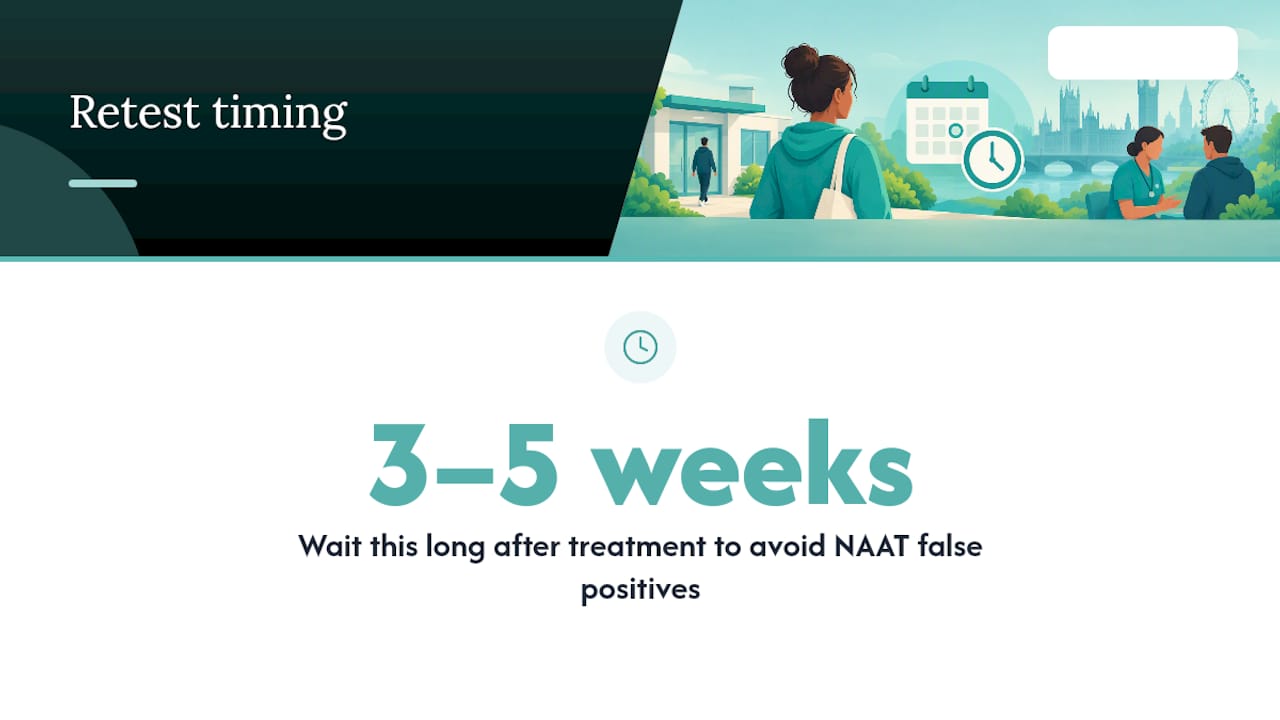
- NAAT tests can produce false positives if done too soon post-treatment due to genetic material fragments lingering, so waiting at least 3 to 5 weeks is crucial.
- Reinfection mainly results from untreated partners, so immediate partner treatment and condom use are key to preventing repeat infections.
- Booking follow-up tests in advance, including home testing kits, increases compliance and timely detection of reinfections.
Table of Contents
- Chlamydia retest timing: what the guidelines actually say
- Test of cure or reinfection check: which one do you need?
- Why timing matters: NAATs, window periods, and false positives
- How to avoid catching it again from an untreated partner
- Booking the actual retest: clinic, GP, or home kit
- Rapidtest’s role in the chlamydia retesting pathway
- Why this follow-up test matters more than people think
- Get your follow-up retest without the waiting room
- Sources
- FAQ
Chlamydia retest timing: what the guidelines actually say
Here’s the thing about chlamydia retesting advice: it can look contradictory if you only skim one source. It isn’t. Once you line up the UK guideline, the American guideline, and the trial data behind them, a clear picture emerges.
The British Association for Sexual Health and HIV’s 2026 guideline recommends retesting for chlamydia sometime between 2 and 6 months after treatment, with earlier retesting around 2 to 3 months often preferred for people under 25. That’s a wide window by design. It gives clinics flexibility, but it also means “sometime this year” isn’t good enough. You need a real date.
Across the Atlantic, the CDC’s treatment guidelines land on a simpler figure: retest at roughly three months, and ideally get that follow-up appointment booked at the same visit where you’re first treated. Different wording, same underlying logic: don’t leave reinfection unchecked for too long, but don’t test so early that the result is meaningless.
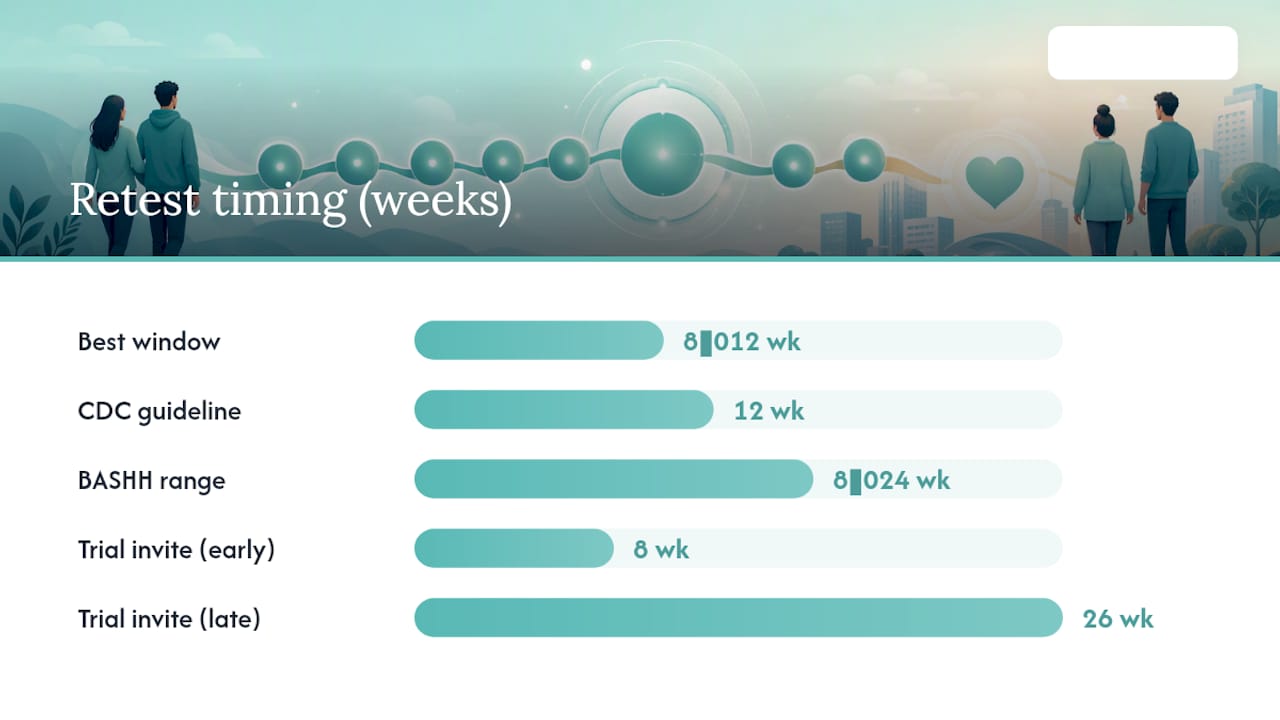
Then there’s the trial evidence that actually shaped this thinking. A randomised controlled trial invited people to retest at 8, 16, or 26 weeks after treatment. The group invited at 8 weeks showed notably higher attendance, while positivity rates were similar across these time points. The takeaway is practical rather than purely clinical: inviting people earlier gets more of them through the door, and testing at 8 weeks catches reinfections just as reliably as waiting longer.
Put the three together and you get a sensible, evidence-backed rule of thumb:
- Best window: approximately 8 to 12 weeks after completing treatment
- Acceptable range: up to 6 months if earlier retesting isn’t possible, per BASHH
- Don’t wait indefinitely: the longer you delay, the greater the risk that reinfection remains undetected
Early invitations encourage higher retest attendance, emphasizing the benefit of booking your follow-up test promptly at treatment.
Test of cure or reinfection check: which one do you need?
These two terms get used interchangeably, and that’s where a lot of confusion starts. A test of cure (TOC) checks whether the specific infection you were treated for has actually cleared. A routine retest checks whether you’ve picked up a new infection since then, usually from a partner who wasn’t treated at the same time.
Most people only need the second one. Test of cure is reserved for specific situations:
- You’re pregnant (chlamydia in pregnancy carries added risks, so confirmation of clearance matters more)
- Your symptoms haven’t improved, or new ones have appeared
- You suspect you didn’t complete the antibiotic course properly, or missed doses
- You were treated with an antibiotic outside the usual recommended options
If a test of cure is genuinely needed, timing still matters. BASHH advises waiting until at least three to four weeks after finishing antibiotics before testing, for reasons covered in the next section. Testing straight after your last tablet is one of the most common, and most avoidable, retesting mistakes.
Why timing matters: NAATs, window periods, and false positives
Nearly every chlamydia test used in the UK, whether at a clinic or through a home kit, relies on a nucleic acid amplification test (NAAT). NAATs are highly sensitive because they detect genetic material from the bacteria rather than waiting for an antibody response, which is exactly why they’re the standard for both diagnosis and retesting.
That sensitivity has a downside straight after treatment. Antibiotics kill the bacteria, but fragments of its DNA can linger in your system for a while afterwards. The CDC notes that testing too soon risks picking up this leftover, non-viable genetic material, which reads as a positive result even though the infection itself is gone. That’s a false positive, and it’s avoidable.
The window to be aware of: allow roughly 3 to 5 weeks after finishing treatment before testing again, longer if you’re specifically doing a test of cure rather than a routine reinfection check.
Sample types vary depending on where the infection was: a urine sample for genital infections in men, a vaginal swab for women, and rectal or throat swabs if that’s where exposure occurred, something worth flagging honestly when you book your test rather than assuming genital testing alone will catch everything.
Pro Tip: If your retest comes back positive, don’t assume the treatment failed. Most positive results at this stage are new infections, not the original one returning, so the next question your clinician will ask is whether your partner was treated too.
How to avoid catching it again from an untreated partner
Chlamydia doesn’t leave you with lasting immunity. Once you clear an infection, your body doesn’t develop meaningful protection against catching it again, which is part of why reinfection is genuinely common, not a sign that something went wrong with your treatment. Repeat positive results affect a notable share of young adults on subsequent tests.
Most positive retests trace back to one thing: an untreated partner. Reduce that risk with a few concrete steps:
- Tell your partner (or partners) straight away. Awkward, yes. Necessary, also yes, since chlamydia is often symptomless and they may have no idea they’re carrying it.
- Get them treated before either of you resumes sexual contact. Guidance is consistent on avoiding sex until everyone involved has completed their full course.
- Book their treatment alongside yours where possible. Clinics can often arrange partner notification and treatment without them needing to disclose how they were exposed.
- Use condoms once you’re both cleared, particularly if either of you has other partners, to lower the odds of a repeat cycle.
- Retest together if you can. It’s far easier to trust a negative result when you both know the other person actually followed through.
Booking the actual retest: clinic, GP, or home kit
Knowing the right window doesn’t help much if the appointment never gets made. A few routes work:
- Sexual health clinics will retest for free on the NHS and can arrange partner treatment in the same visit, which is useful if things are complicated.
- GP surgeries can sometimes arrange chlamydia testing, though availability and turnaround vary by practice.
- Home sampling kits work well for straightforward reinfection checks in people who aren’t pregnant and have no ongoing symptoms, letting you post a sample or read a rapid result without waiting for an appointment slot.
Real-world data backs an obvious point: people who get a specific date, rather than a vague “come back in a couple of months,” are far more likely to actually follow through with the retest.
Pro Tip: Book your retest slot, or order your home kit, on the same day you finish treatment. Set a calendar reminder for week 8. Future-you, mid-busy-life, will thank present-you for not leaving it to memory.
If you’re pregnant, still symptomatic, or know your partner hasn’t been treated yet, don’t wait for the standard window. Speak to a clinician sooner.
Rapidtest’s role in the chlamydia retesting pathway
At-home chlamydia tests with CE marking and results in around 15 minutes, delivered in discreet packaging, are available alongside blog resources covering window periods and testing after exposure. These kits suit a routine reinfection check once you’re past the recommended waiting window. If you’re pregnant, still unwell, or your clinician has specifically requested a test of cure, that’s a situation for clinical follow-up rather than a home kit.
Why this follow-up test matters more than people think
You cleared the infection. Job done, surely? Not quite. Reinfection is common enough that skipping the retest is one of the more overlooked gaps in sexual health care, and it’s an easy one to close if you treat the follow-up as part of the treatment, not an optional extra.
The evidence points the same way from every angle: retest at 8 to 12 weeks, get your partner treated in parallel, and book the follow-up before life gets in the way of remembering it. None of that requires anxiety about “the cure not working.” It requires a diary entry.
— Jack
Get your follow-up retest without the waiting room
Rapidtest is the alternative to booking round a clinic appointment for a routine chlamydia follow-up. You get a CE-certified kit posted in discreet packaging, a result in around 15 minutes at home, and no queue, no lab return, and no explaining yourself to a receptionist.
If your 8 to 12 week window has arrived and you’re not pregnant, have no persistent symptoms, and haven’t been asked by a clinician to complete a test of cure, a home kit is a genuinely convenient way to close that loop. Browse the chlamydia rapid test kit or the wider range of at-home STI kits and order one for the date you already have marked in your calendar. Kits may come with a refund guarantee and shipping options, making it convenient to obtain a follow-up test without delay.
Sources
- British Association for Sexual Health and HIV UK National guideline for the management of infection with Chlamydia trachomatis, 2026
- What Is the Optimal Time to Retest Patients With a Urogenital Chlamydia Infection? A Randomized Controlled Trial
- Chlamydial infections - STD treatment guidelines (CDC, 2021)
Speak to your local sexual health clinic for advice specific to your situation.
This article is general information, not a substitute for advice from a qualified doctor. Consult a qualified healthcare professional about your own circumstances before acting on anything here.
FAQ
How do I know if chlamydia is fully gone?
The only reliable way is a follow-up test, not the absence of symptoms, since chlamydia often causes no symptoms at all even while active. Most people don’t need a formal test of cure. A routine retest at 8 to 12 weeks confirms clearance and catches any reinfection.
How long after antibiotics will I test negative for chlamydia?
Wait at least 3 to 5 weeks after finishing antibiotics before testing again, as NAATs can detect leftover non-viable DNA sooner than that, which can produce a false positive. For a routine reinfection check rather than a test of cure, waiting until the 8 to 12 week mark is more reliable overall.
How long after doxycycline can I test again?
The same rule applies regardless of which antibiotic you were prescribed: give it 3 to 5 weeks minimum before any retest, and aim for 8 to 12 weeks if you’re checking for reinfection rather than confirming cure. Testing immediately after your last dose risks a misleading result.
How long after treatment is chlamydia no longer contagious?
Guidance is consistent on avoiding all sexual contact until you and any partners have completed the full antibiotic course, which for most standard treatments means waiting about a week after the last dose. Resuming sex before your partner has also finished treatment is the most common reason people test positive again afterwards.
Do I need a home kit or a clinic visit for my retest?
A home kit like Rapidtest’s chlamydia test suits a routine reinfection check when you’re not pregnant and have no ongoing symptoms. A clinic visit is the better route if you’re pregnant, still symptomatic, or your clinician has specifically asked for a test of cure.