


12–16 Weeks: When HSV-2 Tests Are Reliable in the UK
If you’ve had a possible exposure, here’s the honest answer: a swab test can pick up active HSV-2 within days of a sore appearing, but a blood test needs time. Most clinicians recommend waiting up to several months after exposure for a type-specific IgG blood test to be reliably conclusive. Test too early, and you risk a false negative that tells you nothing useful. The next sections explain exactly why.
TL;DR:
- Blood tests for HSV-2 require at least 12 to 16 weeks after exposure for reliable results due to antibody development time.
- Active lesions should be tested immediately with a swab or PCR, as these detect the virus directly and provide same-day results.
- False negatives are common if testing occurs within the first few weeks, since antibodies may not yet be detectable.
- A positive blood test confirms past exposure but cannot specify when it happened or identify recent transmission.
- Prioritize testing if symptoms are present, if a partner has an HSV-2 diagnosis, or during pregnancy for proper management.
Table of Contents
- Understanding the HSV-2 window: how the infection actually develops
- Which HSV-2 test should you take, and when will it work?
- How accurate are HSV-2 tests really?
- When should you actually test after a possible exposure?
- What does your result actually mean?
- Who should prioritise testing, and when to see a clinician urgently
- What people get wrong about HSV-2 testing
- Test on your own terms with an at-home HSV-2 kit
- Sources
- FAQ
Understanding the HSV-2 window: how the infection actually develops
Before any test can catch HSV-2, your body has to react to it. That reaction, and how fast it happens, is the whole reason a “window period” exists at all.
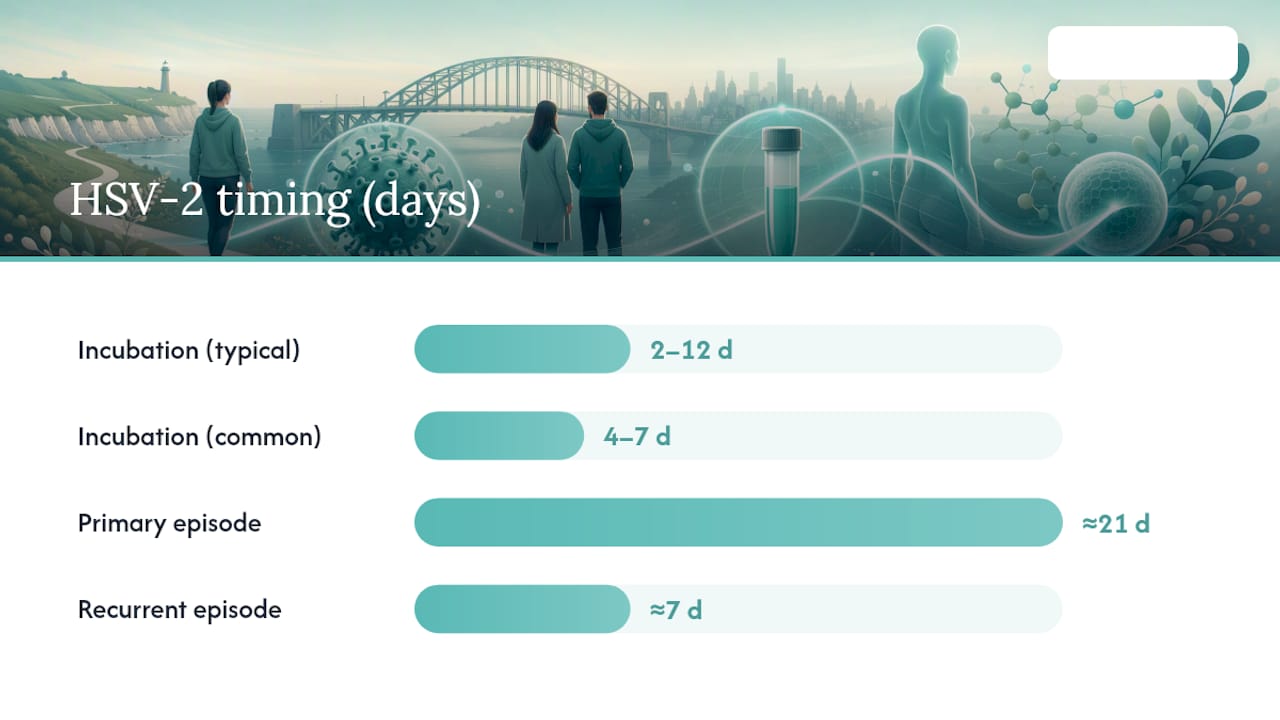
Once the virus gets into your system, symptoms tend to show up faster than most people expect. The NHS puts the typical incubation period at somewhere between 2 and 12 days, with 4 to 7 days being the most commonly reported range. That’s the gap between exposure and the first blister, sore, or itch, if you get one at all.
Notice that “if”. A huge proportion of people carry HSV-2 without ever noticing a symptom worth mentioning to a doctor. Asymptomatic shedding, where the virus is active on the skin without any visible sign, is common, and it’s most frequent in the first year after you catch the virus, according to CDC treatment guidelines. That’s precisely why relying on “I’d know if I had it” is such a shaky strategy.
A few things worth knowing about how symptoms tend to unfold:
- First infection (primary episode): usually the most severe, with multiple sores that can take nearly three weeks to fully resolve.
- Recurrent episodes: typically shorter and milder, often clearing within a week.
- Asymptomatic infection: no visible outbreak at all, sometimes for years, sometimes permanently.
- Shedding without symptoms: the virus can still be present and transmissible even when skin looks completely normal.
This variability is the reason two people exposed on the same night can end up with wildly different experiences: one develops a painful sore within a week, the other feels nothing for months and only finds out through a screening test. Your body’s antibody response follows its own timeline too, separate from whether or not you ever get a visible symptom, and that separation is what drives the whole testing strategy that follows.
Which HSV-2 test should you take, and when will it work?
Not all HSV-2 tests are looking for the same thing, and that’s the single biggest source of confusion around testing timelines. Broadly, you’re choosing between a test that looks for the virus itself and a test that looks for your immune system’s response to it.
Viral detection tests (PCR or swab culture) work by sampling fluid directly from a sore or blister. They detect the virus’s genetic material or live virus, which means they’re only useful while a lesion is actually present. The upside is speed: a swab taken from an active sore is often accurate within days of the outbreak starting, because it’s testing for the virus itself rather than waiting on your immune system, as clinical guidance for urgent care testing confirms. No sore, no sample, no result. That’s the limitation.
Type-specific IgG serology (blood tests) work differently. They don’t look for the virus; they look for antibodies your immune system builds in response to it. Building a detectable antibody level takes time, potentially several weeks to a few months, according to MedlinePlus. That’s the entire reason the 12 to 16 week guidance exists. These tests are also “type-specific”, meaning a properly designed one distinguishes HSV-1 (commonly cold sores) from HSV-2 (commonly genital), rather than lumping them together.
Rapid at-home antibody tests use the same underlying biology as lab-based IgG serology. They’re detecting the same antibodies, which means they’re bound by the same biological window. A rapid format doesn’t shortcut your immune system, it just delivers the result faster once the antibodies are actually there to find.
So which test should you actually ask for?
- You have a visible sore or blister right now: ask for a swab/PCR test immediately. Don’t wait for antibodies to develop, get the active lesion tested.
- You had a specific exposure and have no symptoms: you’re in serology territory, and timing matters (more on this in the practical schedule below).
- You want to know your status generally, with no specific recent exposure in mind: a type-specific IgG test is the appropriate route, understanding that it reflects your history, not a single incident.
- You’re not sure which type of herpes you might have (oral vs genital history): insist on a type-specific test, since older, non-specific antibody tests can’t reliably tell HSV-1 from HSV-2.
Clinicians generally default to viral detection when something is physically visible, and hold serology in reserve for everyone else, precisely because swabbing a sore gives a same-day answer that blood work simply can’t match in the early days.
How accurate are HSV-2 tests really?
This is where things get genuinely nuanced, and where a lot of anxiety gets generated unnecessarily. No HSV-2 test is perfect, and the two ways it can go wrong (false negative, false positive) happen for very different reasons.
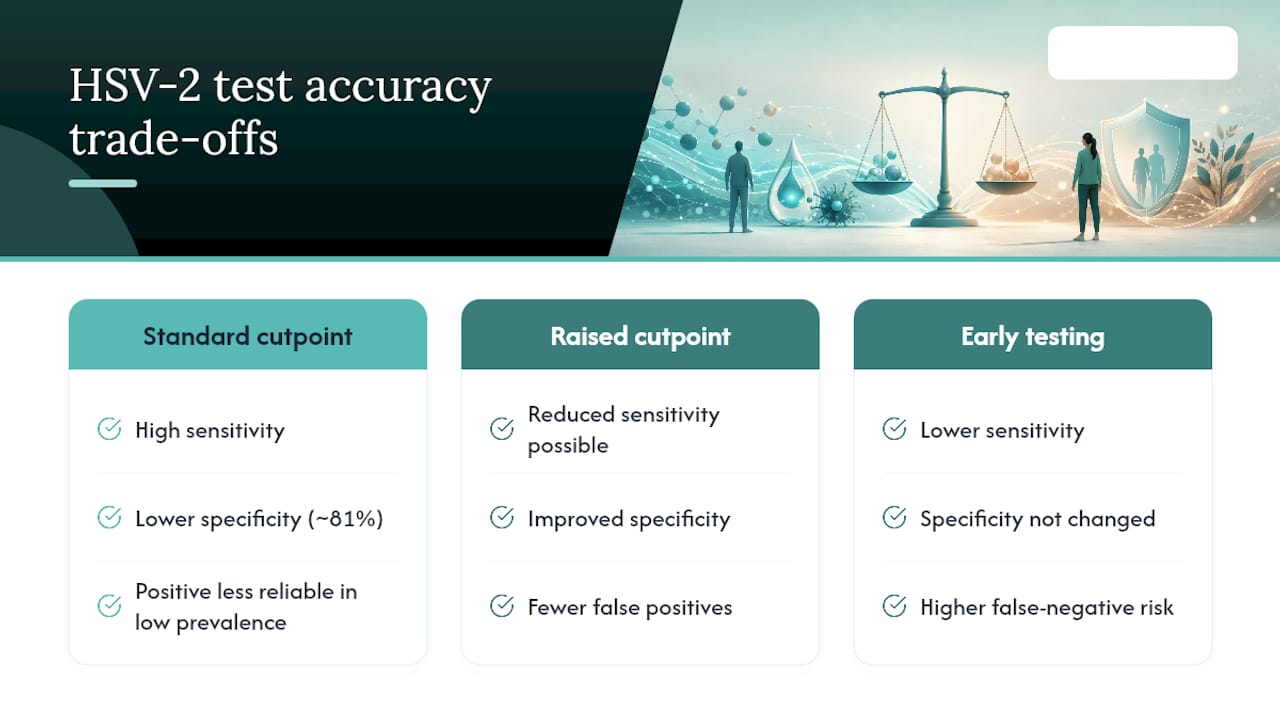
By the numbers: Pooled estimates for the HerpeSelect IgG test show very high sensitivity but lower specificity at the manufacturer’s standard cutpoint, according to an evidence synthesis on serologic screening. Raising the cutpoint improves specificity, though sometimes reduces sensitivity. There’s a genuine trade-off built into how these tests are calibrated.
That 81% specificity figure matters enormously once you factor in how common the virus is in whoever’s being tested. If you’re testing someone with no real reason to suspect exposure, a “positive” result is statistically more likely to be a false alarm than if you’re testing someone with known exposure or symptoms. This is called positive predictive value, and it’s why clinicians don’t treat every positive blood test as definitive, especially near the test’s cutoff.
False negatives happen for a much simpler reason: testing too soon. If you test at 3 or 6 weeks post-exposure, your body may simply not have built enough antibodies yet for the assay to catch, regardless of how good the test is. That’s not a flaw in the test. It’s a mismatch between the test’s biology and your timeline.
Pro Tip: If your result comes back as a “low positive” or borderline index value, don’t panic and don’t assume it’s definitive either way. Ask specifically whether the clinic uses a higher confirmatory cutpoint or a second confirmatory assay, since a repeat test using a different threshold can clarify a genuinely ambiguous result.
When should you actually test after a possible exposure?
Timing your test correctly is the difference between a useful result and a wasted one. Here’s a practical sequence to follow.
- Active sore or blister present: get a swab/PCR test straight away. This is the fastest, most direct route to an answer and doesn’t require waiting on antibodies at all.
- No symptoms, but you know the date of exposure: an early test (around 2 to 4 weeks) can offer some reassurance, but treat any negative result here as provisional, not final.
- Mark your calendar for 12 to 16 weeks post-exposure: this is when a type-specific IgG test becomes reliably conclusive, per CDC guidance on genital herpes screening. This is the test result worth trusting.
- If you get a low-index or borderline result: book a repeat test, ideally with a higher cutpoint or confirmatory assay, rather than accepting an ambiguous number at face value.
- While you wait: use condoms consistently, hold off on sexual contact with new partners, and consider being upfront with existing partners about the situation. None of this requires a diagnosis to be sensible practice.
The gap between weeks 4 and 16 is genuinely frustrating, we know. But testing during that window and getting a negative doesn’t rule anything out definitively, it just tells you what your antibody levels were on that particular day.
What does your result actually mean?
A test result is only useful if you understand what it can and can’t tell you. Here’s how to read the three broad outcomes.
- Positive IgG result: confirms past exposure to HSV-2, but it genuinely cannot tell you when or from whom you acquired it, a point CDC guidance makes explicitly clear. This matters for relationship conversations, since a positive test doesn’t prove recent transmission from a specific partner.
- Negative result: either means no infection, or that you tested before antibodies had developed. If your exposure was within the last 16 weeks, a negative result isn’t the end of the story, it’s a prompt to retest once you hit that window.
- Low or indeterminate result: worth a second look. Ask your clinic about confirmatory testing at a higher index threshold rather than treating a borderline number as final.
Getting a positive result can be genuinely unsettling, and that reaction is completely normal. Sexual health clinics routinely offer counselling alongside diagnosis for exactly this reason, and talking it through with someone who does this daily tends to put the numbers into proportion far faster than searching alone at 11pm.
Who should prioritise testing, and when to see a clinician urgently
Testing makes the most sense for specific situations rather than as blanket routine screening, something evidence reviews on serologic testing back up given the psychological toll of false positives in low-risk groups. Prioritise testing if you have genital symptoms, a partner with a confirmed HSV-2 diagnosis, or recurring unexplained genital irritation that’s never been properly investigated.
Pregnancy changes the calculus considerably. Antenatal appointments are the right setting for this conversation, since timing of any first infection relative to delivery affects neonatal risk, and midwives and obstetric teams are trained to manage this carefully rather than leaving it to guesswork. If you develop severe sores, have difficulty urinating, or are pregnant with any new genital symptoms, see a GP or sexual health clinic promptly rather than waiting for a scheduled appointment.
What people get wrong about HSV-2 testing
The biggest misunderstanding I see isn’t about the virus, it’s about the maths behind the test. People fixate on whether a result is “positive” or “negative” without asking what index value it landed on, or what cutpoint the lab used. That single detail changes how much weight the result deserves.
If you’re heading into a testing conversation, ask three things: which test is being used, what index cutpoint counts as positive, and whether confirmatory testing is available for borderline results. Any clinician worth seeing will have straight answers.
It’s also worth saying plainly: HSV-2 is manageable. Many people who test positive go on to live normal lives, manage occasional recurrences, and have healthy relationships. The window period causes disproportionate anxiety relative to the actual long-term impact of the diagnosis, and that gap between fear and reality is worth remembering while you wait for a conclusive result.
— Jack
Test on your own terms with an at-home HSV-2 kit
Waiting for a clinic appointment shouldn’t be the only route to an answer, especially when you’ve already got the timeline clear in your head. Rapidtest’s at-home HSV-2 test kit gives you a private IgG antibody result in around 15 minutes, without a waiting room or an awkward conversation getting in the way.
Being straightforward with you matters more than making a sale: this is an antibody test, so it carries the same biological window as any other serology, meaning it’s most reliable once you’ve reached that 12 to 16 week mark after exposure. If you currently have a visible sore, a clinic-based swab/PCR test will serve you better, and if you’re pregnant or managing a complex case, a conversation with a clinician should come first. For everyone else timing their test correctly and wanting a private, fast result, browse the full range of at-home STI testing kits and order one to your door today.
This article is general information, not a substitute for advice from a qualified doctor. Consult a qualified healthcare professional about your own circumstances before acting on anything here.
Sources
- Genital herpes | NHS
- Serologic screening accuracy and harms — evidence synthesis
- Herpes Simplex Virus Infections: An Overview of Testing for the Urgent Care Clinician
- Herpes HSV test — MedlinePlus
FAQ
How long can you have HSV-2 before an outbreak?
Symptoms, when they appear, typically show up 2 to 12 days after exposure, most commonly within 4 to 7 days. Many people go far longer, or indefinitely, without any visible outbreak at all.
Is it safe to date someone with HSV-2?
Yes, with sensible precautions. Consistent condom use, open communication about outbreaks, and awareness that shedding can occur without visible symptoms all reduce transmission risk considerably.
Can you test positive for HSV-2 after 2 weeks of being exposed?
It’s possible with a swab test if you have an active sore, but a blood test at 2 weeks is unreliable, since antibodies can take up to three months to reach detectable levels. Treat any early blood test result as provisional and retest at 12 to 16 weeks.
How often does HSV-2 flare?
This varies hugely between individuals. Recurrent outbreaks are generally shorter and milder than the first episode, often resolving within 3 to 7 days, and frequency tends to decrease over time for most people.