


Syphilis False Positives: 11% of Reactive Tests Aren't Infections
Yes, some syphilis blood tests can come back false positive, and which test is reactive tells you a lot about how likely that is. A reactive nontreponemal test (like RPR or VDRL) on its own, without a reactive treponemal test, often points to what’s called a biologic false positive. The right next step is further testing and a chat with a clinician, not jumping straight to treatment.
TL;DR:
- Treponemal antibodies often remain detectable for life after infection, while RPR and VDRL measure nonspecific antibodies that can rise for unrelated reasons.
- About 11% of reactive nontreponemal results are false positives; 88.4% have titers of 1:4 or lower, while titers of 1:32 or higher are uncommon.
- Clinicians assess discordant results with a second treponemal assay, medical history, and repeat testing; treatment before confirmation is reserved for selected situations.
- If you test soon after exposure, antibodies may not yet be detectable; clinics commonly recommend repeating the test four to six weeks after exposure.
Table of Contents
- How syphilis blood tests actually work
- Common causes of biologic false-positive syphilis tests
- Who’s more likely to get a false positive, and what the titer tells you
- What happens after a confusing result, and what you can do
- How soon do syphilis tests become accurate?
- What recent research tells us about false-positive patterns
- How a reactive result affects you emotionally, and how clinics can help
- How labs keep false positives to a minimum
- Ruling out other explanations for a reactive result
- What false positives mean for blood donation and transfusion safety
- A reactive result isn’t a diagnosis, it’s a starting point
- Private screening with Rapidtest, and what to do if it’s reactive
- FAQ
- Sources
How syphilis blood tests actually work
To make sense of a confusing result, it helps to know that syphilis testing isn’t one test. It’s usually two different types working together, and they measure completely different things.
Nontreponemal tests (RPR and VDRL) look for antibodies your body makes against cardiolipin, a fat-like molecule that shows up when cells are damaged, including by syphilis. The catch is that cardiolipin antibodies can appear for reasons that have nothing to do with syphilis at all, which is exactly why these tests sometimes flag a false positive.
Treponemal tests (TP-PA, EIA, CLIA) look for antibodies specific to the bacterium that causes syphilis, Treponema pallidum. These tend to stay positive for life once you’ve been infected, even after successful treatment, which makes them more specific but less useful for tracking whether an infection is active.
Labs run these in one of two orders:
- Traditional algorithm: screen with RPR first, confirm any reactive result with a treponemal test.
- Reverse algorithm: screen with a treponemal test first, confirm with RPR and quantify with a titer.
The reverse approach can increase the number of initially reactive treponemal results, which then need extra reflex testing to work out what’s really going on. There’s also a rare technical quirk called the prozone effect, where an unusually high antibody level actually causes a false negative on an undiluted sample, something labs correct for by diluting and retesting.
Common causes of biologic false-positive syphilis tests
A reactive RPR or VDRL with no treponemal confirmation is often a biologic false positive (BFP), and there’s a fairly consistent list of culprits behind it.
- Autoimmune conditions, particularly lupus, rheumatoid arthritis and antiphospholipid syndrome, are strongly linked to BFPs.
- Other infections, including Epstein-Barr virus, hepatitis C, HIV and some parasitic infections, can trigger the same antibody response.
- Recent vaccination, pregnancy, older age, certain cancers and clotting disorders can all interfere with how the assay reads your blood.
- Lab-specific quirks, such as a borderline signal-to-cutoff ratio or reagents that cross-react with unrelated antibodies, can also tip a result into “reactive” territory.
One in roughly nine reactive nontreponemal tests turns out to be a false positive. A 2019 surveillance analysis of over half a million reactive nontreponemal results found about 11% were biologic false positives, and the overwhelming majority of those were low titer. That’s a meaningful chunk of reactive results that simply aren’t syphilis at all.
Who’s more likely to get a false positive, and what the titer tells you
Titer level, the strength of dilution at which antibodies are still detectable, is one of the clearest clues clinicians use to judge whether a reactive nontreponemal test is likely to be a true infection or a BFP.
| Pattern | What it usually means |
|---|---|
| Titer ≤1:4 | Typical of a biologic false positive; 88.4% of BFPs fall into this low range |
| Titer ≥1:32 | Uncommon for BFPs (around 1%); warrants closer review for active infection |
| Rising titer over repeat tests | Can occur in a minority of BFPs too, so a rise alone doesn’t confirm infection |
| Age ≤18 or ≥45, male sex | Linked to higher odds of false-positive treponemal results in a recent cohort |
A low, stable titer paired with a non-reactive treponemal test fits the classic BFP picture. A high or climbing titer deserves a proper look at your history and exposures rather than an automatic assumption either way.
What happens after a confusing result, and what you can do
When your RPR is reactive but your treponemal test isn’t (or vice versa), that’s a discordant result, and it’s actually a routine thing for sexual health clinics to deal with. Here’s generally how it gets sorted out:
- A different treponemal assay is run, often on a different testing platform, to see whether the first result holds up.
- Quantitative titers are reviewed alongside your symptoms, recent exposures, pregnancy status and any known autoimmune or chronic illness.
- Repeat testing is scheduled, usually a few weeks later, to see whether the picture changes.
- Autoantibody or alternative infection testing may be added if an autoimmune cause or another infection seems plausible.
In a few situations, such as pregnancy or when someone is unlikely to come back for follow-up, a clinician may choose to treat presumptively before everything is fully confirmed. That’s a judgement call made on a case-by-case basis, not a standard response to every discordant result.
Pro Tip: Keep a copy of every test result and date, since comparing titers over time is often what finally settles whether a result was a true infection or a false positive.
In the meantime, there’s no need to notify partners or start treatment based on one screening test alone unless your clinician tells you otherwise. Hold onto your paperwork and book the follow-up test.
How soon do syphilis tests become accurate?
Timing matters as much as test type. Treponemal antibodies, including IgM, typically become detectable around two to three weeks after infection, while nontreponemal antibodies can lag slightly behind.
- Testing too early in primary syphilis can produce a false negative, not just a false positive.
- Most clinics suggest retesting around four to six weeks after a specific exposure if your first test was too early to be reliable.
- Because reverse-sequence screening starts with the more sensitive treponemal test, it can flag more initial reactives that then need confirmatory testing to separate true infection from noise.
What recent research tells us about false-positive patterns
The numbers back up what clinicians have long suspected: most false positives are minor and temporary, but a minority genuinely need a closer look.
- About 11% of reactive nontreponemal tests were biologic false positives in a large multi-year surveillance dataset, with 88.4% at low titer.
- A small number of people initially classed as BFPs showed a four-fold titer rise on repeat testing, a reminder that titer trends alone don’t always settle the question.
- A 2026 cross-sectional study found that autoimmune disease was the strongest driver of biologic false positives, with most false-positive titers sitting at just 1:1 or 1:2.
Most false positives sort themselves out quietly within weeks. The takeaway for anyone staring at a reactive result is that the odds favour a low-titer, transient explanation, though a persistent or rising titer is worth proper clinical attention rather than a shrug.
How a reactive result affects you emotionally, and how clinics can help
To get a reactive syphilis result, even one that later turns out to be a false positive, can be unsettling. It’s natural to feel anxious while you wait for confirmatory tests, and that stress doesn’t disappear just because the statistics are reassuring.
Good counselling at this stage focuses on context rather than certainty. A clinician explaining that a reactive nontreponemal test with a low titer and a non-reactive treponemal test is a common pattern, not a verdict, tends to ease a lot of unnecessary worry. Being told clearly what happens next, which tests are coming, how long results take, and what a discordant result actually means, helps far more than vague reassurance.
Clinics also tend to flag that repeat testing is standard practice, not a sign that something’s seriously wrong. Framing the wait as a normal part of the process, rather than a delay caused by doubt, makes it easier to sit with. If anxiety persists beyond the testing window, many sexual health services can point you towards additional support, since the psychological side of an uncertain result is treated as part of the care, not an afterthought.

How labs keep false positives to a minimum
Laboratories have a direct interest in catching false positives before they reach a patient, and several checks run behind the scenes to make that happen.
Assay-specific signal-to-cutoff (S/CO) ratios are monitored closely. A result that’s only just over the threshold is treated differently from one that’s strongly reactive, and some labs flag borderline S/CO values for automatic retesting rather than reporting them outright. Suspicious high-antibody samples are also diluted to rule out the prozone effect, where an overwhelming antibody level paradoxically produces a falsely low or negative reading on an undiluted sample.
Reflex testing adds another layer. When a reverse-sequence screen comes back reactive, running a second treponemal test on a different platform before confirming the result helps catch assay-specific quirks that a single test might miss. Quality control also includes regular calibration against known positive and negative samples, so a drifting reagent batch gets caught before it skews results across a run of tests.

None of this makes testing infallible, but it does explain why a single reactive result is treated as one data point among several rather than the final word.
Ruling out other explanations for a reactive result
When a test comes back reactive without a confirmed infection, the practical next step is working out what else could be behind it, and there’s a fairly well-trodden list to check against.
Autoimmune disease sits near the top, given how often lupus, rheumatoid arthritis and antiphospholipid syndrome show up in biologic false-positive cases. Chronic viral infections, including hepatitis C and HIV, are another common thread, along with recent vaccination or an acute infection like Epstein-Barr virus that’s still working its way through your system. Pregnancy and advancing age both shift the odds slightly too, simply by changing the antibody background your blood carries.
Clinicians weighing a discordant result typically ask about recent illnesses, vaccinations, known autoimmune conditions and pregnancy status before deciding whether more targeted testing, such as an antinuclear antibody (ANA) panel, makes sense. Targeted follow-up based on your actual history tends to be more useful than running every possible test on everyone, which is part of why a conversation with a clinician matters as much as the lab work itself.
What false positives mean for blood donation and transfusion safety
Syphilis screening is a standard part of blood donation testing, and false positives matter here in a slightly different way than in a clinical setting. A donor with a biologic false positive, perhaps linked to a recent infection or an undiagnosed autoimmune condition, can be deferred from donating even though they don’t actually have syphilis.
This is by design rather than a flaw. Screening programmes are built to catch every possible true positive, which means accepting that some reactive results will turn out to be false positives on closer inspection. Donors who are deferred for a reactive syphilis screen are generally offered confirmatory testing and counselling, following the same logic used in clinical diagnosis: a reactive nontreponemal test with a non-reactive treponemal test points towards a false positive rather than an active infection.
For transfusion recipients, the layered testing approach means a biologic false positive in a donor is extremely unlikely to translate into any risk, since confirmatory testing happens before any unit is used. The inconvenience falls on the donor, who may need to go through additional testing and a temporary deferral, rather than on patient safety.
A reactive result isn’t a diagnosis, it’s a starting point
A single reactive syphilis test, especially a nontreponemal one, tells you far less than it feels like it does in the moment. The data backs this up clearly: roughly one in nine reactive nontreponemal results turns out to be a biologic false positive, and the vast majority of those sit at low titers that resolve or simply stay quiet.
What’s underappreciated is how routine this whole process is for the people running it, even when it feels anything but routine to the person waiting on results. Confirmatory testing exists precisely because screening tests are built to be sensitive rather than perfect, and that trade-off is a feature of the system, not a failure of it.
If you take one thing from this, let it be patience over panic. Arrange the confirmatory test, hold onto your records, and let the follow-up appointment do its job before drawing conclusions.
— Jack
Private screening with Rapidtest, and what to do if it’s reactive
Not everyone wants to book a GP appointment just to find out where they stand, and that’s exactly the gap our at-home syphilis testing kit is built to fill. It’s CE-marked, delivered discreetly, and gives you a result in 10 to 15 minutes without a clinic visit or an awkward conversation.
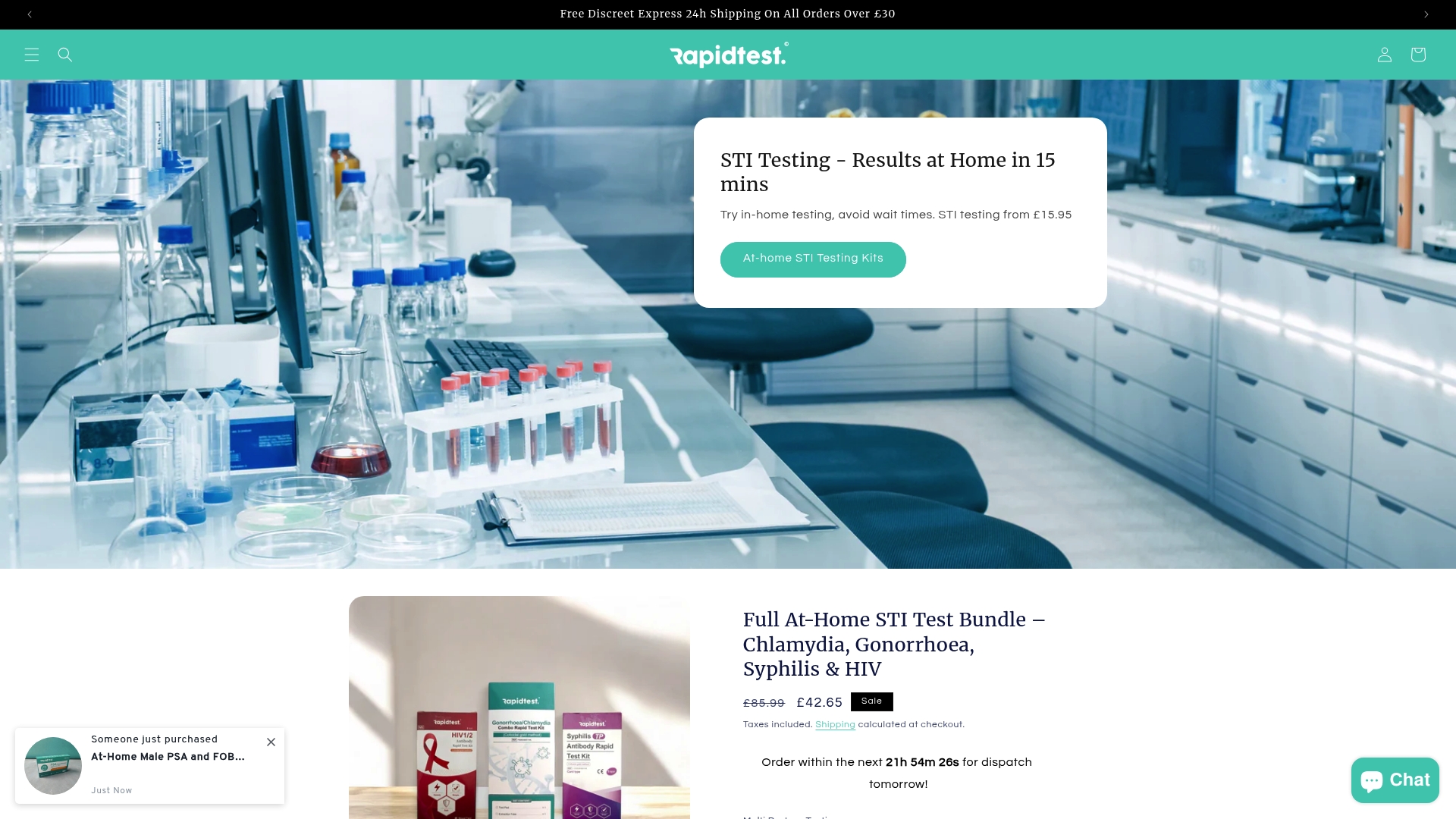
Worth being upfront about: a reactive result on any home test, ours included, is a screening finding, not a diagnosis. The sensible next move is the same one we’ve described throughout this article, book in for confirmatory lab testing and clinical review, since only that combination can properly distinguish a true infection from a false positive. If you’re weighing up where to start, our full range of test kits covers syphilis alongside other STIs, so you can screen privately first and take a confirmed result to your clinician when it matters.
This article is general information, not a substitute for advice from a qualified doctor. Consult a qualified healthcare professional about your own circumstances before acting on anything here.
FAQ
Can you be false positive for syphilis?
Yes, biologic false positives happen, most often when a nontreponemal test (RPR or VDRL) is reactive but a treponemal test isn’t. Surveillance data puts this at around 11% of reactive nontreponemal results, with the large majority at low titer.
Can you test positive for syphilis without having it?
Yes. Conditions such as autoimmune disease, certain infections, pregnancy and even recent vaccination can trigger antibodies that a nontreponemal test picks up even without an actual syphilis infection, which is why confirmatory treponemal testing matters.
What can syphilis be mistaken for?
A reactive syphilis screen can be caused by autoimmune disorders like lupus or antiphospholipid syndrome, as well as other infections such as hepatitis C, HIV or Epstein-Barr virus. Clinicians typically review your history and run further tests to work out which explanation fits.
How accurate is a syphilis test after 2 weeks?
Treponemal antibodies usually become detectable around two to three weeks after exposure, so testing at exactly two weeks can still miss a very recent infection. Most clinics recommend retesting at four to six weeks if your initial test was taken early.
Sources
- Discordant syphilis test results and biologic false-positive rates (surveillance analysis)
- Advantages and limitations of current diagnostic laboratory approaches in syphilis and congenital syphilis
- In-depth evaluation of false-positive biological reactions in the syphilis serological diagnosis: a cross-sectional study
- 2026 study on risk factors for false-positive treponemal tests