


Avoid Wasted Kits: When Rapid STI Tests Are Reliable at Home
If you’ve had a recent sexual encounter and you’re wondering when a rapid test will actually tell you something useful, here’s the short version: chlamydia and gonorrhoea NAAT tests are reliable from about 2 weeks after exposure, HIV antibody tests need around 45 days, and syphilis can take up to 90 days. If you have symptoms, or you’ve had a possible HIV exposure in the last 72 hours, skip the waiting and get seen urgently.
TL;DR:
- NAAT tests for chlamydia and gonorrhoea generally become reliable about two weeks after exposure, especially for genital sites.
- HIV antibody tests usually need around 45 days for accurate results, while syphilis tests can require up to 90 days, necessitating repeat testing.
- Rapid antibody tests detect infections later than molecular tests, and early negative results during the window period are often false negatives.
- Testing too early, before these windows, significantly reduces the likelihood of detecting infections, making timing and re-testing critical.
- Urgent symptoms such as sores or pelvic pain require immediate clinical assessment and should not be delayed by window period guidelines.
Table of Contents
- Window periods by infection: chlamydia, gonorrhoea, HIV, syphilis, hepatitis B/C
- How rapid tests differ from laboratory tests: sensitivity, specificity and timing
- If you test too soon: interpreting a negative and when to repeat testing
- Symptoms and urgent care: when to bypass window advice
- Routine testing frequency and retesting after treatment or ongoing risk
- Publisher perspective: the role of at-home rapid testing
- Getting the timing right with an at-home kit
- FAQ
- Sources
Window periods by infection: chlamydia, gonorrhoea, HIV, syphilis, hepatitis B/C
Every infection has its own timeline, and that’s because tests look for different things: some hunt for the pathogen’s genetic material, others wait for your immune system to produce detectable antibodies. That difference is what drives the whole concept of a window period.
- Chlamydia and gonorrhoea: NAAT tests are reliable from roughly 2 weeks after exposure. Throat or rectal exposure needs a swab taken from that specific site, not just a urine or genital sample.
- HIV: rapid antibody self-tests are commonly reliable from about 45 days, though some rapid antibody formats recommend a further check at up to 12 weeks for full confirmation.
- Syphilis: serology may need up to 90 days for a reliable result, which is why repeat testing is standard practice after recent exposure.
- Hepatitis B and C: window periods tend to run longer than for bacterial STIs, and retest schedules vary, so it’s worth following the timing given with your specific kit or by your clinic.
Guidance from sexual health services consistently points to a 2 week window for chlamydia and gonorrhoea before NAAT testing becomes reliable. That single fact explains why so many early negative results turn out to be wrong, not because the test failed, but because it was asked a question too soon.
Rapid antibody tests generally detect infection later than laboratory-based molecular tests, and the sample type you provide (blood, urine, swab) also shapes how early a test can detect something. If you’re unsure which applies to your situation, our guidance on testing after unprotected sex walks through the timing in more detail.
How rapid tests differ from laboratory tests: sensitivity, specificity and timing
Not all tests work the same way, and that’s the whole reason window periods differ so much between them.
- NAAT (nucleic acid amplification tests) look for the pathogen’s genetic material directly, which is why they can detect chlamydia and gonorrhoea earlier than antibody-based methods.
- Antigen tests detect a piece of the pathogen itself, often used for early HIV detection in laboratory settings.
- Antibody rapid tests wait for your immune response to build, which takes longer but is well suited to fast, at-home formats.
Rapid immunochromatographic strip tests can deliver a result in 5 to 30 minutes, though their sensitivity can run lower than laboratory NAAT, particularly for infections like gonorrhoea where some point-of-care formats have shown notably reduced pick-up rates. This matters most during the early window period, when there’s less of the target material present to detect in the first place.
That said, the technology is moving fast. Newer rapid molecular and multiplex platforms are closing the gap with laboratory performance for several pathogens, and getting a result quickly, even one that’s slightly less sensitive, can mean more people actually get treated rather than falling through the cracks waiting for a lab to call back.
If you test too soon: interpreting a negative and when to repeat testing
A negative result inside the window period doesn’t mean you’re clear. It means the test couldn’t find enough evidence yet, which isn’t the same thing. Testing too early genuinely reduces how much you can trust a negative result, so the timing of a repeat test matters as much as the first one.
- Chlamydia or gonorrhoea: if your initial test was earlier than 2 weeks post-exposure, repeat the NAAT at the 2-week mark.
- HIV: repeat between 6 and 12 weeks depending on the test type you used, as some rapid antibody tests need the longer window to confirm a negative.
- Syphilis: repeat at around 3 months if your exposure was recent.
Write down your exposure date and your test date somewhere you won’t lose it. It sounds trivial, but it’s the detail that lets you (or a clinician) work out exactly when a result becomes meaningful.
Pro Tip: Use condoms or avoid sex until your retest is done, and let recent partners know if there’s a chance you’ve been exposed, even before you have a confirmed result.

Symptoms and urgent care: when to bypass window advice
Window periods are a guide for people without symptoms. If something feels wrong, don’t wait for a calendar date to tell you it’s safe to test.
- Sores, ulcers or blisters on the genitals or mouth
- Heavy, unusual or bloody discharge
- Sharp pelvic or lower abdominal pain
- Fever alongside any genital symptoms
If you’ve had a possible HIV exposure, clinical assessment for PEP is needed within 72 hours. Testing on its own is not a substitute for getting seen urgently, PEP only works within that window, and a rapid test result won’t change that clock. Symptomatic presentations also tend to get fast-tracked straight to diagnosis and treatment rather than waiting out a standard window period.
Routine testing frequency and retesting after treatment or ongoing risk
If you’re sexually active, an annual check is the general baseline most people are advised to follow. If you’ve had multiple or anonymous partners, you’re on PrEP, or you’ve had more than ten partners in the past year, testing every 3 months is the more sensible rhythm.
- After treatment for a bacterial STI like chlamydia, clinics often recommend a retest within 2 to 6 months, with the exact timing depending on your age and setting.
- Time a single test around the end of the relevant window period rather than testing repeatedly too early.
- Many services cap how often you can order self-test kits in short succession, partly because early, repeated testing wastes kits without adding useful information.
Publisher perspective: the role of at-home rapid testing
Rapid tests have genuinely changed who gets tested and how quickly, but speed only helps when the timing is right. A result taken too early can feel reassuring and still be wrong, which is arguably worse than not testing at all.
Where rapid, at-home testing earns its place is discreet routine screening once you’re past the relevant window, quick reassurance after a lower-risk encounter, or pre-travel screening. Where it doesn’t replace a clinic is anything symptomatic, anything involving a possible recent HIV exposure, or a result you need confirmed quickly for clinical reasons.
— Jack
Getting the timing right with an at-home kit
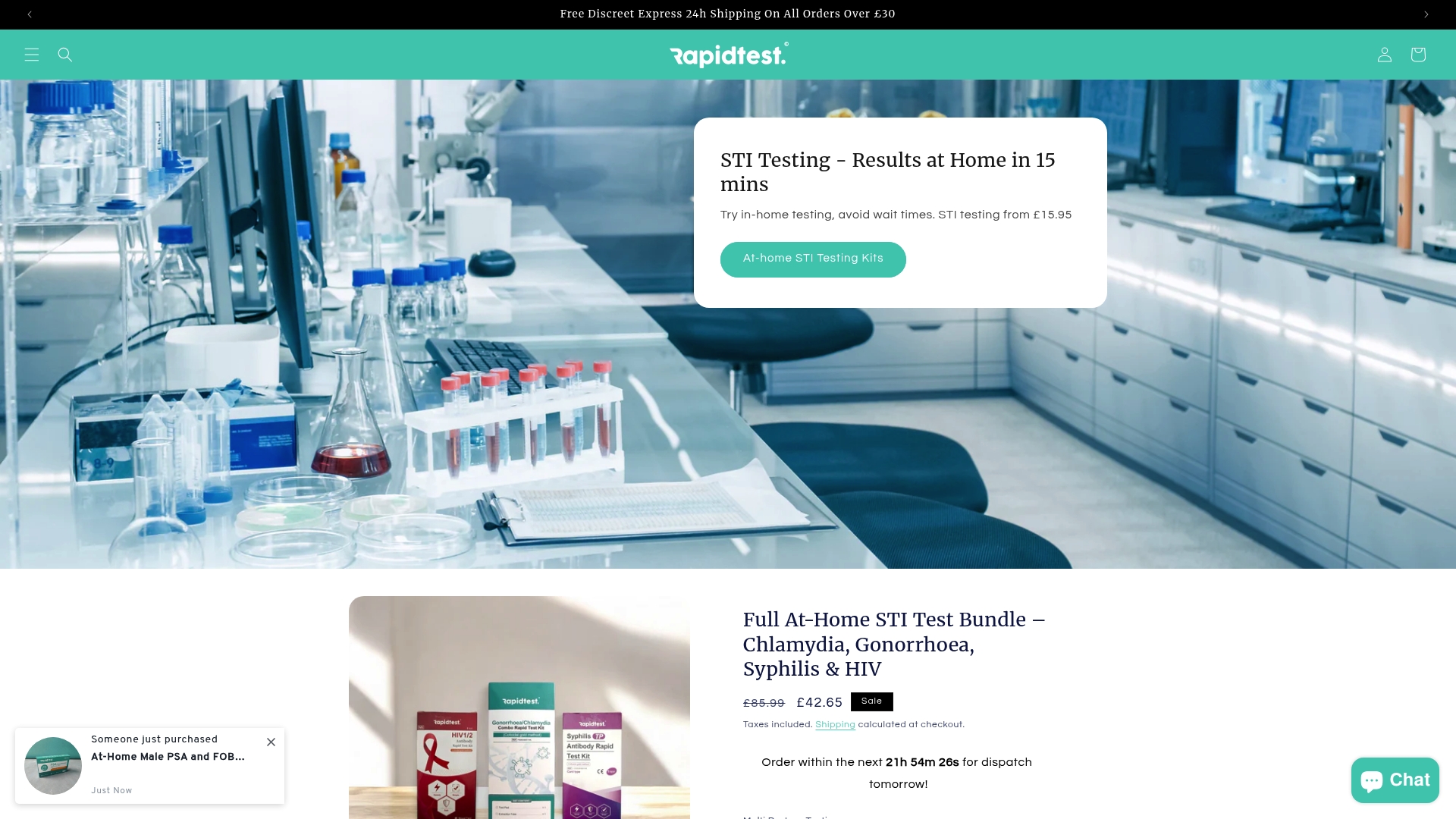
We offer kits designed to provide results quickly, with CE certification and discreet packaging. None of that replaces good timing, though, so a little planning goes a long way.
- Pick the kit that matches your actual exposure and the infection you’re concerned about, not just the first one you see.
- Follow the specimen instructions exactly, including the suggested timing after exposure.
- Note your exposure and test dates so you know exactly when a retest is due.
- If you have symptoms or a recent possible HIV exposure, a clinic visit is still the right call rather than a home kit.
If you’d rather browse what’s available first, our STI and STD test kits are a good place to start, and if fertility or men’s health screening is more what you’re after, we’ve got dedicated kits for that too.
FAQ
Is 2 days too soon to test for an STD?
Yes, for almost every STI, 2 days is well inside the window period and a negative result wouldn’t be reliable. Chlamydia and gonorrhoea need around 2 weeks, and HIV needs closer to 6 weeks, so testing this early mostly risks a false reassurance.
How quickly can an STI show up on a test?
It depends entirely on the infection and test type: chlamydia and gonorrhoea NAAT tests become reliable from about 2 weeks after exposure, while HIV antibody tests typically need around 45 days. Syphilis can take the longest, up to 3 months for reliable serology.
Is 7 days long enough to wait before an STI test?
For most bacterial STIs like chlamydia and gonorrhoea, testing earlier than the recommended 2-week window still falls short. Waiting the full 2 weeks gives you a meaningfully more trustworthy result.
Can chlamydia show signs in 3 days?
Chlamydia often causes no symptoms at all, and even when it does, 3 days is too early for a reliable NAAT result. The recommended wait is at least 2 weeks after exposure, regardless of whether symptoms have appeared.
When should I seek care instead of waiting for a test window?
If you have symptoms such as sores, unusual discharge or pelvic pain, or you’ve had a possible HIV exposure in the last 72 hours, seek clinical assessment straight away rather than waiting out a standard window period. Symptomatic cases are generally fast-tracked to diagnosis and treatment.