


How Often Should You Have a PSA Test? A UK Guide
There is no single official answer, and that surprises a lot of men. In the UK there is no formal guidance on how often to have a PSA blood test. Prostate Cancer UK suggests every couple of years for men with no symptoms, and some men choose to test every year. The useful bit is working out where you sit, because your age, ethnicity and family history change the picture. Once you know that, a regular routine is easy to stick to, and our at-home PSA screening kits give you a result in around 15 minutes without a queue or a waiting room.
TL;DR
- There is no formal UK rule on PSA test frequency. Every two years is the usual suggestion for men without symptoms, and some men test annually.
- Routine PSA testing is not offered on the NHS unless you carry a faulty BRCA2 gene or have symptoms, but you can ask your GP about it.
- Black men, men with a family history of prostate cancer and men with BRCA variations are advised to talk about testing from age 45.
- A high PSA does not mean cancer. Enlarged prostates, infections and even a bike ride can push it up.
- Prepare for 48 hours before any PSA test so your result is a fair one, and take any raised result to your GP.
Table of Contents
- What a PSA test actually tells you
- So how often? What the UK guidance says
- Who should start thinking about it, and when
- Can you get a PSA test on the NHS?
- Why a home routine makes frequency easier
- Getting a fair reading: how to prepare
- What to do with a raised result
- Our view on PSA testing
- Start your routine with Rapidtest
- FAQ
- Sources
What a PSA test actually tells you
PSA stands for prostate specific antigen. It’s a protein made by the prostate, and a PSA test measures how much of it is in your blood. High levels may be a sign of a prostate condition, and that includes prostate cancer.
The key word is “may”. The NHS is clear that a high PSA does not mean you have cancer. It can be down to something far more common, such as benign prostate enlargement. Prostate Cancer UK explains that the prostate tends to grow as we age, releasing more PSA, and that enlarged prostates are very common in men over 50.
So think of PSA as a marker worth tracking, not a verdict. One number matters less than the direction it moves in over the years. That is the main reason testing on a regular schedule beats one-off tests when the mood strikes.
So how often? What the UK guidance says
Let’s be real: you’d probably like a neat answer like “every 12 months”. The honest position is that nobody has pinned one down.
Here is what the main UK sources say:
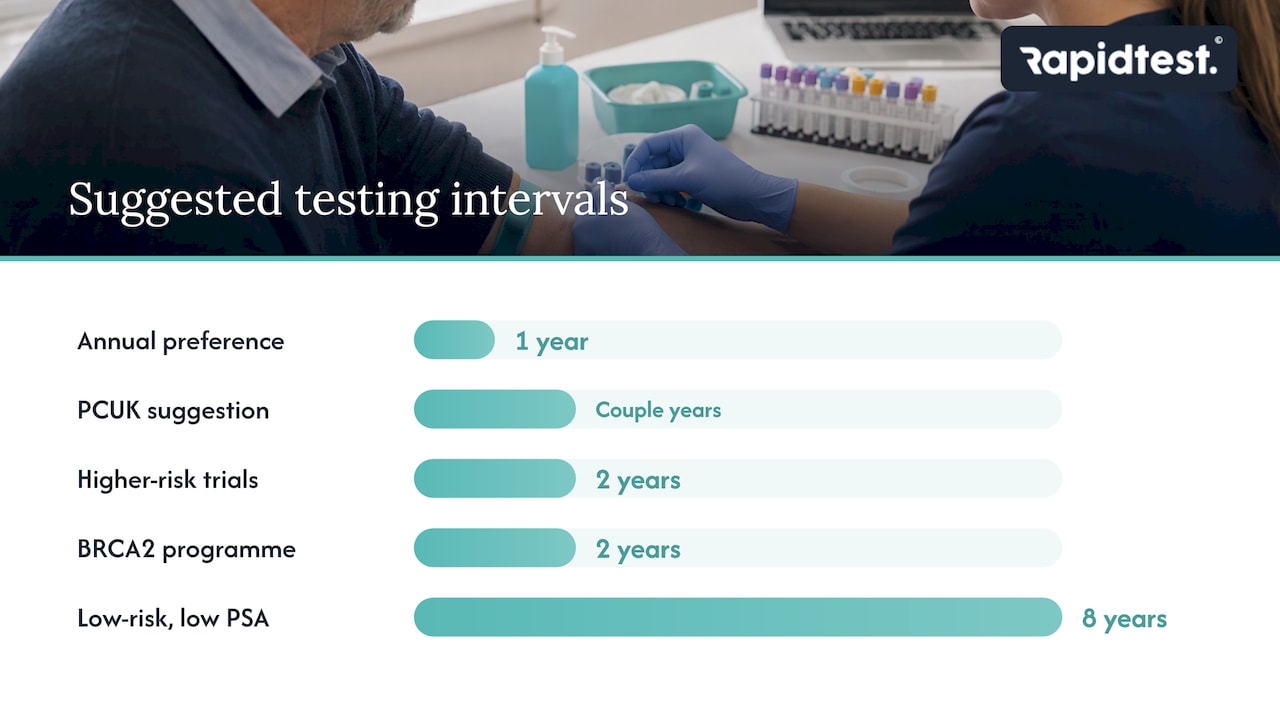
- Prostate Cancer UK says there is no formal guidance, but suggests testing every couple of years. Some men prefer annual testing. For men without symptoms, there’s currently no evidence that testing more often than that helps, because prostate cancer usually grows slowly.
- The Wessex Cancer Alliance’s 2025 consensus statement says the best interval for repeat testing in men without symptoms is unknown. Trials point to every 2 years for men at higher risk, and possibly every 8 years for low-risk men whose first PSA was under 1 at age 40 or under 2 at age 60.
- The UK National Screening Committee, in its March 2026 review, recommended a targeted programme of PSA testing every 2 years for men aged 45 to 61 who have a pathogenic BRCA2 variant and a family history of breast, ovarian, pancreatic or prostate cancer.
Put those together and a sensible pattern appears. Two years is the common rhythm. A first reading at a younger age that comes back low can reasonably stretch the gap. A reading that’s creeping up, or a higher-risk background, is a reason to keep your checks regular and talk it through with your GP.
A simple way to think about your interval
| Your situation | A sensible starting point |
|---|---|
| 50 or over, no symptoms, no extra risk factors | Every couple of years if you choose to test, as Prostate Cancer UK suggests |
| 45 or over and Black, or with a close relative who has had prostate cancer | Talk to your GP about starting, then a regular schedule, often every two years |
| BRCA2 variant with relevant family history, aged 45 to 61 | Every 2 years, per the UK NSC recommendation, arranged through your clinical team |
| Already had a raised result | Follow your GP’s advice on repeat tests and next steps |
| Urinary symptoms or other changes | See your GP rather than waiting for your next scheduled test |
This table is a guide to the published advice, not a personal prescription. Your GP can look at your full history.
Who should start thinking about it, and when
Age matters, but so does your background. According to the Wessex consensus statement, the average lifetime risk of prostate cancer for men in the UK is 1 in 6. For Black British, African and Caribbean men it is 1 in 4, starting from around age 45. If a first-degree relative (a father or brother) has had prostate cancer, you’re 2.5 times more likely to develop it, and 4 times if two are affected.
The same statement says primary care professionals can consider discussing risk and PSA testing with men aged 45 or over who are Black, have a family history, or carry BRCA gene variations. Men aged 50 or over with no extra risk factors aren’t proactively invited, but they can ask for a test after hearing the pros and cons.
If you want a quick read on where you stand, Prostate Cancer UK points men to its online Risk Checker, which takes about 30 seconds. It’s a good first step before any conversation with your GP.
In short:
- Under 45, no symptoms, no family history: there is no standard reason to test.
- 45 and over with higher risk: this is the point to raise it.
- 50 and over, average risk: the choice is yours, and you can ask.
Can you get a PSA test on the NHS?
Sometimes. Routine PSA testing isn’t currently offered on the NHS unless genetic tests have shown you carry a faulty BRCA2 gene. You may also be offered one if a doctor thinks your symptoms could point to prostate cancer. Anyone with a prostate can ask a GP about testing, and the doctor will go through the benefits and risks with you first.
The House of Lords Library sets out the same position under official guidance: if you request a test without symptoms, your GP should discuss the pros and cons and use clinical judgement. GPs shouldn’t proactively raise it with people who have no symptoms. Anyone over 50 with a prostate can ask.
There’s also a bigger shift on the way. NICE’s clinical knowledge summary, revised in June 2026, notes that only England has accepted the targeted BRCA2 programme so far and that it isn’t yet active. Advice on men without a known BRCA variant was expected by autumn 2026. Because that’s moving, it’s worth checking the NHS pages for the latest.
All of that leaves a gap. Plenty of men over 40 want to keep an eye on their numbers, don’t meet the criteria for a routine NHS test, and don’t fancy booking a GP slot just to ask. That’s the gap a home kit fills.
Why a home routine makes frequency easier
The hardest part of “every couple of years” isn’t the science. It’s remembering, and finding the time. Appointments get put off, and then it’s been four years.
A home kit takes most of that friction away. With our PSA screening kits, you get your result at home in around 15 minutes. There are no queues, no waiting room and no awkward conversation, and the kit comes with full instructions and in discreet packaging. UK shipping is free, and our kits are CE-certified. If a kit doesn’t work, our 60-day refund guarantee has you covered.
A few ways men use that convenience well:
- Pick a date and repeat it. Your birthday month, or the same month each year or every second year, means you never have to remember when you last tested.
- Keep a simple note. Write down the date and what the result said. Direction of travel is useful for your GP.
- Pair it with other health habits. Plenty of men in their 40s and 50s use the same moment to check in on their wider health.
- Look at bowel health too. Our men’s health range also includes FOB kits, which screen for blood in stool, a sign linked with bowel problems.
Getting a fair reading: how to prepare
PSA can be nudged up temporarily, which is why preparation matters. The NHS advises that for 48 hours before a PSA test you should avoid:
- anal sex
- ejaculating
- breathless exercise
- riding a bike
If you’ve had a urine infection, wait 4 to 6 weeks after it has cleared. Prostate Cancer UK adds that some medicines can also temporarily affect levels, so mention anything you’re taking to your GP.
Follow the same preparation every time you test. That way, each reading is comparable with the last one, and a change means something.
What to do with a raised result
First, breathe. A raised PSA is more likely to be something other than prostate cancer, such as an enlarged prostate.
Second, make a GP appointment and take your result with you. If your PSA is raised, the NHS says you may be offered another test to see whether levels are still high. If they are, your GP may talk to you about a referral to a specialist for further tests, such as an MRI scan or a biopsy.
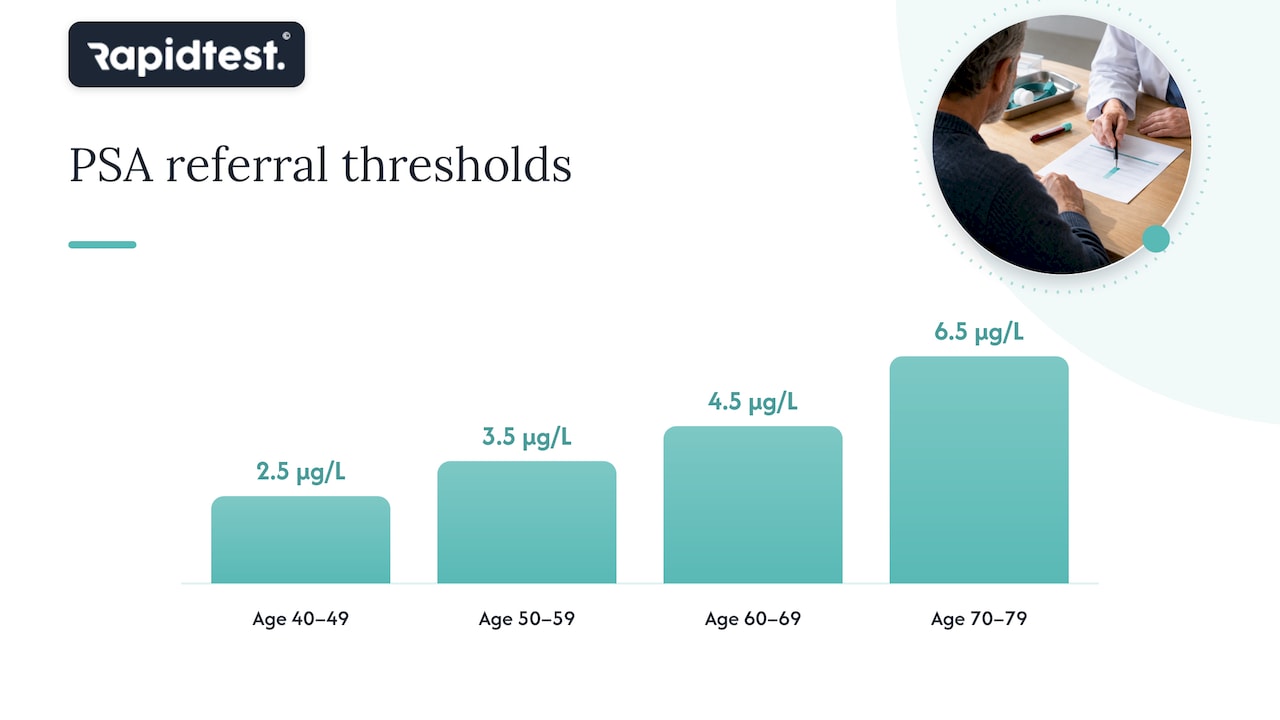
GPs use age-specific thresholds when deciding on a referral. NICE’s suspected cancer guidance (NG12) suggests considering a suspected cancer pathway referral when PSA is above:
| Age | PSA above (µg/L) |
|---|---|
| 40 to 49 | 2.5 |
| 50 to 59 | 3.5 |
| 60 to 69 | 4.5 |
| 70 to 79 | 6.5 |
Below 40 and above 79, clinical judgement applies. These thresholds are there for clinicians, so don’t try to diagnose yourself from a table. Your GP will weigh your age, symptoms, history and preferences.
If you have urinary symptoms, such as getting up at night to pee, needing to go more often, hesitancy, urgency or erectile problems, or you see blood in your urine, see your GP promptly. NICE says a PSA test and a rectal examination should be considered in those cases.
Our view on PSA testing
We built Rapidtest around a simple idea: looking after your health shouldn’t mean taking half a day off work, sitting in a waiting room and feeling awkward about it.
When it comes to PSA, the honest message from the UK guidance is that regular, informed checking is a personal choice, and the best interval depends on you. That’s exactly why we think men should have an easy way to make that choice themselves. A kit at home, with full instructions, a result in around 15 minutes and discreet packaging, means the routine you decide on is one you will actually keep.
We’d always encourage you to learn your risk factors first, prepare properly for each test, and share any raised result with your GP. Our kits are CE-certified, UK delivery is free, and there’s a 60-day refund guarantee if a kit doesn’t work. Proactive health care should feel affordable and straightforward, not like a hurdle.
Jack
Start your routine with Rapidtest
If you’re a man in your 40s or beyond and you’d like to keep tabs on your prostate, our men’s health range has you covered. It includes PSA kits for prostate screening and FOB kits for bowel health. Everything arrives in discreet packaging, with full instructions, and you get your result at home in around 15 minutes.
You can browse the full range on our men’s health screening page, or see everything we offer, including STI and other home test kits, if you’re keen to look after the rest of your health in one go.
FAQ
How often should you get a PSA test?
There’s no formal UK guidance, but Prostate Cancer UK suggests every couple of years for men without symptoms. Some men test annually. If you’re at higher risk, your GP may suggest a regular two-year pattern, and if you have symptoms you should see them rather than wait.
Can I have a PSA test on the NHS?
Routine PSA testing isn’t currently offered unless you carry a faulty BRCA2 gene, or a doctor thinks your symptoms could be prostate cancer. You can still ask your GP about it, and they’ll talk through the benefits and risks with you before deciding. If you’d rather check at home, our kits give a result in around 15 minutes.
Does a high PSA mean I have prostate cancer?
No. The NHS says a high PSA can be caused by other things, such as an enlarged prostate. Infections, recent ejaculation and vigorous exercise can also raise it temporarily. A raised result is a reason to speak to your GP, who may suggest a repeat test.
At what age should I start testing?
For most men with no extra risk factors, the choice opens from age 50, when you can ask for a test. If you’re Black, have a close relative with prostate cancer, or carry a BRCA variation, the Wessex Cancer Alliance says the conversation can begin from age 45.
Sources
- PSA test - NHS
- Q&A: Answering your questions on the PSA blood test - Prostate Cancer UK
- Consensus Statement on PSA Testing for Prostate Cancer 2025 - Wessex Cancer Alliance
- Prostate cancer - UK National Screening Committee
- Prostate cancer: Tests for men at the highest risk - House of Lords Library
- Screening for prostate cancer - NICE CKS
- Suspected cancer recommendations by site of cancer - NICE NG12