


PSA levels in prostate cancer: what they mean
If you’ve recently had a PSA test or been told your levels are elevated, it’s easy to jump straight to worst-case thinking. Understanding what are PSA levels in prostate cancer terms, and what they actually tell you, is far more reassuring than most men expect. A PSA reading is not a cancer diagnosis. It’s a signal worth paying attention to, but one that needs proper context. This article breaks down what PSA levels measure, what’s considered normal for your age, what else can push those numbers up, and what to do if your result comes back higher than expected.
Table of Contents
- Key takeaways
- What PSA levels actually measure
- What else can raise your PSA levels
- PSA levels and prostate cancer risk
- When and how often to test
- What to do after an abnormal result
- My honest take on PSA testing
- Check your PSA from home with Rapidtest
- FAQ
Key takeaways
| Point | Details |
|---|---|
| PSA is not a cancer test | Elevated PSA has many causes beyond cancer, including infection and benign enlargement. |
| Age changes the goalposts | Normal PSA ranges differ by age group, so your result needs to be read in that context. |
| A single number is not enough | Doctors use PSA velocity, density, and free PSA ratio alongside your reading to assess risk. |
| At-home testing is a real option | You can now check your PSA levels privately at home, with results in under 15 minutes. |
| An abnormal result needs follow-up | A high PSA reading is the start of a conversation with your doctor, not a conclusion. |
What PSA levels actually measure
PSA stands for prostate-specific antigen. It’s a protein produced by cells in your prostate gland, and small amounts of it naturally enter your bloodstream. Every man has some PSA in his blood. The question is how much, and whether the amount is appropriate for your age.
A PSA blood test measures the concentration of this protein in nanograms per millilitre (ng/mL). The result gives your doctor a snapshot of prostate activity. Higher levels can suggest the prostate is under stress, whether from cancer, infection, or simple enlargement.
What counts as normal?
This is where age matters enormously. PSA thresholds vary by age: men under 60 are generally considered normal below 2.5 ng/mL, while men aged 60 and over are typically assessed against a threshold of 4.0 ng/mL. The table below gives you a clearer picture.
| PSA level (ng/mL) | General interpretation |
|---|---|
| Below 1.0 | Low risk, reassuring result |
| 1.0 to 3.9 | Low to moderate, monitor over time |
| 4.0 to 9.9 | Increased risk, further investigation often advised |
| 10.0 and above | High likelihood of significant prostate disease |
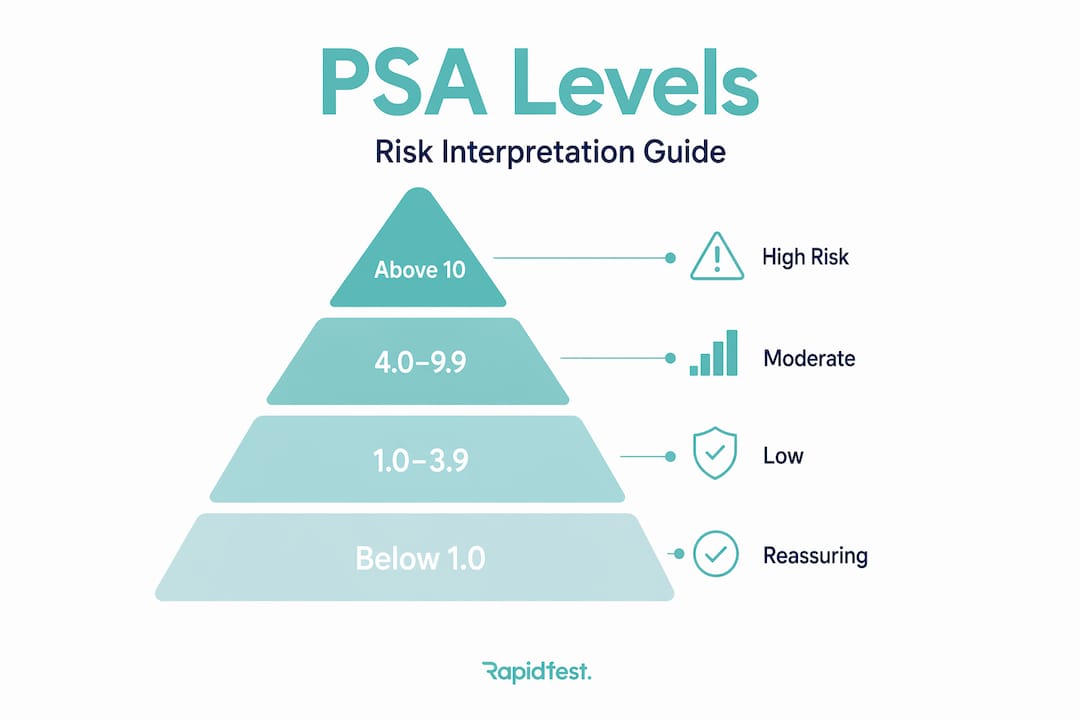
These ranges are guidelines, not verdicts. A man in his 70s with a PSA of 5.0 ng/mL is in a very different position to a 45-year-old with the same reading. Context is everything when it comes to understanding PSA levels.
Pro Tip: If you are under 50 and your PSA is creeping above 2.0 ng/mL, mention it to your GP even if it technically falls within the “normal” bracket. Earlier tracking gives you a much stronger baseline.
What else can raise your PSA levels
Here’s something that catches a lot of men off guard. Cancer is not the most common reason for an elevated PSA. Several everyday and medical factors can push your numbers up without any cancer being present at all.
Common causes of raised PSA that are not cancer include:
- Benign prostatic hyperplasia (BPH): An enlarged prostate is extremely common in men over 50 and regularly raises PSA levels.
- Prostatitis: Inflammation or infection of the prostate can cause a significant spike in PSA, sometimes quite suddenly.
- Urinary tract infections: These can affect the prostate area and temporarily elevate readings.
- Recent ejaculation: Sexual activity within 48 hours of a test can raise PSA. Avoiding ejaculation and vigorous exercise for at least 48 hours before testing is standard advice.
- Vigorous cycling or exercise: Pressure on the perineum from cycling, or intense physical exertion, can temporarily elevate PSA.
- Medical procedures: A prostate biopsy, cystoscopy, or catheterisation can cause a significant but temporary rise.
The free PSA ratio is a useful tool when your reading falls in the grey zone between 4 and 10 ng/mL. A free PSA ratio under 10% is associated with a higher likelihood of cancer, while a higher ratio tends to suggest benign causes. This is the kind of nuance that helps doctors avoid unnecessary biopsies.
Pro Tip: Before any PSA test, avoid ejaculation, intense exercise, and cycling for 48 hours. It’s a small adjustment that can prevent a misleading result and unnecessary worry.
PSA levels and prostate cancer risk
So, what do PSA levels actually indicate when it comes to cancer specifically? Clinicians use PSA as one piece of a larger picture. No doctor will diagnose prostate cancer from a PSA reading alone. The PSA test is not diagnostic. A biopsy is required to confirm cancer. But PSA levels do help assess how likely cancer is, and how aggressive it might be.
Here’s how PSA fits into cancer staging:
- Low risk (PSA below 10 ng/mL): Often associated with localised, slower-growing cancer. Frequently managed with active surveillance rather than immediate treatment.
- Intermediate risk (PSA 10 to 20 ng/mL): Suggests a more significant finding. Doctors typically combine this with tumour grade to assess treatment options.
- High risk (PSA above 20 ng/mL): PSA levels above 20 ng/mL are used alongside grade groups to classify more advanced cancer stages and guide treatment decisions.
PSA velocity and PSA density
Two measurements that go beyond a single reading are PSA velocity and PSA density. PSA velocity tracks how quickly your PSA is rising over time. A rise of 0.35 to 0.75 ng/mL per year raises concern even if the absolute number seems manageable. PSA density compares your PSA level to the actual size of your prostate. A PSA density above 0.15 ng/mL per cubic centimetre suggests the prostate is producing more PSA than its size would normally warrant, which can indicate cancer.

The grey zone, a PSA reading between 4 and 10 ng/mL, is where most of the clinical complexity lives. In this range, roughly one in four men will have prostate cancer. That’s why repeat testing, free PSA ratios, and sometimes MRI imaging are used before a biopsy is even considered. Experts consistently caution against rushing to conclusions or treatment based on a single elevated reading.
| PSA category | Cancer risk association |
|---|---|
| Below 4.0 ng/mL | Lower risk, age-dependent interpretation |
| 4.0 to 10.0 ng/mL (grey zone) | Approximately 25% chance of cancer |
| Above 10.0 ng/mL | Greater than 50% chance of significant disease |
| Above 20.0 ng/mL | High-risk staging, further evaluation required |
When and how often to test
Most guidelines suggest men start thinking about PSA testing at age 50. If you have a family history of prostate cancer, or you are of African-Caribbean heritage (where risk is statistically higher), starting at 45 makes sense. Some doctors recommend beginning at 40 for those with a strong family history.
Key factors that should prompt a conversation about PSA testing:
- You are aged 50 or over with no previous testing
- You have a first-degree relative (father or brother) who had prostate cancer
- You are of African-Caribbean heritage
- You have noticed urinary symptoms such as weak flow, frequent night-time urination, or difficulty starting
- You have not had a PSA test in the past one to three years
How often you test depends on your baseline. Men with a PSA below 1.0 ng/mL at age 50 can typically wait three years between tests. Those with readings closer to the threshold for their age group may benefit from annual checks. Your GP can help you decide on the right interval, but you do not need to wait for a GP appointment to get started.
At-home PSA testing has changed the picture for a lot of men. Rapidtest’s PSA rapid test kit lets you test from home with a simple finger-prick blood sample, and you get your result in around 15 minutes. There are no queues, no waiting rooms, and no awkward conversations. The step-by-step process is straightforward, and the results give you a clear starting point before you speak to a clinician. At-home testing is not a replacement for clinical follow-up, but it is an excellent way to stay on top of your health between appointments.
For guidance on how often to test, Rapidtest has a dedicated resource that walks you through the decision based on your age and risk profile.
What to do after an abnormal result
Getting a higher-than-expected PSA result is unsettling. But it is worth repeating: a raised PSA is a prompt for further investigation, not a diagnosis. Here is what typically happens next.
Your doctor will usually recommend a repeat PSA test after four to six weeks. This rules out temporary causes like a recent infection or the pre-test lifestyle factors mentioned earlier. If the second result is still elevated, the next step is usually a free PSA ratio test, which helps distinguish between benign and potentially cancerous causes.
If the ratio suggests a higher cancer risk, an MRI scan is often the next step before any biopsy is considered. This approach has significantly reduced the number of unnecessary biopsies. A biopsy is only recommended when imaging and PSA data together point clearly towards the need for tissue sampling.
Pro Tip: If you receive a high PSA result from an at-home test, do not panic and do not ignore it. Book a GP appointment within the week, share your result, and ask about a repeat blood test. Taking that step calmly and promptly is exactly the right response.
Active surveillance is a legitimate and widely used option for men with low-risk prostate cancer findings. PSA screening reduces prostate cancer deaths by around two per 1,000 men screened, but the medical community is careful about overtreatment. Not every cancer detected needs immediate intervention. Knowing this can make the whole process feel far less frightening.
Emerging methods that combine PSA with kallikrein panels and MRI are improving diagnostic precision further. Next-generation screening approaches aim to reduce overtreatment while catching genuinely aggressive cancers earlier.
My honest take on PSA testing
I’ve spent a lot of time helping men make sense of PSA results, and the pattern I see most often is this: men either dismiss an elevated reading entirely, or they spiral into panic before they have any real information. Both responses are understandable. Neither is helpful.
What I’ve found is that the men who do best are the ones who treat PSA testing as a regular, unremarkable part of looking after themselves. Not a one-off scare, not a crisis. Just a number to track over time, like blood pressure or cholesterol.
In my experience, the nuance matters enormously. A single elevated reading tells you very little on its own. Two readings taken months apart, combined with a free PSA ratio and a conversation with a clinician, tell you a great deal. That’s why I genuinely believe at-home testing is a good thing. It removes the barrier of waiting for an appointment and gives men the information they need to have a more informed conversation with their doctor.
What I’d push back on is the idea that testing is only for men with symptoms. By the time symptoms appear, the prostate has often been under stress for a while. Proactive screening, starting in your 40s if you have any risk factors, is where the real value lies.
The goal isn’t to live in fear of your PSA number. It’s to know it, track it, and act on it sensibly.
— Jack
Check your PSA from home with Rapidtest
If this article has prompted you to think about getting tested, the good news is you don’t need to book an appointment or sit in a waiting room to get started.
Rapidtest’s at-home PSA test gives you a clinically accurate result in around 10 minutes, using a simple finger-prick sample you take yourself at home. No lab, no GP referral, no fuss. For men who want broader coverage, the PSA and FOB test bundle screens for both prostate and bowel cancer markers in one go. It’s the kind of proactive health check that fits around your life, not the other way around. Take five minutes today. Your future self will thank you.
FAQ
What is a normal PSA level for my age?
Most urologists consider PSA below 2.5 ng/mL normal for men under 60, and below 4.0 ng/mL for men aged 60 and over. These thresholds help guide whether further investigation is needed.
Does a high PSA mean I have prostate cancer?
Not necessarily. Raised PSA can be caused by benign prostate enlargement, prostatitis, or infection. A PSA test is not diagnostic. A biopsy is required to confirm cancer.
What PSA level should I be worried about?
A PSA above 10 ng/mL carries a greater than 50% likelihood of significant prostate disease and warrants prompt clinical evaluation. Readings in the 4 to 10 ng/mL grey zone require further investigation but do not automatically indicate cancer.
Can I test my PSA at home?
Yes. At-home PSA tests like those from Rapidtest use a finger-prick blood sample and deliver results in around 10 to 15 minutes. They are a practical way to monitor your levels between clinical appointments.
How often should I have a PSA test?
Most guidelines suggest every one to three years from age 50, or from age 45 if you have a family history of prostate cancer or are of African-Caribbean heritage. Your GP can advise on the right interval for your situation.