


Biotin and Test Results: What It Can Change and When to Stop
Biotin is the vitamin in many hair, skin and nail supplements, and at high doses it can make some lab blood tests read wrong. Not all of them, and not at the small amounts you get from food or a standard multivitamin. But if you take a 5 mg or 10 mg tablet and then book a thyroid, hormone, PSA or heart test, it is worth knowing what happens, how long to leave it before a sample, and who to tell.
This guide gives you the plain version, using UK hospital guidance and published research. If you would rather skip the lab queue for routine screening, we also cover where our at-home kits fit in.
TL;DR
- High-dose biotin (roughly 5 mg a day and above) can make some immunoassays, a common type of lab blood test, read falsely high or falsely low. Everyday dietary biotin and multivitamin doses up to about 1 mg have not been reported to cause interference.
- Thyroid tests are the best-known example, but hormone tests (including testosterone, FSH, LH and estradiol), PSA and troponin have also been affected in studies.
- UK hospital guidance suggests stopping a 5 mg+ supplement for about a week before a non-urgent test, or at least 8 hours as a minimum, depending on the lab. Always ask your own lab or GP.
- Tell whoever orders your test about every supplement you take. NICE now recommends clinicians ask about biotin when thyroid problems are suspected.
- Never stop prescribed biotin, for example for multiple sclerosis, without speaking to your doctor first.
Table of Contents
- How biotin gets into a blood test result
- How much biotin is enough to matter?
- Which tests can biotin change?
- What UK guidance says
- How long to stop biotin before a blood test
- What if you already had a test while taking biotin?
- Where at-home rapid screening fits
- Our view
- FAQ
- Sources
How biotin gets into a blood test result
Biotin is vitamin B7. Your body needs only a tiny amount: Barnsley Hospital’s pathology guidance puts the required daily intake at 30 to 70 micrograms. A microgram is a thousandth of a milligram, so a 10 mg hair supplement is far above that.
The problem is a quirk of lab chemistry. Many automated lab tests use a very strong bond between biotin and a protein called streptavidin to capture the substance being measured. The AACC guidance document (2020) explains that when a sample holds a lot of extra biotin, it competes for those binding sites. In the common “sandwich” test format, the result comes out falsely low. In the “competitive” format, it comes out falsely high.
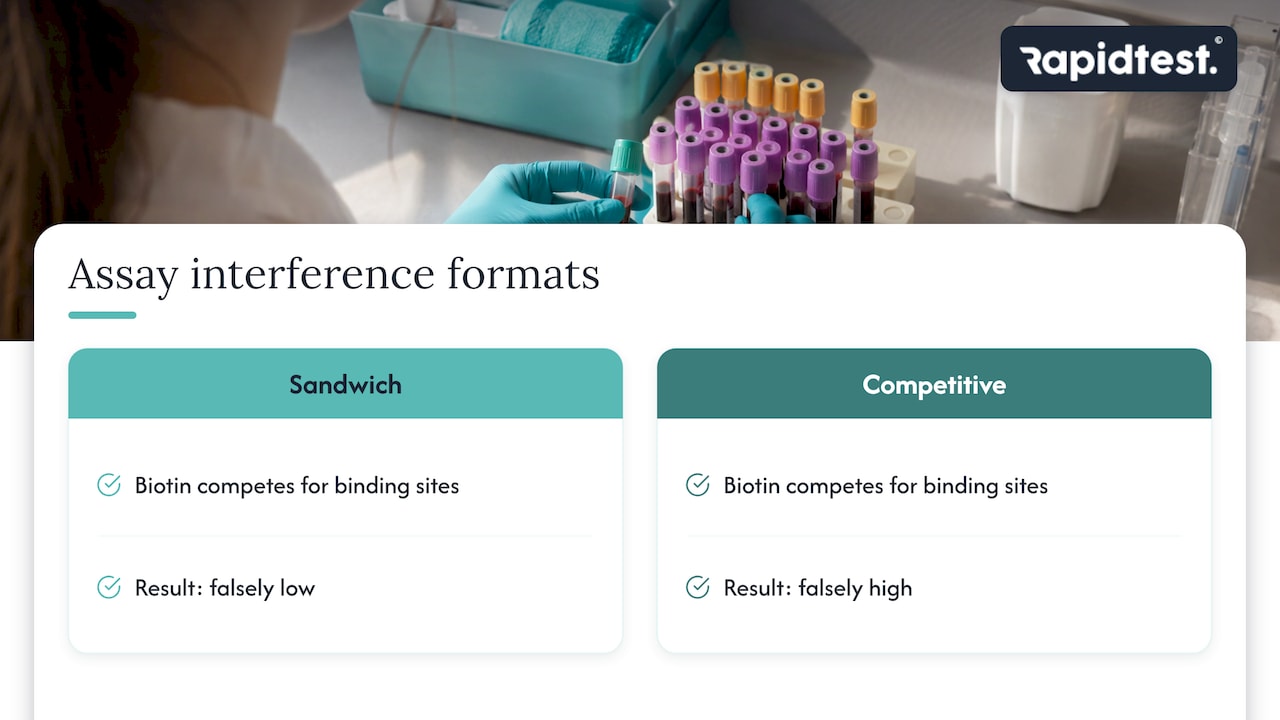
In plain terms: the machine is not broken, and neither is your body. The supplement is simply getting in the way of the measurement.
It does not affect every test
This is the part that often gets lost. The same AACC document says excessive biotin is unlikely to interfere with tests that do not use biotin-streptavidin binding, or where that binding is completed in the reagents before your sample is added. Dasgupta and Yeo (2022) make the same point: how the test is designed, not just whether biotin chemistry is involved, decides whether it is vulnerable. They note that most Abbott assays do not use biotin, and the few that do are built so high biotin levels do not affect them.
So whether your result is skewed depends on three things: how much biotin you took, how recently, and which analyser your lab uses for that test.
How much biotin is enough to matter?
Here is how the doses compare, based on UK hospital and laboratory guidance.
| Source of biotin | Typical amount | Interference risk |
|---|---|---|
| Food and normal diet | Micrograms (30 to 70 µg needed daily) | Not reported to interfere |
| Standard multivitamin | Small amounts, often up to about 1 mg or less | Not reported to interfere up to 1 mg |
| Hair, skin and nail supplements | 5 to 10 mg, sometimes more | Can interfere |
| Some supplements from health shops or online | Up to 10,000 µg (10 mg) per tablet | Can interfere |
| Prescribed high-dose use (for example multiple sclerosis trials) | Up to 300,000 µg a day | Significant interference possible |
A useful habit: check the label for “mg” rather than “µg” or “mcg”. If it says 5,000 mcg or 10,000 mcg, that is 5 mg or 10 mg. Multivitamins, “beauty” gummies, energy blends and some men’s health formulas can all carry biotin, so look at every product you take, not just the obvious hair one. The UK medicines regulator’s letter (May 2023) specifically says multivitamins and hair, skin and nail supplements can contain biotin and affect results.
How common is this in the UK? A British study of 554 anonymised surplus blood samples, discussed in Dasgupta and Yeo’s review, found biotin below the 10 ng/mL level considered the lowest interference threshold in every sample. The authors concluded the chance of interference in that population was extremely low. That is reassuring for most people, and it also tells you the risk sits with those taking concentrated supplements.
Which tests can biotin change?
The affected list is mostly immunoassays, which measure hormones, proteins and markers. Examples from UK and international sources:
Thyroid tests
This is where biotin causes the most trouble. According to the same Dasgupta and Yeo review, biotin can falsely raise T4 and T3 readings while falsely lowering TSH, a pattern that mimics an overactive thyroid. The NIH Office of Dietary Supplements reports case reports of results falsely suggesting Graves’ disease in people taking 10 to 300 mg a day, and says even a single 10 mg dose interfered with thyroid tests taken within 24 hours.
York Teaching Hospital’s laboratory bulletin (November 2021) adds that, on Roche immunoassays, doses above 5 mg may produce false positives for TPO antibodies and TSH receptor antibodies.
Hormone tests: testosterone, FSH, LH and more
If you are checking hormones because of fertility worries or low testosterone symptoms, this matters. The AACC document describes healthy volunteers who took a single 10 to 300 mg dose and then showed interference in tests including testosterone, estradiol, progesterone, LH and FSH, as well as ferritin, vitamin B12 and PSA.
Exeter’s laboratory alert lists, for its own analysers, falsely low readings for AMH, FSH, free beta hCG and total PSA, and falsely high readings for testosterone, free T3, free T4 and vitamin D. Barnsley Hospital reports that on its Siemens platform, serum folate and testosterone can read falsely high while SHBG and erythropoietin can read falsely low, at doses of at least 5 to 10 mg a day.
The pattern varies by manufacturer. One study summarised by the AACC found that in healthy volunteers taking 10 mg a day for a week, 9 of 23 biotin-based tests from three manufacturers showed interference, to different degrees.
Heart tests (troponin)
This is the serious one. Troponin is the marker used to help diagnose a heart attack. Health Canada notes that false results here can lead to serious consequences and says it is aware of one death reported in another country after falsely low troponin results in a patient taking high levels of biotin. If you ever go to A&E with chest pain, tell the team about your supplements. It takes seconds.
Infection tests
Lab-based hepatitis and HIV panels use immunoassays too. A French study discussed by Bayart is not needed here: Dasgupta and Yeo’s review lists hepatitis and HIV panels, procalcitonin and tumour markers among assays that can be vulnerable. The practical point is the same as for every other test: tell the person ordering it what you take.
What UK guidance says
Biotin interference is now on the radar of UK regulators and clinical guideline writers.
- The MHRA’s May 2023 levothyroxine letter says biotin interference should be considered if thyroid test results do not match how a patient presents. It also says labs should be told about biotin use before tests are ordered, because alternative assays may be available. It warns that high-dose biotin could lead to mismanagement in people whose levothyroxine dose is adjusted using regular thyroid tests.
- NICE’s 2023 exceptional surveillance report (published 12 October 2023) decided to update its thyroid disease guideline (NG145) to recommend asking adults, children and young people with suspected thyroid dysfunction about their biotin intake.
In other words, the system is moving towards asking you. But you will get a better result if you volunteer the information first, especially if you take a supplement you think of as “just a vitamin”.
How long to stop biotin before a blood test
There is no single UK-wide number, because it depends on your dose and the lab’s analyser. These are the figures UK and international sources give.
| Your biotin intake | Suggested gap before blood is taken | Source |
|---|---|---|
| Under 1 mg a day | About 2 hours | Exeter laboratory |
| 1 to 10 mg a day | About 8 hours | Exeter laboratory |
| 5 mg or more, non-urgent test | Stop for 1 week where safe | Barnsley Hospital |
| Above 5 mg | At least 8 hours after the dose, ideally skip it on the day | York Teaching Hospital |
| 10 mg a day or above | Up to 72 hours | Exeter laboratory |
| High-dose therapy (100 mg a day or more) | At least 72 hours, unless medically unsuitable | AACC guidance |
The science behind those gaps comes from a pharmacokinetic study (Grimsey et al., 2017). It found that after doses of up to 1 mg a day, blood biotin fell below the 10 ng/mL interference threshold within 2 hours. At 20 mg a day or more, it took 31 hours to reach 30 ng/mL and 73 hours to reach 10 ng/mL. The authors caution that the models used healthy volunteers, and biotin may clear more slowly in people with poor kidney function.
A separate study of thyroid tests in ten healthy adults found interference on two of three analyser platforms, none on the third, and that 8 hours was enough after 5 mg a day. After 10 mg a day, interference lasted one or two days depending on the platform. If you want to dig into the timing detail, this write-up on biotin washout times before testing covers the dose-dependent advice and the kidney caution.
A sensible routine
- List everything you take. Include multivitamins, gummies, powders and anything labelled for hair, skin or nails.
- Check the biotin amount in mg or mcg on each label.
- Tell the person ordering your test, or the lab, before the sample. The MHRA letter notes alternative assays may be available.
- Ask how long to pause for your particular test. A non-urgent check is easier to plan than an urgent one.
- Never stop prescribed biotin on your own. If a doctor has prescribed it, for example for multiple sclerosis or an inherited metabolic condition, speak to them first. If you cannot safely stop it, Barnsley Hospital advises the clinician to discuss it with the duty biochemist.
What if you already had a test while taking biotin?
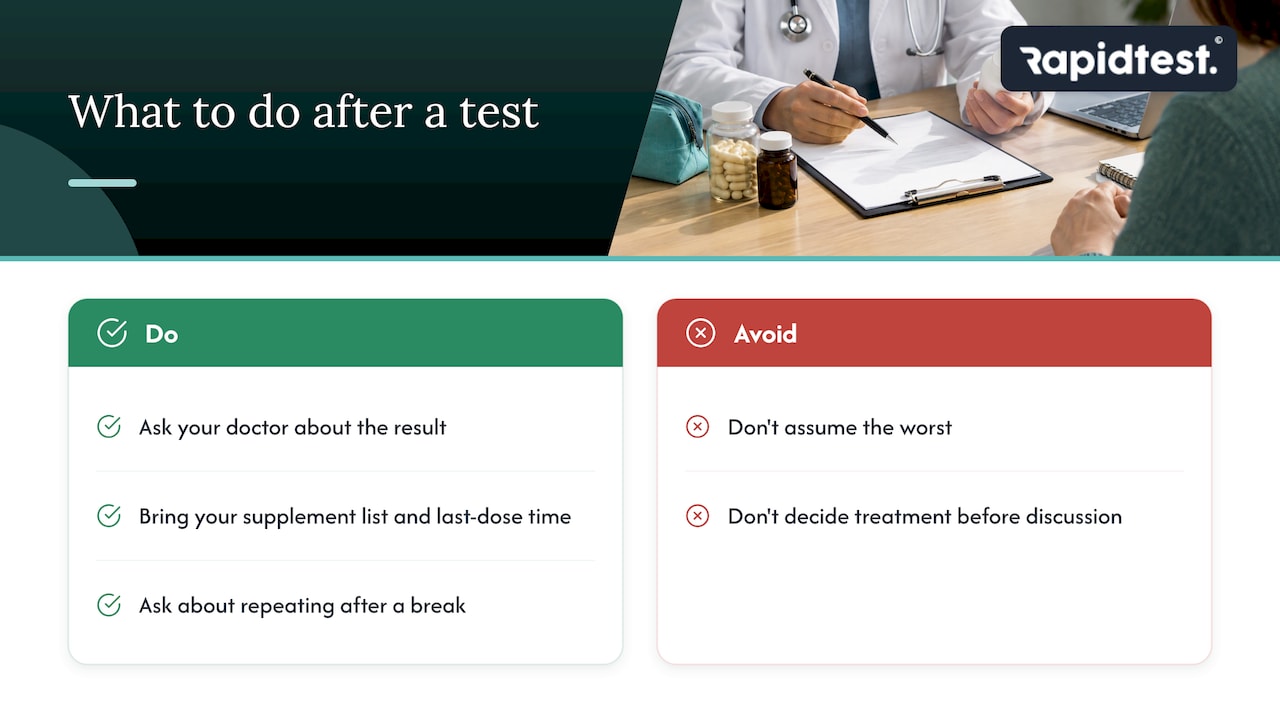
Don’t panic. A result that looks odd is a reason to ask a question, not a reason to assume the worst.
The MHRA letter advises anyone taking or recently taking biotin to consult their doctor, and says clinicians should consider biotin interference when thyroid results do not fit the clinical picture. Gifford and colleagues, writing in Canadian Family Physician (2018), explain that labs have workarounds: diluting the sample, running it on an unaffected analyser, or removing the biotin from it. They also warn that an apparent Graves’ disease picture caused by biotin can lead to unnecessary procedures.
So take your result, your supplement list and the date and time of your last dose to your GP. Ask whether a repeat test after a biotin break is sensible. That conversation is for your doctor, and it is worth having before any treatment decision is made on a result that does not match how you feel.
Where at-home rapid screening fits
Biotin timing is one more reason a lot of busy people dread booking tests: appointments, a pause in your routine, then days of waiting. At-home screening takes some of that friction out for the checks it covers.
Our kits are built for people who want a private, quick answer:
- STI and STD test kits, including chlamydia, gonorrhoea, syphilis, HIV, Hep B, Hep C, HSV-2 and HPV, from £21.95 one-off.
- Fertility Insight kits for hormone markers such as FSH, LH and HCG, plus sperm concentration.
- Men’s health screening for PSA and FOB, which look at prostate and bowel health. There is also an at-home FOB kit for readers in Europe.
You get your result at home in around 15 minutes, with no lab returns and no waiting room. Full instructions come in the box, delivery is discreet, UK shipping is free, and our kits are CE-certified. If a kit does not work, there is a 60-day refund guarantee.
Whatever you choose, keep your supplement habits in mind and mention them if a result prompts a conversation with your GP.
If you are ready to look, start with our full range of home test kits.
Our view
Most people we speak to about health checks are not short of good intentions. They are short of time, and they are slightly nervous about what an appointment might involve.
Biotin is a perfect example of how small things trip people up. A hair supplement feels harmless, and for most of us it is. But the published guidance is clear that a high dose can nudge some lab results off course, and the sensible answer is simple: know what you take, say so, and plan your timing.
That is the spirit behind what we do. Proactive health works best when it is easy to start. Our home kits give you a private, quick result in 15 minutes, with clear instructions, discreet packaging and a 60-day refund guarantee if a kit does not work. We designed our range around the things people tell us they put off: sexual health, fertility, and prostate and bowel screening for men.
If a result worries you, speak to your GP, and bring your supplement list with you.
Jack
FAQ
Does biotin affect every blood test?
No. Only tests that rely on biotin-streptavidin chemistry are vulnerable, and even then the analyser design matters. The AACC guidance says normal dietary intake and multivitamin doses up to 1 mg have not been reported to cause interference. High-dose supplements are the issue.
Does biotin affect thyroid tests?
Yes, it can. High-dose biotin can make TSH appear falsely low and T3 and T4 appear falsely high, which looks like an overactive thyroid. NICE now recommends clinicians ask about biotin intake when thyroid problems are suspected, so mention your supplements before testing.
What supplements contain biotin?
Hair, skin and nail products are the main ones, typically with 5 to 10 mg or more per dose. Multivitamins usually contain much smaller amounts. Biotin is also prescribed in some cases for multiple sclerosis or inherited metabolic disorders.
How long should I stop biotin before a blood test?
UK hospital guidance ranges from at least 8 hours for supplements above 5 mg to a week for non-urgent tests, and up to 72 hours for very high doses. Your lab or GP can tell you what suits your test and dose. Do not stop a prescribed biotin treatment without medical advice.
Sources
- AACC Guidance Document on Biotin Interference in Laboratory Tests
- Biotin Interference in Immunoassays and Patient Safety (AJCP, 2022)
- Barnsley Hospital NHS: drugs and other substances that can interfere with biochemistry tests
- York Teaching Hospital NHS laboratory bulletin, November 2021
- Exeter Clinical Laboratory: Biotin Alert
- NIH Office of Dietary Supplements: Biotin fact sheet for health professionals
- Health Canada: Biotin and the risk of false lab test results
- MHRA levothyroxine letter, May 2023
- NICE 2023 exceptional surveillance of thyroid disease (NG145)
- Population pharmacokinetics of exogenous biotin (Grimsey et al., 2017)
- Assessment of biotin interference in thyroid function tests (2020)
- Biotin interference: underrecognized patient safety risk (Canadian Family Physician, 2018)